

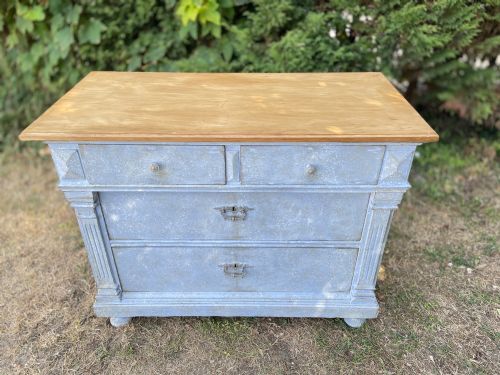
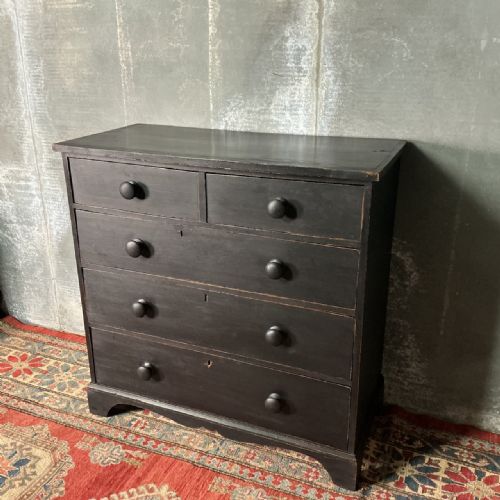
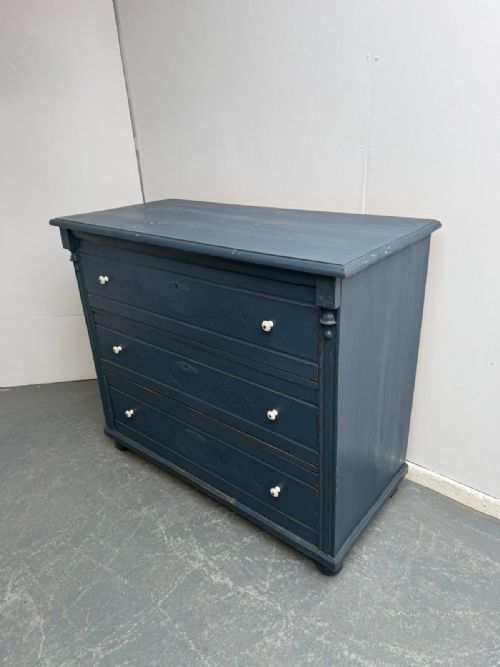


Carved Painted Commode Chest
A carved painted commode chest brings provincial elegance and generous storage to a bedroom through curved timber and aged brushwork.

Carved Painted Commode Chest
A carved painted commode chest combines the structural utility of a drawer chest with decorative painted surfaces and carved woodwork. Buyers seeking a carved painted commode chest will encounter various regional interpretations, from French Provincial and Gustavian to Italian Rococo Revival pieces.
The inventory on this page spans several centuries, with particular emphasis on nineteenth-century adaptations and earlier eighteenth-century prototypes. Forms range from compact two-drawer commodes to larger serpentine and bombe shapes.
Origin plays a defining role in the aesthetic, with Swedish, French, Italian, and German examples each displaying distinct regional characteristics in their carving and paint treatments.
Materials and construction methods
These chests rely on solid foundational timbers such as pine, oak, and other native woods, chosen for their stability and responsiveness to carving. Artisans shaped these woods into serpentine, straight, or bombe profiles before applying decorative surface treatments.
Painted finishes, often layered over gesso or direct wood, define the visual identity of these pieces, sometimes complemented by marble tops and brass hardware. Carving is executed directly into the timber, highlighting structural contours such as drawer edges, aprons, and corners.
Carved Painted Commode Chest Retail Price Guide 2026
Typical asking prices for carved painted commode chest among the pieces listed under this phrase on Sellingantiques today, from the lower quarter to the upper quarter. They describe what is for sale here now, not the wider market.
German grotto chests bring masked bombe carvings that seem to watch over the room's linens.
Distinctions in quality and execution
Quality in these chests rests upon the crispness of the wood carving and the integrity of the painted surface. Superior examples demonstrate confident chisel work that integrates smoothly with the structural form rather than appearing as an afterthought.
The harmony between the painted finish and the underlying timber dictates visual success, with original or well-preserved historical paint layers holding greater distinction. Proportions also govern the piece, where serpentine and bombe shapes require precise geometric balance to succeed.
The Carved Painted Commode Chest Glossary
- Commode
- A low chest of drawers or cabinet, typically originating from French furniture traditions. It serves as both a functional storage unit and a decorative focal point.
- Serpentine
- A furniture front or top shaped with a curving contour, featuring a convex centre flanked by concave sides. This technique adds visual fluidity to heavy timber forms.
- Bombe
- A swelling, outward-curving profile found on the sides and fronts of case furniture. It demands advanced woodworking skill to execute properly.
- Gustavian
- The Swedish interpretation of French neoclassical styles, characterised by lighter proportions and pale, restrained painted finishes. It reflects a simpler, brighter aesthetic.
- Chinoiserie
- European decorative motifs inspired by Chinese art and design, often rendered in lacquer or paint. This style gained immense popularity during various historical revivals.
Carved Painted Commode Chest: Frequently Asked Questions
What is a commode chest?
A commode chest is a low piece of furniture featuring multiple drawers, designed primarily for bedroom or reception room storage. The term often denotes continental European origins and decorative flourishes.
Unlike standard utility chests, these pieces prioritise aesthetic presence through carved details, painted finishes, and shaped fronts.
Where were painted commodes made?
Painted commodes were produced across various European nations, with distinct regional workshops developing their own stylistic vocabularies. France, Italy, Sweden, and Germany are particularly well represented in this tradition.
Each region favoured specific colour palettes, carving motifs, and silhouette curves, ranging from strict neoclassical lines to exuberant baroque revival forms.
How do I date an antique commode?
Dating relies on examining construction techniques, joinery methods, hardware, and the wear patterns on the timber and paint layers. Structural clues inside the drawer construction often reveal the period of manufacture.
Stylistic markers, such as the transition from heavy baroque carving to lighter neoclassical or provincial revival forms, also help narrow down the decade or century.
How do I maintain a painted antique?
Maintenance requires stable indoor humidity levels and protection from direct sunlight, which can fade or destabilise historic paint layers. Dusting should be done gently with a dry, soft cloth without modern chemical polishes.
Avoid placing damp items directly onto wooden or painted surfaces to prevent lifting or water staining of the historic finish.