




Carved Marquetry Chair
A carved marquetry chair brings together fine cabinetmaking and domestic seating across periods from the seventeenth century onward.
Carved Marquetry Chair
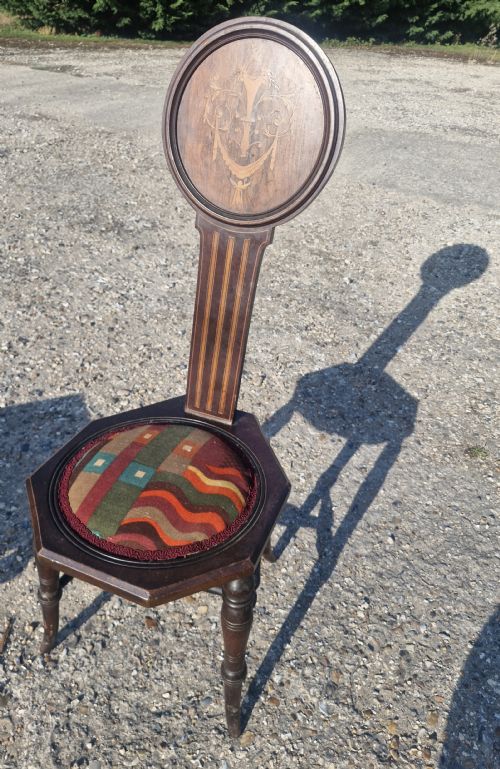
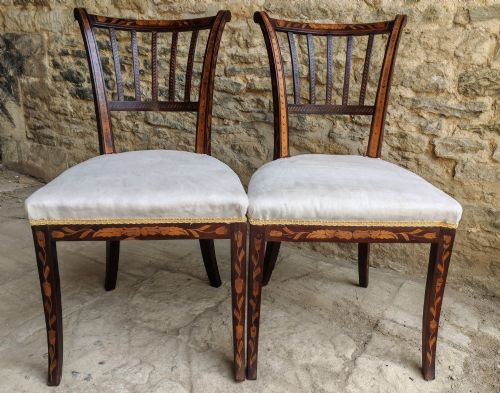
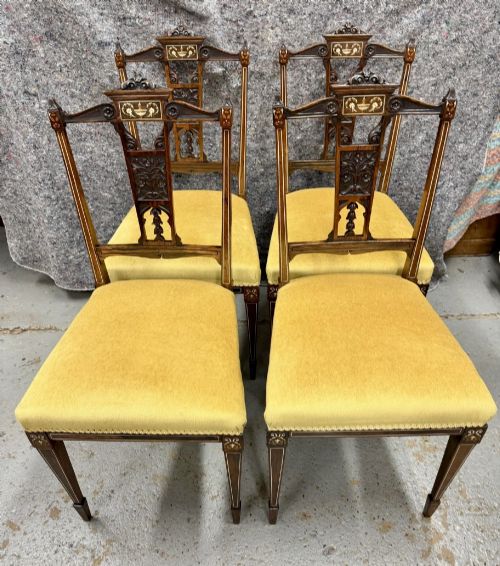
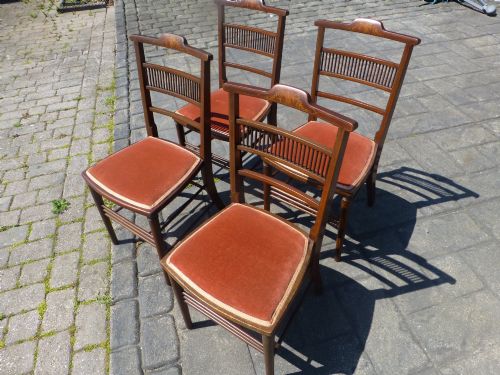
A carved marquetry chair combines structural woodwork with detailed surface decoration, appearing most frequently in Edwardian dining and occasional forms, alongside nineteenth-century examples and earlier pieces.
The selections span dining chairs, armchairs, corner chairs, and library desk chairs executed in walnut, mahogany, rosewood, and beech.
Origin points range from British workshops to continental centres including Italy, Switzerland, and the Netherlands, as well as distinct regional traditions such as Syrian and Moorish revival designs.
Materials and Technique
Construction relies on solid timbers like mahogany, walnut, and oak forming the frame, shaped into cabriole legs, high backs, or rocking structures.
Decoration is achieved through wood inlay, satinwood inlay, and pictorial marquetry veneers applied to splats, crest rails, and seats, sometimes accented with brass wire or brass mounts.
Upholstered variants incorporate silk, velvet, or contemporary fabric pads secured to sprung or webbed bases.
The listings span periods from the 17th century through the Victorian and Edwardian eras, utilising mahogany, walnut, rosewood, and beech.
Evaluating Craftsmanship
Quality depends on the precision of the marquetry cutting and the variety of contrasting veneers utilised to create pictorial depth.
Structural integrity differentiates standard production seating from master-carved armchairs, particularly in the tightness of frame joints and the crispness of hand-carved details on the timber.
The Carved Marquetry Chair Glossary
- Marquetry
- Decorative veneer work assembled in geometric or pictorial patterns on a wooden ground. The technique uses contrasting wood species to form intricate designs.
- Corner chair
- An armchair designed to fit into the corner of a room, featuring a diagonal seat plan and a continuous curved backrest supported by turned pillars.
- Satinwood
- A lustrous yellowish timber native to India and Ceylon, frequently employed for contrasting inlay work on mahogany and rosewood furniture.
- Savonarola chair
- A folding armchair formed of multiple intersecting curved wooden slats, originating in the Italian Renaissance and revived in nineteenth-century design.
Carved Marquetry Chair: Frequently Asked Questions
How do I date a carved marquetry chair?
Dating relies on identifying the underlying timber, the style of the carving, and the complexity of the veneer work. Seventeenth-century examples typically display heavy oak frames, while Edwardian pieces often utilise lighter mahogany or beech.
Secondary indicators include construction methods visible beneath the seat and the chemical composition of the adhesives or finishes used in period workshops.
Where were marquetry chairs typically used?
These chairs served multiple domestic functions depending on their specific form, from formal dining settings to private libraries and bedrooms.
Occasional and corner chairs occupied reception rooms as decorative accents, while larger armchairs functioned as primary seating in studies and halls.
How should I care for inlaid wooden furniture?
Preservation requires stable environmental conditions away from direct sunlight and strong heat sources to prevent the wood and veneers from drying and cracking.
Regular application of suitable furniture wax maintains the finish without sealing moisture into the pores of the timber.
What distinguishes Moorish revival chairs from other styles?
Moorish revival pieces incorporate intricate geometric lattice carving and mother-of-pearl or contrasting wood inlay derived from Islamic architecture and furniture traditions.
These chairs often feature folding frames or distinctive low-slung proportions that set them apart from standard European cabinetwork.