

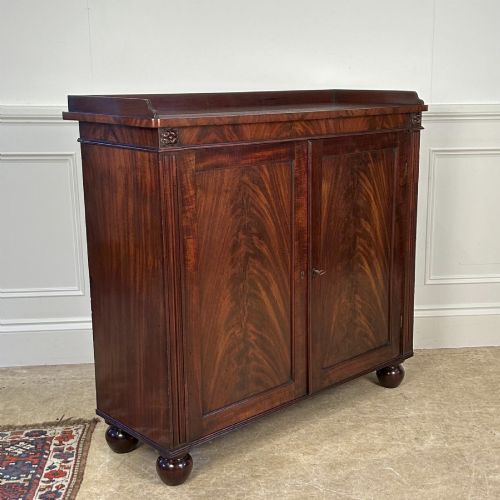
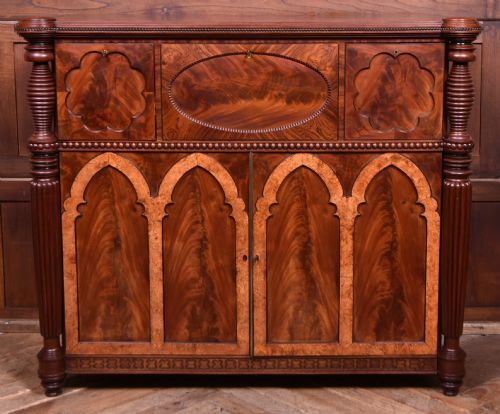
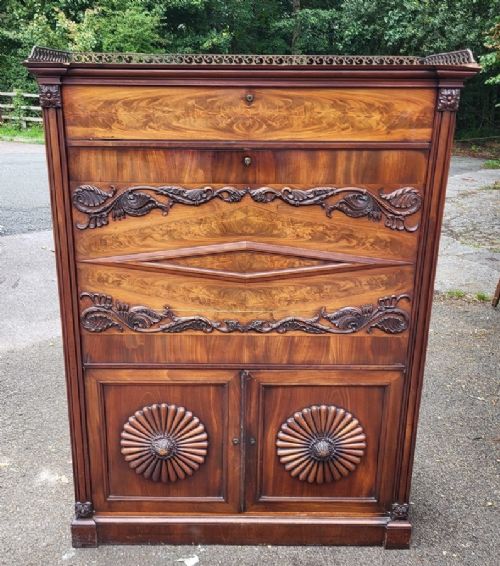


Carved Mahogany Secretaire
These carved mahogany secretaire pieces offer a clever writing surface tucked inside stately cabinetry.
Carved Mahogany Secretaire
A carved mahogany secretaire combines a standard chest or cabinet with a fitted drop-front desk drawer, serving multiple domestic uses. Buyers searching for a carved mahogany secretaire typically encounter tall secretaire bookcases, compact cabinets, and side tables dating across the nineteenth century.
The selection ranges from Regency and William IV periods through to Victorian Gothic Revival and Arts and Crafts styles. Pieces take various forms, including upright secretaire abattants, chest on chest configurations, and library bookcases.
How they were constructed
Cabinet makers utilised solid timbers alongside flame mahogany and burr walnut veneers, applying careful carving to drawer fronts and pediments. Interiors frequently feature contrasting secondary woods alongside fitted pigeonholes and small drawers.
Writing surfaces are often lined with leather or baize, while hardware incorporates brass handles, escutcheons, and glazed doors for upper bookcase sections.
Carved Mahogany Secretaire Retail Price Guide 2026
Typical asking prices for carved mahogany secretaire among the pieces listed under this phrase on Sellingantiques today, from the lower quarter to the upper quarter. They describe what is for sale here now, not the wider market.
The listings here feature nineteenth-century pieces incorporating mahogany, glass, brass, leather, and baize across various cabinet and desk formats.
What dictates quality in these items
Quality rests upon the selection of timber, particularly the choice of figured or flame mahogany veneer matched across drawer fronts. Finer examples display crisp hand-carving rather than mechanical decoration, along with well-executed internal drawer layouts.
Construction methods such as dove-tailed drawer joints and the smoothness of the drop-front mechanism distinguish superior pieces from standard workshop output.
Gillows·Gregory & Co. of London
The Carved Mahogany Secretaire Glossary
- Secretaire
- A piece of furniture containing a concealed writing drawer or drop-front desk compartment. This drop-front pulls down to reveal small pigeonholes and letter drawers.
- Flame mahogany
- A veneer cut from the fork of the mahogany tree where the branch meets the trunk. It creates a distinctive, fiery pattern across the wood grain.
- Escritoire
- An alternative term for a writing cabinet or desk. These units often feature a fall-front panel hiding a fitted interior.
- Secretaire bookcase
- A tall cabinet combining upper bookshelf storage behind glass doors with a lower desk drawer. It acts as both a library unit and a writing bureau.
- Biedermeier
- A Central European style dating from the early nineteenth century focusing on utilitarian comfort and clean lines. Pieces often highlight warm mahogany veneers without excessive ornamentation.
Carved Mahogany Secretaire: Frequently Asked Questions
What is a secretaire?
A secretaire is a cabinet or chest featuring a specialised drawer that folds down to create a writing surface. Inside, users find an arrangement of small drawers and pigeonholes for stationery.
Historically, this dual purpose allowed individuals to write letters and store documents securely within a piece of living room or bedroom furniture.
How do I use a secretaire daily?
The drop-front or sliding drawer pulls out to form a desk when needed, then shuts away paperwork and clutter instantly. This makes them practical for modern home offices where floor space is limited.
Keep the leather or wood writing surface conditioned and avoid placing heavy damp items directly on the finish.
How do I distinguish Regency from Victorian pieces?
Regency pieces often display classical architectural motifs, cleaner lines, and restrained brass inlay inspired by antiquity. They date from the early decades of the nineteenth century.
Victorian examples tend to be heavier, sometimes incorporating Gothic Revival details, richer carvings, and darker polished finishes from the later decades of the century.
What woods are used in these desks?
Mahogany serves as the primary structural and visual timber, frequently enhanced by figured veneers like flame mahogany. Secondary woods like oak or pine appear in drawer linings and internal dividers.
Accents of burr walnut, rosewood, and brass hardware also feature across different regional workshops and periods.