


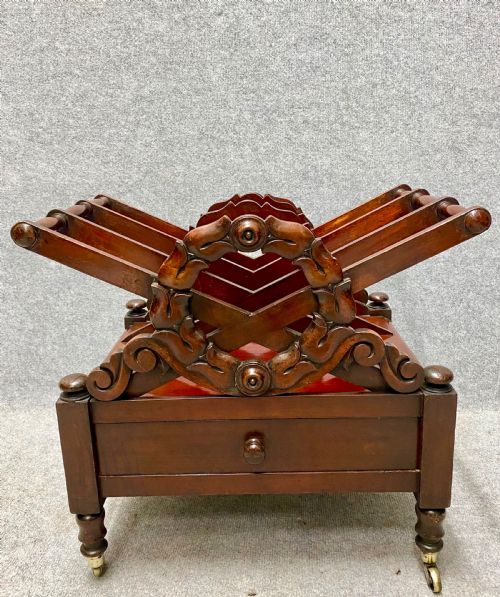

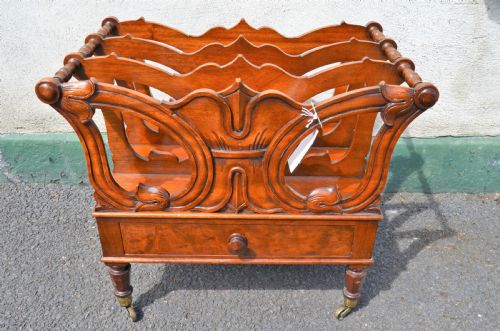
Carved Mahogany Canterbury Rack
A carved mahogany canterbury rack brings order to sheets and papers with the distinct weight of Regency and Victorian craftsmanship.
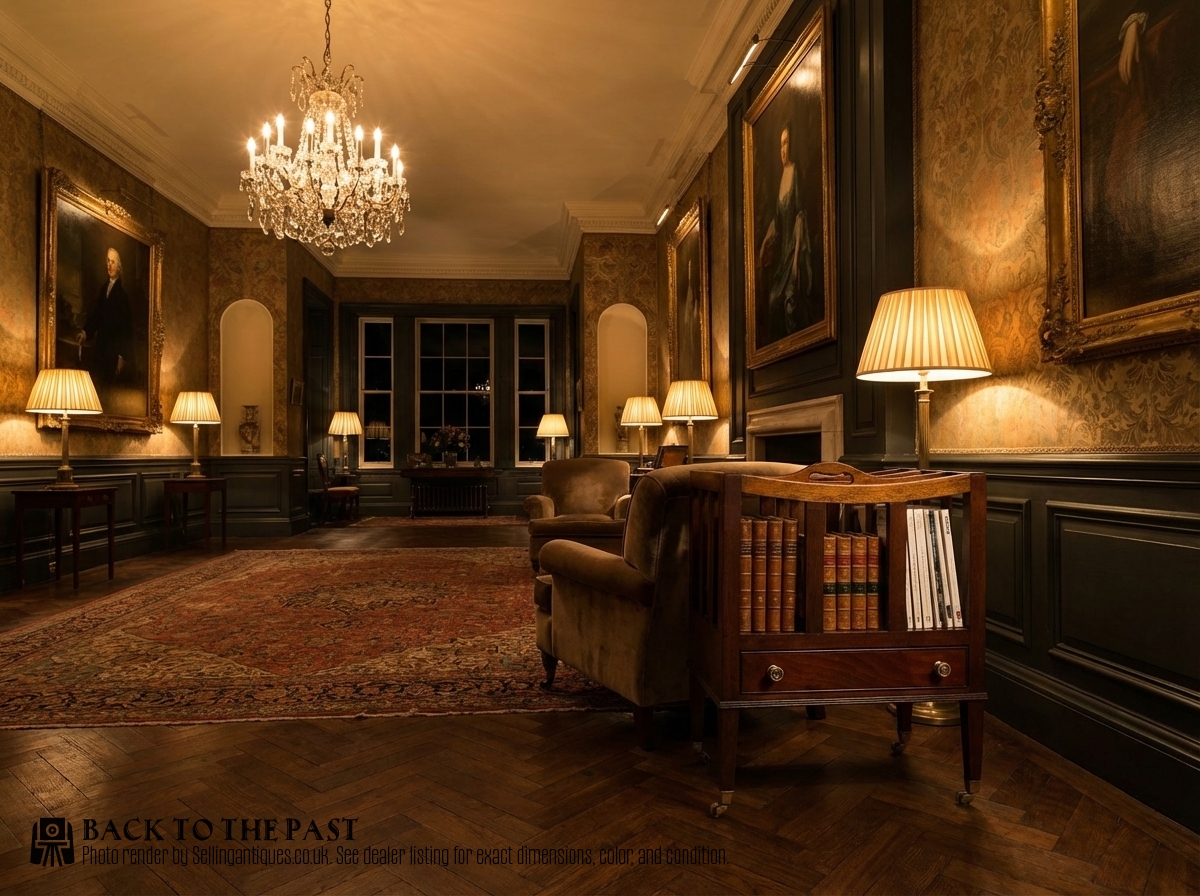
Carved Mahogany Canterbury Rack
A carved mahogany canterbury rack is a low, compartmentalised stand designed to hold folios, newspapers, magazines, and music sheets near a seating area. These pieces appear across the 18th century, Regency, Georgian, Victorian, and Edwardian periods, maintaining a utilitarian yet decorative purpose in the home.
The form typically comprises divided tiers or slatted divisions above a low plinth or drawer base, often fitted with castors for ease of movement. Buyers on this page will most frequently encounter mahogany and Cuban mahogany examples featuring pierced scroll divisions, X-frame supports, or wreath-carved detailing.
How they were made
These items are constructed primarily from solid mahogany and Cuban mahogany, sometimes accented with rosewood and brass fittings. Workshops shaped the timber using traditional joinery, turning upright supports and piercing the fretwork panels by hand.
Makers utilised straight and figured grain to accentuate the curves of scroll divisions and the upright lines of the frame. Metal castors and hinges, where present, were fixed with small slotted screws suited to the period of manufacture.
Some nineteenth-century writers suggested that the very first canterbury was commissioned because an archbishop simply needed a tidy place for his excess sheet music.
What varies in quality
Quality in a carved mahogany canterbury rack rests in the depth and sharpness of the timber carving and the architectural balance of the divisions. Pieces with finely pierced scrollwork or crisp wreath carving demonstrate a higher degree of workshop skill than plain or later reproductions.
The choice of primary timber also sets examples apart, with dense Cuban mahogany and rich rosewood marking out the more ambitious commissions. Construction details, such as the neatness of the joints where the divisions meet the base, distinguish a robust piece from a simple utility stand.
Gillows of Lancaster·J.C.Loudon
The Carved Mahogany Canterbury Rack Glossary
- Canterbury
- A low stand with divisions for holding books, music, or papers. The name is traditionally linked to an Archbishop of Canterbury who requested a similar piece of furniture.
- Cuban mahogany
- A dense, richly figured timber imported from the Caribbean used in high-status furniture. It is prized for its dark colour and fine grain.
- X-frame
- A structural arrangement where the side supports cross to form an X shape. This configuration provides rigid support for the slatted divisions.
- Scroll divisions
- Upright partitions shaped into curving, scroll-like profiles. They separate the compartments while adding a decorative element to the upper tier.
- Castors
- Small wheel attachments fixed to the base of the legs. They allowed the stand to be moved easily across carpets or floorboards.
Carved Mahogany Canterbury Rack: Frequently Asked Questions
What was a canterbury rack used for?
These stands were originally designed to hold sheet music, folios, and books close to a piano or seating area in the parlour. Over time, their partitioned sections made them equally useful for newspapers, magazines, and general correspondence.
Their mobility allowed servants or family members to wheel the stand across the room as seating arrangements shifted throughout the evening.
How do I date a mahogany canterbury?
Dating relies on observing the stylistic markers of the woodturning, the profile of the fretwork, and the overall proportions. Regency and Georgian examples tend to feature crisp, classical reeding and refined brass castors, while Victorian and Edwardian pieces often display heavier mouldings.
Examining the underside and the joinery methods will also reveal whether the piece belongs to the early nineteenth century or a later revival period.
Are all canterburys fitted with castors?
Many examples retain their original brass or wooden castors beneath the low legs, reflecting the need to move the stand about a large room. Some variants, however, were built to remain stationary on a carpet or beside a specific piece of library furniture.
The presence of castor cups or fixing blocks often indicates how the piece was intended to rest upon the floor.
How do I live with a canterbury rack?
A canterbury rack functions well beside a sofa or armchair to store current reading material, journals, or vinyl records. The vertical divisions keep papers upright and easy to browse without cluttering tabletops.
Positioning the stand away from direct heat sources and sunlight protects the polished mahogany surface and prevents the dry wood from splitting.