
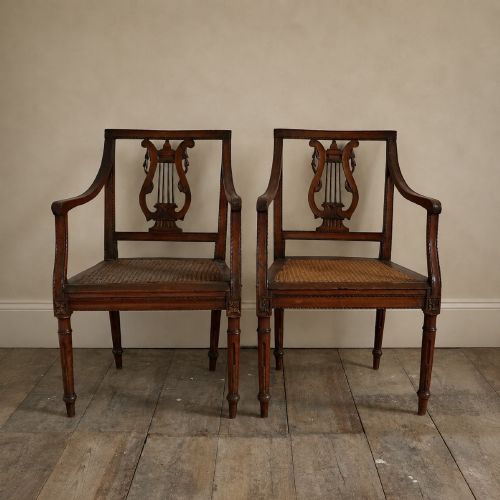
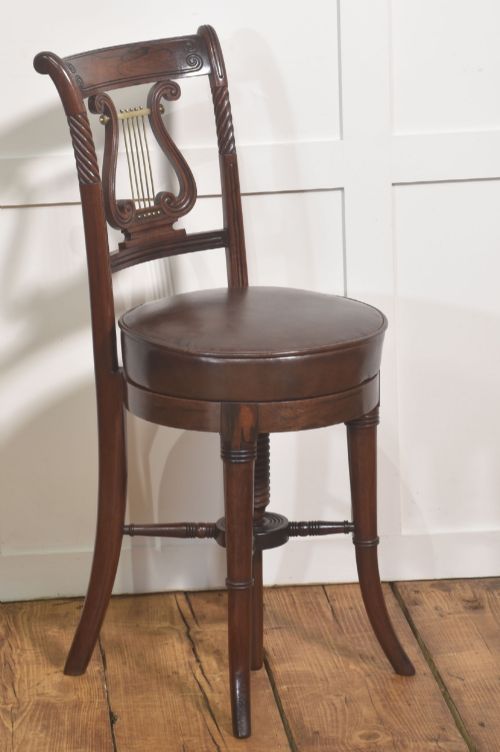
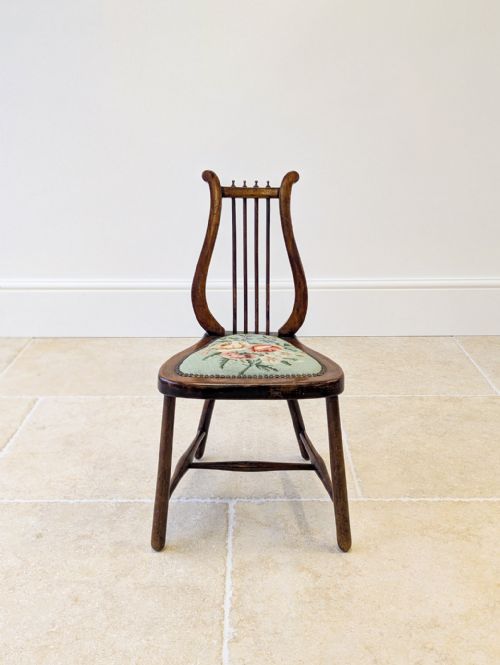


Carved Lyre Back Seat
A carved lyre back seat brings neoclassical grace to a room through open woodwork shaped like a stringed instrument.
Carved Lyre Back Seat
When you search for a carved lyre back seat, you encounter forms ranging from dining chairs and armchairs to dressing chairs and side chairs. These pieces draw upon classical antiquity, utilising a distinctive splat shaped to resemble an ancient Greek lyre.
The selections available here span several distinct periods, including the Regency era, the Victorian period, and the Edwardian epoch, alongside later interpretations in the neoclassical manner. Forms vary from single side chairs to pairs of armchairs and larger sets intended for formal dining rooms.
Makers across these periods adapted the lyre motif to various seating types, incorporating cane, leather, tapestry, and upholstery into the design. Whether rendered in mahogany, walnut, beech, or giltwood, each piece centres on the characteristic musical scrollwork of the backrest.
Materials and construction
Cabinetmakers constructed these frames primarily in dense timbers such as mahogany and walnut, alongside more pliable woods like beech and elm for specific regional or domestic forms. Artisans shaped the characteristic lyre splats using precise joinery and hand-carving techniques to achieve the slender curves of the instrument.
Surfaces frequently receive elaborate finishes, from the deep polish of nineteenth-century mahogany to the luminous application of giltwood on neoclassical frames. Seating elements incorporate traditional methods, ranging from woven cane panels to padded upholstery secured with needlepoint, tapestry, or leather.
Carved Lyre Back Seat Retail Price Guide 2026
Typical asking prices for carved lyre back seat among the pieces listed under this phrase on Sellingantiques today, from the lower quarter to the upper quarter. They describe what is for sale here now, not the wider market.
Periods represented include the Regency era, Victorian period, Edwardian epoch, and the late nineteenth century.
Assessing quality and execution
The distinction between standard examples and superior pieces lies in the crispness of the timber carving and the architectural proportion of the lyre splat. Finer versions exhibit smooth, uninterrupted curves in the woodwork and careful attention to the grain of the mahogany or walnut.
Construction integrity also separates grades of seating, visible in the rigidity of the joints and the quality of the secondary timbers used beneath the upholstery or cane work. Period harmony, such as the consistent application of Regency or Neoclassical design principles across the entire frame, elevates the standing of any individual chair.
The Carved Lyre Back Seat Glossary
- Lyre back
- A chair design featuring a central splat shaped like an ancient Greek lyre. This motif became particularly popular during the Regency and Neoclassical revivals.
- Splat
- The vertical central strip of wood down the back of a chair. In these pieces, it takes the form of stringed instrument curves.
- Giltwood
- Timber treated with gold leaf or gesso and gold paint. It appears on high-status neoclassical and continental seating.
- Cane
- Woven rattan material used for chair seats and backs. It provides a lightweight and flexible surface.
- Neoclassical
- A style reviving the classical forms of ancient Greece and Rome. It influences the proportion and ornamentation of these chairs.
Carved Lyre Back Seat: Frequently Asked Questions
How do I date a mahogany chair?
Dating a mahogany chair involves examining the grain, the timber density, and the joinery methods used within the frame. Earlier nineteenth-century examples often display deep patination and hand-cut joinery specific to traditional cabinetmaking.
Stylistic cues, such as the presence of Regency reeding or Edwardian proportions, further clarify the period of manufacture when compared against documented design eras.
Can I use these chairs at a dining table?
Dining chairs and side chairs within this selection suit placement around a dining table, provided the seat height matches standard table clearances. Many historical sets were made specifically for dining use.
Armchairs and larger library seats function better as occasional chairs or desk companions, offering wider proportions that require more space around a room.
What is the difference between Regency and Edwardian styles?
Regency style draws directly from early nineteenth-century classical antiquity, featuring bold mahogany timbers, brass accents, and strict geometric proportions. Edwardian pieces often revive these earlier themes with lighter construction and softer native woods like beech.
Understanding these distinctions helps determine whether a piece belongs to the original nineteenth-century period or the later Edwardian revival.