


Carved Gold Fob
A carved gold fob carries centuries of personal history in miniature, offering collectors a wearable piece of functional art that doubles as an intriguing conversation starter.
Carved Gold Fob
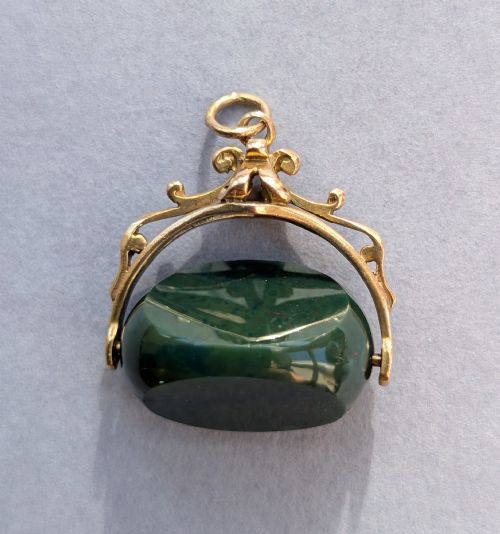
A carved gold fob represents a portable desk stamp and personal signature, designed originally to hang from a pocket watch chain and press into hot wax for sealing letters. When searching for a carved gold fob, collectors encounter an array of swivel, pendant, and ring forms spanning Georgian, Victorian, and Edwardian eras. The most common varieties feature hardstone matrices set into heavy gold or gold cased metal mounts.
The selection ranges from simple Georgian gold seals to ornate Victorian designs featuring lions, horses, elephants, and classical figures. Makers utilised specific periods like the 19th Century and the 1960s to produce variations in both solid 9ct gold and gold cased metal. These items bridge the gap between jewellery and utility, functioning equally well as pendants on chains or charms on bracelets.
Materials and construction methods
Craftsmen built these seals using solid 9ct gold, 9ct rose gold, and gold cased metal to form the ornate swivel frames and pendant loops. The durability of the metal allowed goldsmiths to cast and chase intricate floral patterns, scrollwork, and figural mounts around the central stone without risking structural integrity.
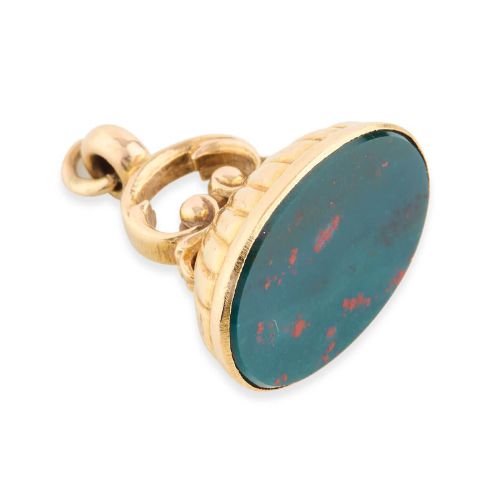
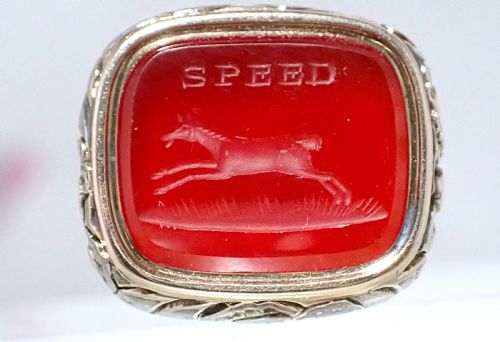
The base stones - principally bloodstone, carnelian, chalcedony, sardonyx, and rock crystal - were hand-carved using abrasive wheels and diamond dust to create reverse intaglio designs. These carved matrices depicted anything from heraldic animals and Greek figures to specific words and portraits, requiring immense precision from the lapidary.
One Georgian piece bears the urgent word SPEED carved beside a galloping horse, reminding correspondents that delayed replies were clearly as frustrating then as they are now.
Assessing quality in seals and fobs
The depth and artistic merit of the stone intaglio dictate the upper tier of quality, where a finely carved Roman emperor or Greek figure displays anatomical nuance and sharp relief. Lesser pieces rely on shallow, machine-smoothed surfaces or blank stones that lack the detailed handiwork found in superior examples.
Mount construction further separates standard items from exceptional ones, particularly the weight of the 9ct gold and the complexity of the ornate chasing on the bezel and bail. A robust swivel mechanism that holds the stone securely without looseness demonstrates superior initial manufacturing.
The Carved Gold Fob Glossary
- Intaglio
- A design carved into the surface of a hardstone so that the impression produced in wax appears in relief. This technique was essential for creating personal signet stamps.
- Fob Seal
- A small pendant or charm featuring a matrix designed to impress wax seals. They hung from watch chains during the Georgian and Victorian periods.
- Carnelian
- A brownish-red variety of quartz chalcedony frequently used for signet rings and fob seals. Its uniform colour made it ideal for showing off detailed intaglio carving.
- Gold Cased
- A method of bonding a layer of gold to a base metal core to provide the appearance and wear of solid gold at a different weight. This technique allowed for larger, more ornate mounts.
- Matrix
- The carved face of the seal that stamps the wax. It often contains initials, crests, or classical motifs.
Carved Gold Fob: Frequently Asked Questions
What is a carved gold fob used for?
These pieces functioned historically as personal stamps for closing correspondence and legal documents with hot wax, swung from a gentleman's watch chain. Today, collectors repurpose them as pendants on necklaces or charms suspended from heavy bracelets.
Their dual nature as both ornamental jewellery and functional tools makes them versatile additions to modern wardrobes.
How do I date a fob seal?
Dating relies on stylistic clues in the gold mount, the shape of the swivel or loop, and the specific motifs popular in the Georgian, Victorian, and Edwardian eras. Neoclassical subjects usually point to earlier periods, while heavier cast ornamentation often suggests later Victorian production.
Examining hallmark stamps where present on the 9ct gold can also narrow down the exact decade of manufacture.
What is the difference between bloodstone and carnelian?
Bloodstone is a dark green chalcedony splashed with red jasper inclusions that resemble drops of blood, creating a striking contrast. Carnelian is a translucent orange-to-red chalcedony favoured for its warm tones and clear carving surface.
Both stones were chosen for their hardness, which prevented the carved intaglio from wearing down during repeated use in wax.
Can I wear these fobs on a bracelet?
Many examples are robust enough to be worn as charms on heavy watch chain bracelets, provided the jump rings are secure. The daily wear requires checking that the swivel mechanism or pendant loop remains tight and reliable.
Choosing a solid 9ct gold piece rather than a gold cased alternative ensures better longevity for daily bracelet wear.