


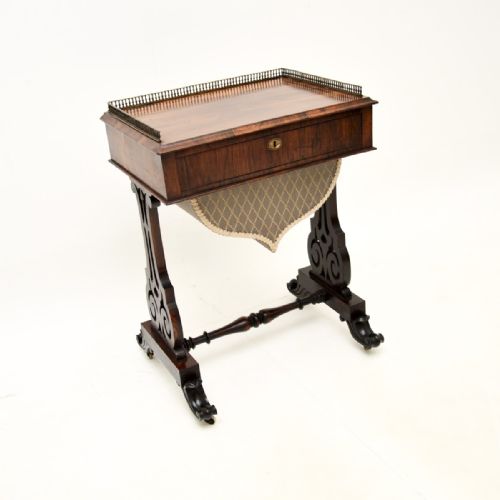


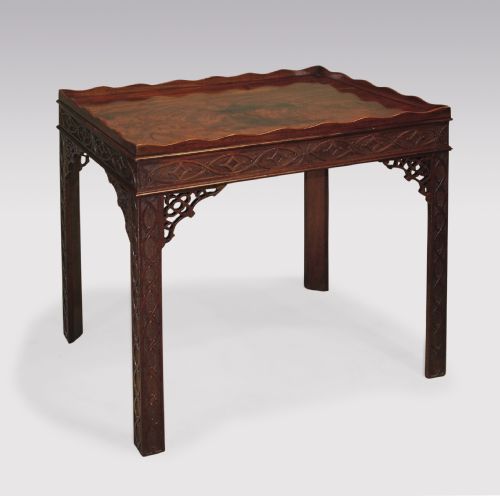


Carved Gallery Tray
A carved gallery tray brings tactile depth and raised borders to domestic serving and display, combining practical containment with refined cabinetmaking.
Carved Gallery Tray
A carved gallery tray typically presents itself in mahogany, oak, burr walnut, or rosewood, often associated with occasional tables, silver tables, or butler's trays on stands.
Buyers seeking a carved gallery tray encounter examples spanning the eighteenth century, the nineteenth century, the Edwardian era, and revival periods.
The form ranges from oval serving trays and scalloped edges to silver tables and tray tops resting on stands, showing the versatility of the design.
How they were made
Cabinetmakers utilised dense timbers such as mahogany, oak, rosewood, and burr walnut, often shaping the edges into distinctive galleries and raised borders.
Detailing includes carved motifs such as sunflowers and clover, alongside brass handles, ormolu accents, and fabric inserts where appropriate.
Even three-leaf clovers managed to sneak onto Edwardian trays, proving that even tea service needed a bit of extra luck.
What varies in quality
Quality rests upon the crispness of the timber carving along the gallery rim and the integration of the tray top with its supporting stand or table base.
The choice of figured veneers like burr walnut or solid timbers such as mahogany dictates the visual depth and historical weight of the piece.
The Carved Gallery Tray Glossary
- Gallery
- A raised border or pierced railing around the edge of a tray or table top to prevent items from sliding off. It is frequently carved or fretted from solid wood.
- Butler's tray
- A removable tray with hinged or fixed sides, traditionally designed to sit upon a folding wooden stand for serving. It appears in both oak and mahogany.
- Silver table
- A distinct form of side table with a raised gallery designed for displaying or serving silver tea services. These date from the eighteenth century and subsequent revival periods.
- Chippendale
- A style originating from the mid-eighteenth-century designs of Thomas Chippendale, characterised by rich mahogany and meticulous carving. It experienced several revivals in the nineteenth and twentieth centuries.
Carved Gallery Tray: Frequently Asked Questions
What is a carved gallery tray used for?
These pieces served historically for carrying tea services, silver, or glassware while keeping items secure behind raised borders. Today they function equally well on stands as occasional tables or resting on sideboards for display.
Their robust construction in mahogany, oak, or walnut allows them to transition smoothly between practical utility and decorative furnishing within a room.
How do I tell an eighteenth-century tray from a revival piece?
Examination of the timber grain, tool marks, and construction joints offers the clearest indication of age. Eighteenth-century pieces display the natural patination and hand-working methods of the period.
Revival pieces, such as those from the Edwardian era or the later nineteenth century, often exhibit a cleaner, more uniform machine finish alongside period-appropriate revival styling.
How do I care for wood gallery trays?
Maintenance requires gentle dusting with a soft, dry cloth to protect the delicate carved edges of the gallery. Avoid excessive moisture and direct sunlight to preserve the finish of timbers like rosewood and burr walnut.
Occasional application of appropriate wax helps maintain the natural lustre of the wood without building up heavy residues.