
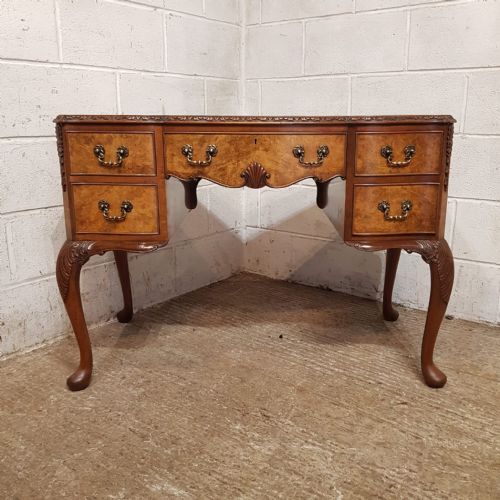


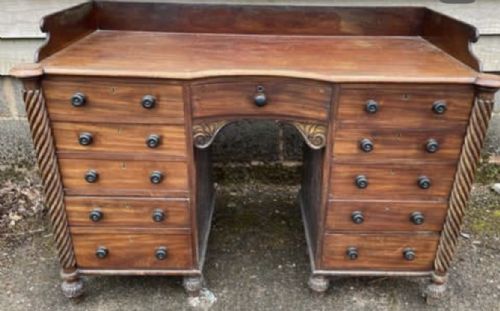


Carved Front Kneehole Desk
A carved front kneehole desk is a compact writing table with a central recess, offering a functional workspace and fitted drawers for daily use.

Carved Front Kneehole Desk
A carved front kneehole desk provides an organised writing surface with a central kneehole recessed beneath the top, often flanked by pedestals of small drawers. You will frequently encounter revival iterations from the Edwardian and early twentieth century, alongside earlier Georgian and Regency examples.
The form appears in several distinct outlines across the periods, including serpentine fronts, bowfronts, and concave shapes. These variations change the visual weight of the piece in a room whilst retaining the internal compartment layout.
Makers utilised various timber grains and inlays to enhance the aesthetic of the kneehole desk, ranging from figured mahogany to burr walnut. Some variations double as dressing tables or washstands depending on their original domestic context.
Factors of quality
The choice of timber veneer dictates much of the visual standard, with heavily figured burr walnut or carefully matched mahogany holding greater presence. Precision in the execution of the serpentine or bowfront shaping separates standard production from finer cabinetwork.
The crispness of carved details along the drawer fronts and the integration of internal drawer construction demonstrate the skill of the maker. Consistency in the brass hardware and the preservation of original fitted interiors also influence the standing of the piece.
Listings feature mahogany and burr walnut timber across Georgian, Regency, and early twentieth century revival periods.
The Carved Front Kneehole Desk Glossary
- Kneehole desk
- A writing table featuring a central recessed space for the legs, flanked by banks of drawers. This form allows a seated user to work closely to the writing surface.
- Serpentine front
- A furniture front curved outward in the centre and inward at the sides in an 'S' shape. This profile requires advanced woodworking skill to execute cleanly.
- Bowfront
- A convex front that curves outward in a continuous arc. It softens the linear appearance of a standard rectangular desk.
- Burr walnut
- Timber taken from the warted growths on walnut trees, showing intricate swirling grain patterns. It is sliced into veneers to adorn prominent desk surfaces.
- Satinwood inlay
- A decorative technique using contrasting light-coloured exotic wood set flush into the primary timber surface. It creates geometric borders and floral motifs.
Carved Front Kneehole Desk: Frequently Asked Questions
What is a kneehole desk?
A kneehole desk is a freestanding writing table featuring a central knee recess beneath the main top. This architecture creates a compact footprint while providing multiple side drawers.
Such pieces functioned historically as private writing cabinets or dressing tables within domestic chambers. Today they serve well as study desks or hall furniture.
How do I date a kneehole desk?
Dating relies on observing the secondary timbers, construction methods, and characteristic hardware of the period. Stylistic cues such as Chippendale revival details or Regency concave fronts offer further clues.
Comparing the secondary wood inside the drawer boxes to known period examples helps clarify the timeline. Revivals often mimic eighteenth-century forms using twentieth-century construction techniques.
What woods were used for these desks?
Makers relied heavily on mahogany and walnut for the primary exterior surfaces and drawer fronts. Oak frequently served as a sturdy secondary wood for drawer linings and interior framing.
Decorative elements often included satinwood inlay and ebony stringing for contrast. Burr walnut veneers provided highly figured patterns across the top and front panels.
Where should I place a kneehole desk?
These desks suit studies, libraries, or bedrooms due to their modest proportions and finished backs. Their compact pedestal design allows them to sit comfortably against a wall or float within a room.
Ensure the clearance of the central kneehole matches your seating requirements for daily use. Keep them away from direct heat sources to protect the wood veneers.