





Late Victorian Kneehole Desk
A late victorian kneehole desk offers a solid pedestal arrangement and generous drawer space, combining sturdy utility with period character.

Late Victorian Kneehole Desk
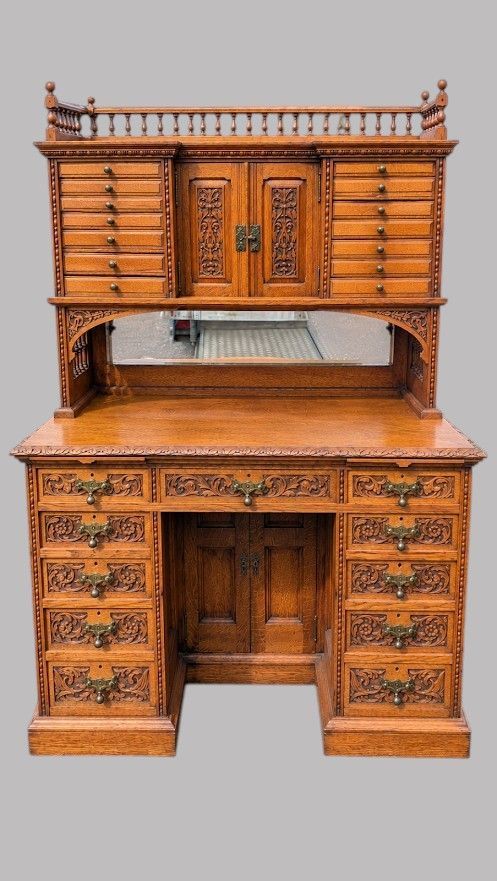
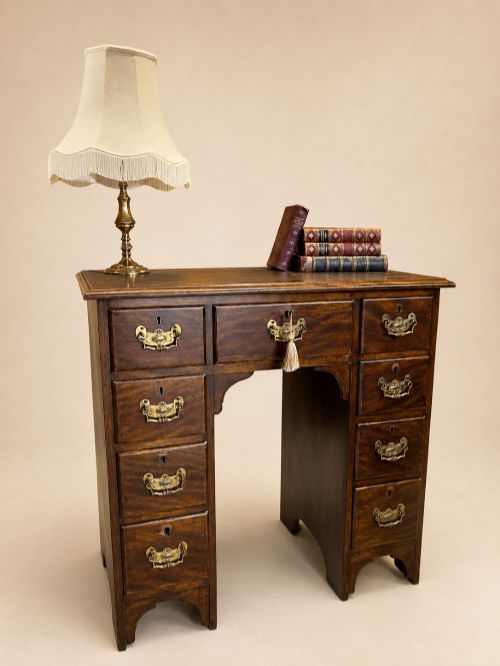
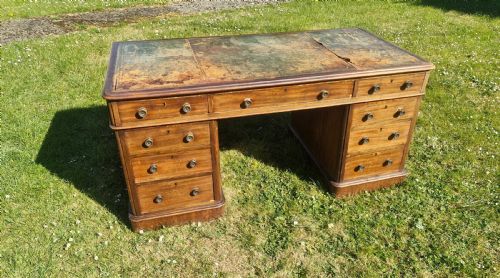
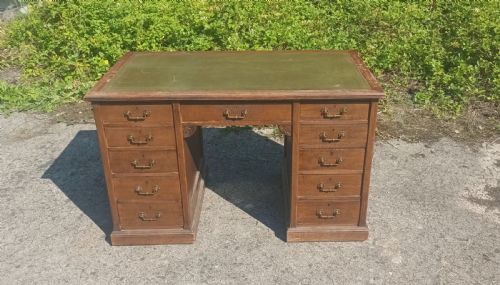
A late victorian kneehole desk is a substantial pedestal writing table featuring a central recessed space flanked by banks of drawers, designed for study or clerical work. The pieces appearing here span the late nineteenth century, predominantly taking the form of twin pedestal desks built in mahogany, oak, and walnut.
Buyers encounter variations ranging from neat compact writing tables to large three-part pedestals, alongside related forms such as dressing tables and library bookcases. These pieces emerge from the Victorian era carrying characteristic period proportions and practical writing surfaces.
Woods such as pollard oak, satin birch, and ebonised timber appear alongside standard mahogany and oak, occasionally displaying inlay or aesthetic movement detailing. The central kneehole configuration remains the defining architectural feature across these variants.
How they were made
Cabinet makers constructed these desks using solid timbers and veneers of mahogany, oak, and walnut, frequently incorporating mahogany-lined drawer interiors for durability. Brass hardware, campaign style handles, and leather writing inserts completed the structural and functional composition of the pedestals.
Joinery techniques relied on dovetailed drawer construction and robust framing to support heavy timber tops and multiple stacked drawers. Secondary woods like pine and pitch pine appeared in concealed structural areas, while decorative treatments included ebonising, inlay, and stencilled decoration.
Listings demonstrate a strong prevalence of oak and mahogany timbers, alongside walnut, pitch pine, and ebonised wood.
What varies in quality
Quality in these pedestal desks rests upon the choice of timber figure, such as pollard oak or figured walnut, and the precision of the cabinet work. Superior examples show careful timber selection, intact mahogany linings, and original brass hardware or campaign handles.
Thomas Turner
The Late Victorian Kneehole Desk Glossary
- Kneehole
- A recessed space beneath the desk top situated between two pedestals of drawers, allowing a person to sit comfortably.
- Pedestal
- A vertical supporting column containing drawers, forming one side of a twin pedestal desk.
- Campaign style
- A utilitarian design approach featuring recessed brass handles and robust construction originally intended for transport.
- Side slide
- A pull-out shelf housed beneath the desk top to provide additional auxiliary surface area.
- Ebonised wood
- Timber treated with a dark finish to imitate expensive ebony, seen on aesthetic movement pieces.
Late Victorian Kneehole Desk: Frequently Asked Questions
How are these desks configured?
These pieces typically employ a twin pedestal layout containing multiple drawers on either side of a central kneehole space. The top surface often incorporates an inset panel of leather for writing.
Larger versions arrive in three separate sections for transport, comprising two pedestals and a long top. Smaller or neat variants consolidate this arrangement into a single fixed unit while retaining the pedestal drawer banks.
What woods were used?
Mahogany and oak form the vast majority of surviving examples, supplemented by walnut, pitch pine, and ebonised wood. More decorative pieces utilise pollard oak, satin birch, and delicate inlaid veneers.
Secondary timbers like pine frequently support internal drawer framing and concealed partitions. Brass hardware and leather inserts provide the standard contrasting materials across the different timber types.
Where were they placed?
These desks served in private libraries, morning rooms, and studies as functional workspaces for correspondence and administration. Their finished backs often allowed them to stand free in the middle of a room rather than against a wall.
Related forms such as dressing tables functioned in bedrooms, sharing the same pedestal kneehole architecture. Their robust construction suited daily administrative tasks in nineteenth century households.
How do aesthetic movement examples differ?
Aesthetic movement variants depart from traditional heavy Victorian proportions by employing ebonised wood and simpler linear forms. They reflect late nineteenth century design reforms that favoured artistic styling over conventional ornamentation.
These pieces often present a lighter physical profile while maintaining the standard kneehole pedestal functionality. Their distinct surface treatments set them apart from standard mahogany or oak equivalents.