
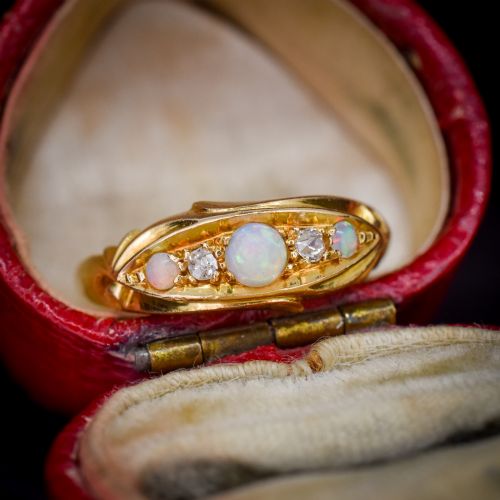
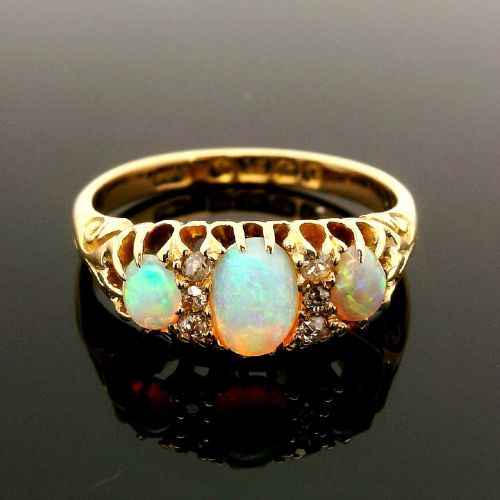
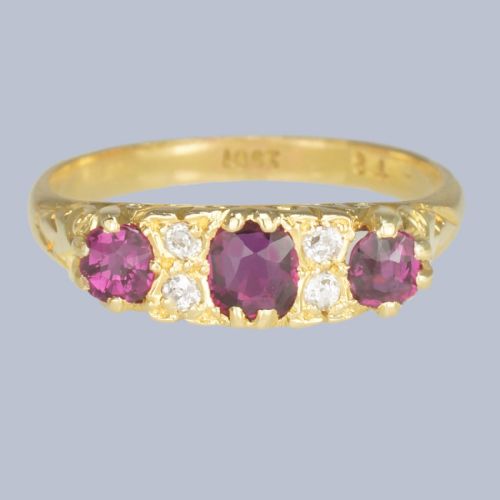


Carved Boat Head Ring
These carved boat head ring examples are distinctive gemstone jewellery pieces prized for their curved settings and fine period craftsmanship.
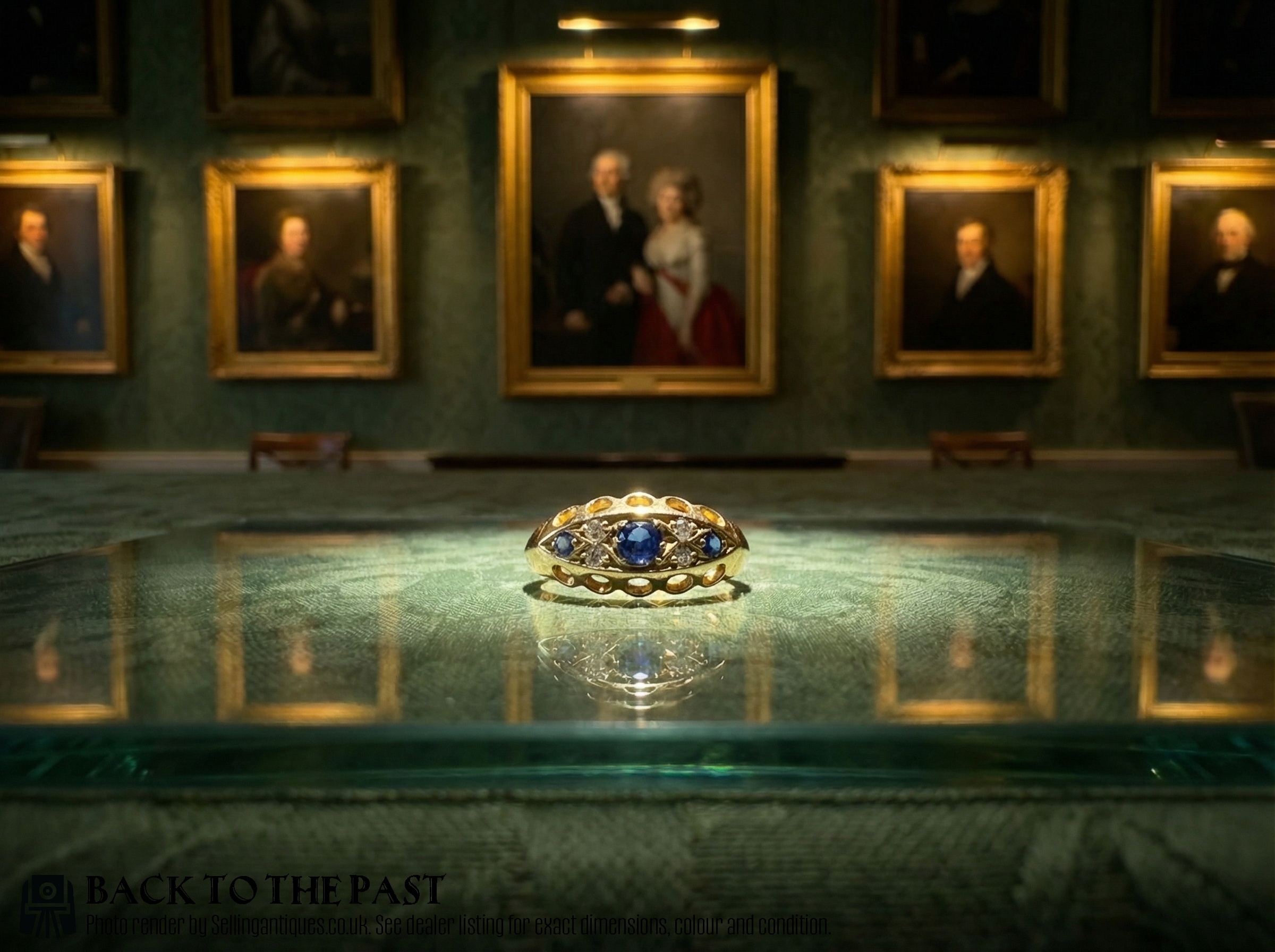
Carved Boat Head Ring
A carved boat head ring presents a curved, boat-shaped setting that sits low along the finger, designed to showcase multiple gemstones in a row. These pieces primarily date from the Victorian, Edwardian, and George V eras, spanning the late nineteenth century through the early twentieth century.
The most common form seen here combines opals, sapphires, or rubies flanked by diamonds, all mounted in eighteen karat gold. Makers from this span utilised regional assay offices such as Birmingham and Chester to hallmark their work.
Materials and construction methods
Goldsmiths constructed these rings using eighteen karat yellow gold, shaping the metal to form the characteristic curved boat mount that cradles the stones. Stones such as old cut diamonds, natural opals, sapphires, and rubies are secured within the metal framework.
Assay marks stamped into the gold indicate the location and year of testing, offering a direct record of the British workshops that produced them during the Victorian and Edwardian periods.
Several rings carry tiny secret letters inside the band that tell us precisely which year a Birmingham goldsmith struck them.
Assessing quality in period jewellery
The distinction between tiers of quality rests on the selection and matching of the gemstones, particularly the play of colour in natural opals and the depth of hue in sapphires and rubies. Finer examples display harmonious stone sizing and precise claw or bezel work that holds each gem securely.
Overall wear to the eighteen karat gold band and the crispness of the original hallmarks also influence the character of the piece, as heavier usage softens the fine details shaped by the goldsmith.
The Carved Boat Head Ring Glossary
- Boat ring
- A ring featuring a curved, boat-shaped setting designed to hold a row of gems. This form was especially popular during the Victorian and Edwardian periods.
- Old cut diamond
- A diamond cut with a small table, high crown, and open culet, typical of nineteenth and early twentieth century jewellery before modern standards developed.
- Hallmark
- An official stamp applied by an assay office to indicate the metal purity and origin. British marks often include town symbols and date letters.
- Assay office
- An organisation that tests precious metals to guarantee their purity. Birmingham and Chester offices appear frequently in these records.
Carved Boat Head Ring: Frequently Asked Questions
What is a boat ring?
A boat ring is a piece of jewellery featuring a curved, elongated setting that resembles the hull of a boat. This mounting allows several gemstones to sit comfortably in a row along the finger.
Craftsmen during the Victorian and Edwardian periods favoured this shape because it maximised the visual impact of diamonds and coloured stones. The design sits relatively low, making it practical for daily wear.
How do I date these rings?
Dating relies primarily on the hallmarks stamped inside the gold band by British assay offices. These marks include specific letters that correspond to the year the metal was tested.
Stylistic elements like the use of old cut diamonds and the specific arrangement of opals, sapphires, or rubies also help narrow the production era to the late nineteenth or early twentieth century.
Are the opals natural?
The opals found in these period settings are natural stones sourced during the heyday of late Victorian and Edwardian jewellery production. They exhibit characteristic play of colour unique to genuine opal formation.
Jewellers selected them to contrast against diamonds and yellow gold, creating vibrant colour combinations that define the style of the era.