

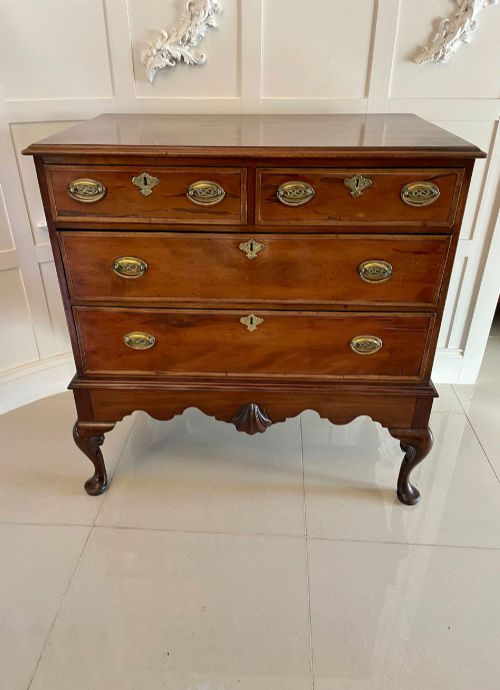
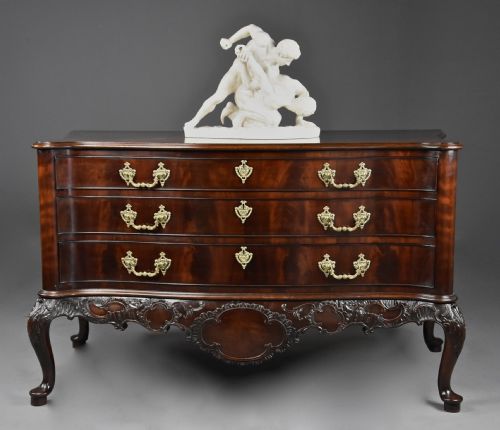
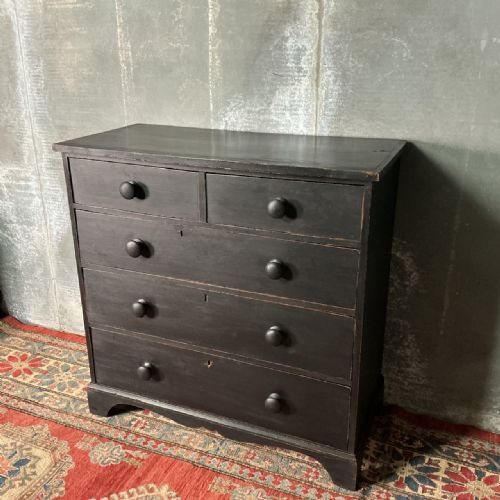


Carved Apron Commode
These carved apron commode examples bring solid timber and serpentine curves together, offering practical storage with distinct period character.
Carved Apron Commode
A carved apron commode is essentially a chest of drawers defined by the decorative shaping along its lowest front rail. These pieces function primarily for storage while displaying craftsmanship through their moulded woodwork.
The versions met on this page span from eighteenth-century walnut and Portuguese pieces to nineteenth-century mahogany, oak, and painted wood interpretations. Chests of drawers and commodes form the core of what appears here.
Makers drew on French Provincial, George III, Chippendale Revival, and Swedish Provincial styles to shape these items. Buyers encounter serpentine fronts alongside straightforward oak and mahogany forms.
How they were made
Makers relied on solid timber and veneers, primarily utilising mahogany, oak, and walnut. Brass hardware often complemented these woods, while painted wood and metal also appeared.
Cabinetmakers shaped the timber by hand to create serpentine fronts and fitted drawers. Carpenters integrated intricate joinery to ensure the structural integrity of chests on stands and standard drawer chests.
Carved Apron Commode Retail Price Guide 2026
Typical asking prices for carved apron commode among the pieces listed under this phrase on Sellingantiques today, from the lower quarter to the upper quarter. They describe what is for sale here now, not the wider market.
Listings span from the 18th century through the Victorian era up to the 1920s, utilising mahogany, oak, walnut, and painted wood.
What varies in quality
Quality rests in the precision of the woodwork along the curved apron and the choice of primary timber. Finer examples display harmonious grain patterns in mahogany or walnut rather than utilitarian pine.
Proportion and execution define the hierarchy between standard pieces and high-end items. Elaborate serpentine lines require skilled hand-shaping that lesser workshop output lacks.
The Carved Apron Commode Glossary
- Serpentine
- A front contour that curves outward at the sides and recesses in the centre. This undulating line demands precise woodworking skill.
- Commode
- A low chest of drawers originating in France. The term covers various ornamented storage chests from the eighteenth and nineteenth centuries.
- Chippendale Revival
- A later stylistic movement copying the eighteenth-century designs of Thomas Chippendale. Pieces in this style often incorporate robust proportions and detailed carving.
Carved Apron Commode: Frequently Asked Questions
What is a carved apron commode?
A carved apron commode is a chest of drawers featuring decorative woodwork along the lower rail. These pieces combine practical storage with stylistic shaping.
They appear in various timbers such as mahogany, oak, and walnut. The category spans several centuries of cabinetmaking traditions.
How do I style a commode at home?
These chests work well in hallways, living rooms, or bedrooms as focal storage points. Their decorative aprons and serpentine fronts add texture to plain walls.
Pair them with simple lamps or mirrors to highlight the wood grain and period details. Ensure the scale matches the surrounding furniture.
How do I date a wooden chest?
Dating relies on identifying the timber species, construction methods, and stylistic cues present in the piece. Eighteenth-century examples often use walnut or distinct regional joinery.
Nineteenth-century versions frequently employ mahogany or oak alongside later hardware. Examining drawer linings and backboards provides further clues to age.
What is a serpentine front?
A serpentine front curves outward at the outer edges and dips inward in the middle. This undulating shape requires advanced woodworking techniques.
It adds visual movement to heavy timber furniture. Master cabinetmakers utilised this profile to elevate standard chests into statement pieces.