

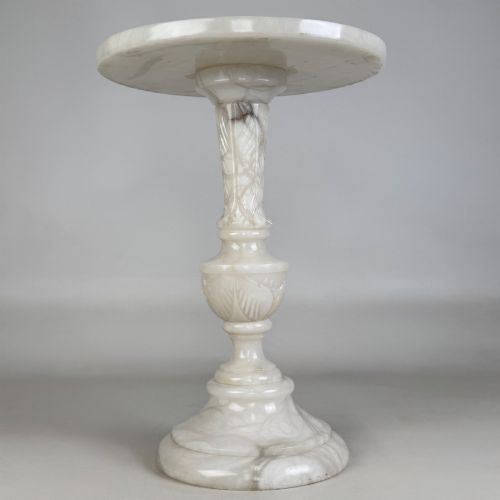


Carved Alabaster Stand
These carved alabaster stand examples bring classical weight and luminous carved detail to a room, offering genuine architectural presence.
Carved Alabaster Stand
A carved alabaster stand serves as a decorative base or sculptural support, frequently taking the form of plant stands, pedestals, columns, or floor lamps.
Buyers browsing this selection encounter pieces from the nineteenth century through the early twentieth century, spanning periods such as nineteen hundred, nineteen twenty, and nineteen thirty.
The decorative styles represented on this page range from neoclassical revival, art nouveau, and rococo revival to art deco and nineteenth century Indian designs.
How They Were Made
Craftsmen shaped these items from natural alabaster, marble, and stone, sometimes combining the translucent mineral with metal components or mahogany bases.
Artisans carved figural statues, columns, and lamp bodies by hand, capturing fine details in female figures, botanical motifs, and architectural fluting.
Carved Alabaster Stand Retail Price Guide 2026
Typical asking prices for carved alabaster stand among the pieces listed under this phrase on Sellingantiques today, from the lower quarter to the upper quarter. They describe what is for sale here now, not the wider market.
The listings on this site span the nineteenth century through the nineteen thirties, featuring alabaster, marble, and stone.
What Varies in Quality
The fineness of the hand-carved detail separates standard production from exceptional figural sculpture and architectural columns.
The purity and translucency of the stone dictate visual impact, with certain pieces displaying remarkable depth of grain and light penetration.
Fritz Kochendorfer
The Carved Alabaster Stand Glossary
- Alabaster
- A fine-grained, translucent stone favoured for classical sculpture and decorative stands because it accepts delicate carving and admits light.
- Neoclassical Revival
- A design style drawing inspiration from classical antiquity, often featuring columns, urns, and formal architectural proportions.
- Art Nouveau
- A turn-of-the-century aesthetic defined by flowing, organic lines and depictions of young women or natural plant forms.
- Pedestal
- A structural support or stand designed to elevate a bust, plant, or sculpture above floor level.
Carved Alabaster Stand: Frequently Asked Questions
How do I style a carved alabaster stand?
These pieces function as focal points in a room, supporting bronze figures, large floral displays, or functioning directly as floor-standing lamps.
Their neutral stone tones and classical proportions allow them to sit comfortably alongside both period interiors and modern minimalist spaces.
How do I date an alabaster stand?
Dating relies on the stylistic vocabulary of the carving, such as the sinuous lines of art nouveau or the strict symmetry of neoclassical revival.
Purchasing records and historical markers like turn-of-the-century clothing styles on figural sculptures also help narrow down the period of manufacture.
Are alabaster stands fragile?
Alabaster is a softer stone than marble, meaning it requires careful placement away from high-traffic zones where it might sustain knocks.
Routine maintenance involves dusting with a dry cloth, avoiding harsh chemical cleaners that can etch the polished surface of the mineral.