
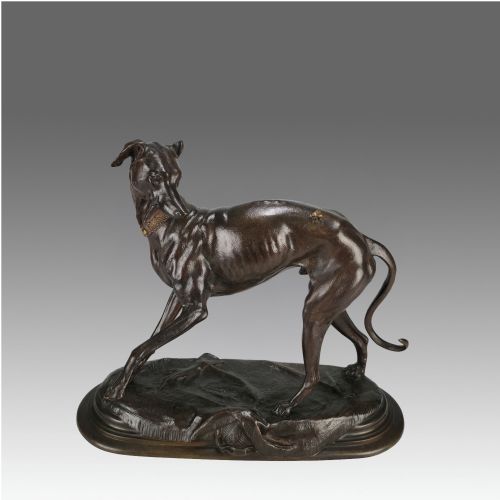
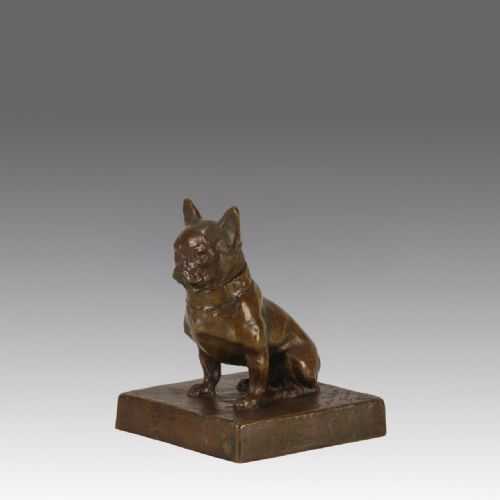


Canine Desk Ornament
These canine desk ornaments are miniature sculptures, inkwells and lamps cast in bronze or moulded in porcelain to bring character to a study.
Canine Desk Ornament
When you search for canine desk ornament, you meet small animalier sculptures, functional inkwells and table lamps modelled on breeds from pugs to greyhounds. The selection spans the Victorian era through the Art Deco period, capturing dogs in resting, begging or alert poses.
Bronze is the dominant medium on this page, often finished with cold-painted enamel or patination, alongside porcelain figures from German potteries and carved wood examples. Functional pieces combine utility with portraiture, such as triple inkwells featuring bullmastiffs or carved Black Forest designs.
Most items originate from French and Austrian workshops of the nineteenth and early twentieth centuries, reflecting the popular Animalier movement. Sculptors captured specific canine anatomy, creating desktop accessories that double as fine art.
How they were made
Bronze pieces are cast using the lost-wax technique, capturing fine fur texture and musculature before being finished with cold-painted enamel or dark patination. Foundries such as Barbedienne utilised skilled casting methods to ensure sharp detail on small-scale figures.
Porcelain examples are moulded and glazed, sometimes incorporating electrical wiring later for use as table lamps, while wooden pieces rely on hand-carving techniques typical of Black Forest production. Paint is applied carefully to surface details like eyes and collars to heighten realism.
Listings feature bronze, porcelain, and wood across periods from the Victorian era to the Art Deco twentieth century.
What varies in quality
Quality rests in the fidelity of the modelling and the crispness of the casting, where superior bronzes retain sharp muscle definition and clear facial expressions. Finer pieces show careful hand-chasing after casting to remove seams and refine surface textures.
Original surface finishes dictate value, particularly on cold-painted bronzes where intact enamel adds desirability. Maker signatures inscribed in the metal base also distinguish standard foundry work from documented artistic pieces.
Alfred Barye·Dora Heber·Rosenthal·Edith Parsons·Arthur Waagen·P.de Soete·Joseph Francois Victor Chemin·Franze Bergman·Barbedienne
The Canine Desk Ornament Glossary
- Animalier
- A nineteenth-century artistic movement focused on the realistic portrayal of animals. Sculptors in this tradition studied anatomy closely to render dogs in lifelike action.
- Cold-Painted Bronze
- Bronze sculpture decorated with non-fired paint applied over a metallic base. This technique required delicate application and remains prone to flaking over time.
- Patina
- The surface coloration and sheen developed on bronze through age or chemical treatment. A rich patina adds depth to the sculptural form.
- Inkwell
- A small desktop container for holding liquid ink, frequently mounted with a hinged lid. In this context, the lid often forms part of a sculptural dog's head or back.
- Chasing
- The process of hand-finishing a metal casting using small punches and chisels. This step sharpens details lost during the primary moulding phase.
Canine Desk Ornament: Frequently Asked Questions
Are these desk ornaments heavy enough to hold paper?
Most bronze examples possess sufficient weight to function effectively as paperweights or sturdy desktop accessories. Their dense metal construction prevents them from sliding easily during daily use.
Porcelain and wooden versions are lighter, though inkwells and larger figural pieces still offer adequate heft for routine placement on a writing desk.
How do I clean a cold-painted bronze dog?
Dust the surface gently with a soft, dry brush to remove particles without disturbing delicate paintwork. Avoid using water, detergents or chemical solvents that strip the cold-painted enamel.
Patinated bronzes tolerate a very light application of microcrystalline wax if they require nourishment, but painted surfaces demand strict caution.
Can I use the antique inkwells for actual writing?
Glass or ceramic inserts inside the inkwells often hold liquid, but older seals and hinges may leak if tilted. It is prudent to check the internal reservoir for cracks before filling.
Many collectors prefer to keep them dry to preserve the original interior condition and prevent corrosion of the surrounding metal or wood.
How do I identify an Art Deco canine piece?
Art Deco dogs often display stylised geometric lines, sleek greyhound forms and streamlined bases distinct from naturalistic Victorian designs. The postures emphasise speed and modern elegance.
Materials and foundry marks from the interwar period further separate these pieces from older nineteenth-century animalier sculptures.