


Canine Bronze Paperweight
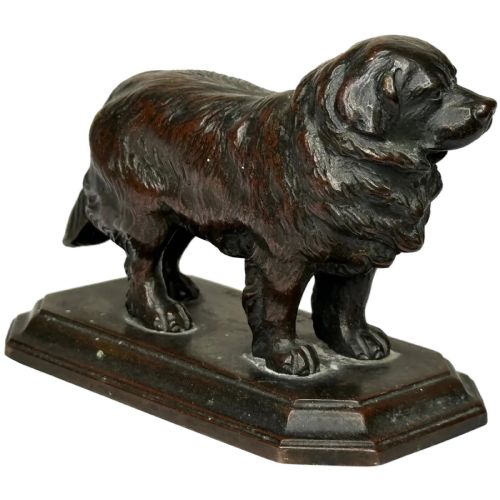
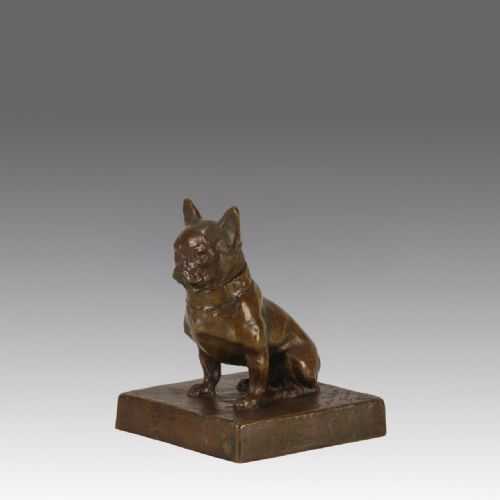
These canine bronze paperweight examples bring character to a desk, capturing dogs in patinated bronze, marble and cold-painted enamel.
Canine Bronze Paperweight
A canine bronze paperweight brings together sculpture and utility, often taking the form of specific breeds such as the French Bulldog, King Charles Spaniel, Basset Hound, and English Bulldog. These pieces draw on styles including Victorian Animalier, French Animalier, and Meiji Period Japanese work, reflecting a long tradition of capturing canine form in metal.
The objects span the nineteenth century into the early twentieth century, with dates such as 1890, 1900, 1910, and 1920 appearing across the selection. Many pieces function as small sculptures, figurines, or car mascots mounted on timber bases or marble plinths, while others stand independently as detailed studies of dogs in begging or seated poses.
Materials and methods
Foundries shaped these items using bronze casting techniques, frequently applying a patinated finish to accentuate the musculature and coat of each dog. Certain pieces incorporate cold-painted enamel or paint to add realistic colouration to the surface of the metal.
Mounts and supports utilise materials such as marble and timber bases to anchor the heavier bronze figures. Chrome also appears among the elements supporting specific car mascot forms.
Periods represented across the items include the Victorian era, the Meiji period, and the early twentieth century up to 1920.
Assessing the work
Quality rests upon the fidelity of the casting and the crispness of the chasing, which determines how sharply the fur, facial expressions, and anatomical details are rendered. Works by known sculptors and foundries exhibit superior handling of proportion and texture compared to unsigned or generic workshop output.
The preservation of original surface finishes, whether patinated bronze or cold-painted enamel, dictates the visual impact of the piece. Integrated bases of marble or timber that complement the scale of the dog rather than overpowering it also contribute to a successful composition.
Dora Heber·Pierre Jules Mene·Antoine Louis Barye·P.de Soete·Franze Bergman
The Canine Bronze Paperweight Glossary
- Animalier
- A nineteenth-century artistic movement focused on the realistic depiction of animals, particularly predators and domestic beasts. Sculptors in this tradition studied anatomy closely.
- Cold-painted bronze
- A technique where bronze figures were painted with cold enamel rather than fired in a kiln. The surface requires careful handling to preserve the remaining pigment.
- Patination
- The ageing or chemical treatment of a bronze surface to produce a specific colour and sheen. It protects the metal while defining the contours of the sculpture.
- Car mascot
- A decorative figurine mounted on the radiator cap of an automobile during the early twentieth century. Many bronze dog models doubled in this capacity.
- Meiji period
- The era of Japanese history lasting from 1868 to 1912, known for sophisticated metalwork and bronze casting exported to Western markets.
Canine Bronze Paperweight: Frequently Asked Questions
What breeds are represented?
The selection includes Newfoundlands, French Bulldogs, sighthounds, King Charles Spaniels, Bassets, English Bulldogs, terriers, and Boxers. Each breed is modelled with distinct posture and expression.
Artists captured these dogs in various states, from seated and begging poses to alert standing figures.
How were they used?
These bronze figures served primarily as desk accessories to hold down papers, combining utility with sculptural decoration. Some examples functioned as car mascots mounted on automobiles.
Over time, many transitioned into pure cabinet pieces or shelf ornaments collected for their artistic merit.
What is Vienna bronze?
Vienna bronze refers to small, highly detailed cold-painted bronze sculptures produced in Austrian workshops around 1900. These pieces are known for their vibrant enamel colours and lifelike animal subjects.
They often depict dogs and other creatures with considerable character and humour.
How do I date these pieces?
Dating relies on stylistic markers, historical periods such as the Victorian or Meiji eras, and occasionally signatures or foundry marks. Pieces from around 1900 frequently exhibit specific patination and casting methods characteristic of the turn of the century.
Materials like marble plinths and timber bases also help contextualise the age of the mount.