
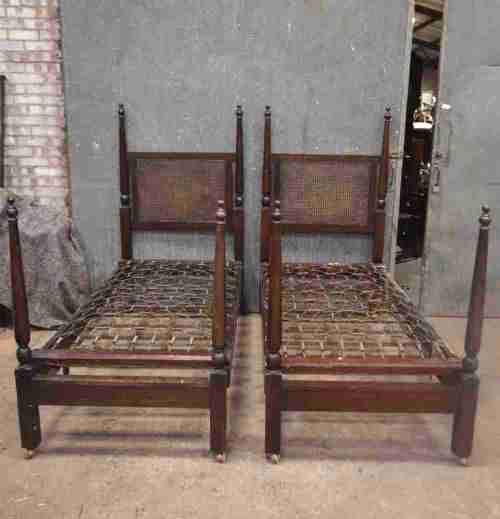
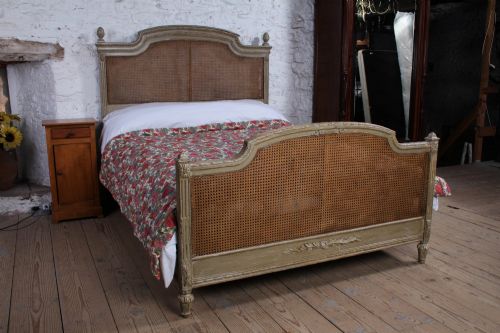


Caned Bedstead Frame
A caned bedstead frame brings light woodwork and woven panels into the bedroom, offering traditional sleeping architecture.
Caned Bedstead Frame
A caned bedstead frame provides a sturdy wooden or painted structure fitted with woven cane panels, typically seen in single, double, king, and super king sizes. These pieces often arrive from the Victorian era up through the nineteen-twenties, reflecting periods such as the early twentieth century and late Victorian times.
The selection here includes French chateau pieces, Louis XVI style designs, Colonial revival work, and art deco platform beds. Buyers will frequently encounter oak bergere four-poster configurations, hand-painted portrait panels, and carved gilded surfaces alongside simpler painted finishes.
How they were made
Craftsmen shaped these frames using solid timbers including oak, beech, and satinwood, often applying layers of paint, gold leaf, or polychrome decoration to the woodwork. Carved wooden details give definition to headboards and footboards.
Natural cane is woven tightly into the openings of the wooden framework to create breathable, textured panels. This traditional technique provides both structural flexibility and decorative lightness within the design of the bed.
Listings span the Victorian era, nineteen-hundred, nineteen-ten, and nineteen-twenty, featuring materials like natural cane, beech, oak, paint, and gold leaf.
What varies in quality
The skill of the hand-carved woodwork and the precision of the woven cane panels define the grade of each piece. Elaborate gilding, hand-painted portrait panels, and matching bedroom furniture indicate higher-tier craftsmanship.
Makers such as Maple and Co demonstrate superior joinery and finishing compared to standard workshop output. The weight and choice of primary timber, from plain painted softwood up to figured satinwood or oak, establish the hierarchy of these frames.
Maple and Co
The Caned Bedstead Frame Glossary
- Bergere
- A closed-arm armchair or matching bed component featuring upholstered or caned panels. This French style influences many twentieth-century oak and painted frames.
- Louis XVI Style
- A neoclassical design vocabulary characterised by straight lines, symmetry, and classical carvings. It appears frequently in carved and caned French beds from nineteen-ten and nineteen-twenty.
- Polychrome
- Decoration executed in multiple colours, often found on hand-painted portrait panels. This technique adds pictorial detail directly onto the bed frame.
- Satinwood
- A durable, lustrous wood native to Ceylon and India, prized for its golden sheen. High-end Victorian makers utilised it for luxury bedroom suites.
Caned Bedstead Frame: Frequently Asked Questions
What is a caned bedstead frame?
A caned bedstead frame is a structural bed designed with woven cane inserts in the headboard or footboard, combined with wood such as oak, beech, or satinwood.
These pieces date from the Victorian era through the nineteen-twenties, incorporating styles ranging from French chateau to art deco.
How do I clean natural cane?
Natural cane requires gentle dusting with a soft brush and occasional wiping with a damp cloth to maintain its moisture balance.
Avoid harsh chemical cleaners that can dry out and snap the woven plant fibres over time.
Are these beds standard mattress sizes?
Sizes range from single and double up to king, super king, and kingsize dimensions depending on the specific period and origin.
Some antique frames require careful measurement to ensure modern standard mattresses fit correctly within the wooden surrounds.
How do I identify Louis XVI style beds?
Louis XVI style frames show restrained classical geometry, straight tapered legs, and carved ornamentation rather than flowing curves.
They frequently feature painted finishes, gilded accents, and caned panels set within architectural wooden borders.