
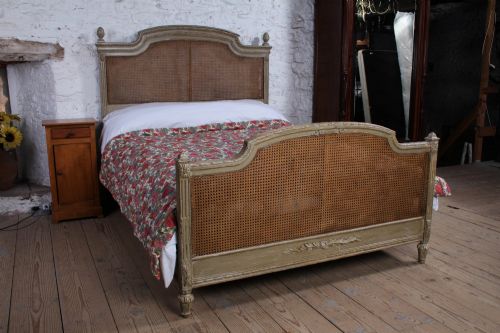


French Cane Bedstead
A French cane bedstead brings an airy yet grounded presence to a bedroom, combining woven natural panels with carved woodwork.
French Cane Bedstead
When you search for a french cane bedstead, you encounter larger sleeping furniture forms including double, king size, super king size, and single beds alongside matching bedroom suites. These pieces originate from periods spanning the Victorian era through to the early twentieth century, specifically around 1900, 1910, and 1920.
The dominant aesthetic draws heavily on Louis XVI style, French chateau influences, and neoclassical design, while occasional examples venture into Art Deco platform configurations. You meet painted finishes, gold leaf highlights, and carved wooden frames alongside the characteristic woven panels.
Most examples function as complete bed frames or bedsteads, occasionally accompanied by matching bedside tables, drawers, or chairs. The proportions tend toward grander scales, with king and super king dimensions appearing frequently among the listings.
How they were made
Makers constructed these frames predominantly from wood, utilising beech for structural integrity alongside other carved timbers. Artisans shaped the wood through detailed carving to achieve the neoclassical and Louis XVI motifs characteristic of the style.
The characteristic panels utilise natural cane and rattan, woven tightly to form breathable, decorative headboards and footboards. Painters applied polychrome finishes, paint, and gold leaf by hand to accent the wooden mouldings and portrait panels.
Certain single beds boast hand-painted portrait panels, ensuring you sleep accompanied by an anonymous historical gaze.
What varies in quality
The distinction between standard and superior pieces rests in the depth and crispness of the carved wooden ornament. Hand-painted portrait panels and intricate polychrome work elevate specific examples well beyond simple utilitarian frames.
The integrity and tightness of the woven cane panels dictate much of the textural quality across different pieces. Gilded surfaces finished in gold leaf display varying degrees of patination and hand-applied nuance that separate routine manufacture from finer workshop output.
The French Cane Bedstead Glossary
- Caning
- A method of weaving rattan or natural plant materials to create light, porous panels for headboards and footboards. This technique allows air circulation while providing a decorative backdrop.
- Polychrome
- The practice of decorating architectural elements or furniture in multiple colours. Artisans used this to enliven carved wooden panels with painted scenes.
- Louis XVI Style
- A neoclassical design movement characterised by straight lines, symmetry, and classical motifs such as fluting and ribbons. It influences the geometry of many early twentieth-century French beds.
- Gilded
- Coated thinly with gold leaf or powder to give the appearance of solid gold. This treatment adds reflective warmth to carved wooden frames.
French Cane Bedstead: Frequently Asked Questions
What mattress size fits these beds?
Many of these frames are built to standard modern metric or imperial proportions, including double, king, and super king dimensions.
However, older European sizing can occasionally vary slightly from modern UK or US standards, so checking the internal dimensions before sourcing a mattress is advisable.
How do I clean cane panels?
Natural cane benefits from gentle dusting with a soft brush or a vacuum attachment on a low setting. Keeping the material slightly humidified prevents the rattan from becoming brittle over time.
Avoid soaking the cane with excess water during routine cleaning to maintain the tension of the weave.
Are slats included with these frames?
Listings occasionally specify whether bed bases or platforms are included with the main structure. Some Art Deco or period frames come equipped with integrated supports.
It remains important to verify whether modern slatted bases or supportive boards accompany the antique woodwork.
How do I date a French bed?
Dating relies on stylistic markers, such as the transition from ornate Victorian carving to clean-lined Art Deco forms. Construction techniques, wood types, and the presence of original paint or gold leaf provide further chronological clues.
Comparing the decorative vocabulary against documented periods like 1900 or 1920 helps narrow down the era of manufacture.