
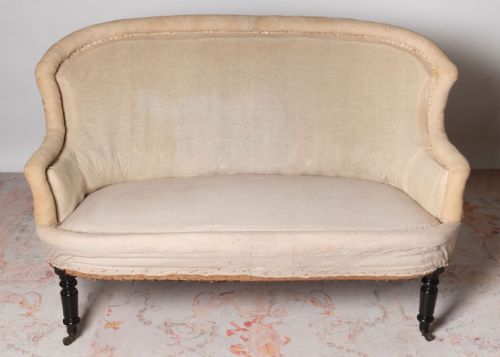
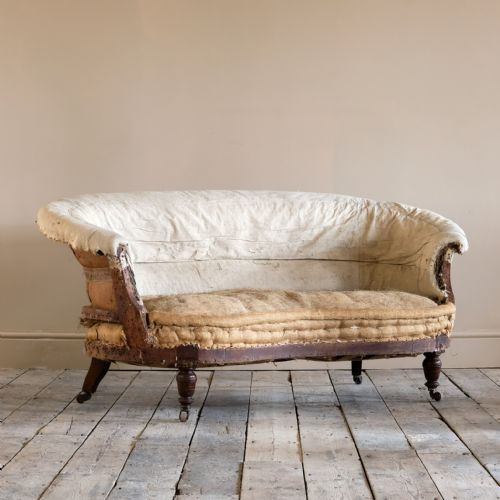


Calico Upholstered Settee
A calico upholstered settee brings unpretentious comfort and traditional lines into a room, offering a versatile base for loose covers or a clean, neutral finish.
Calico Upholstered Settee
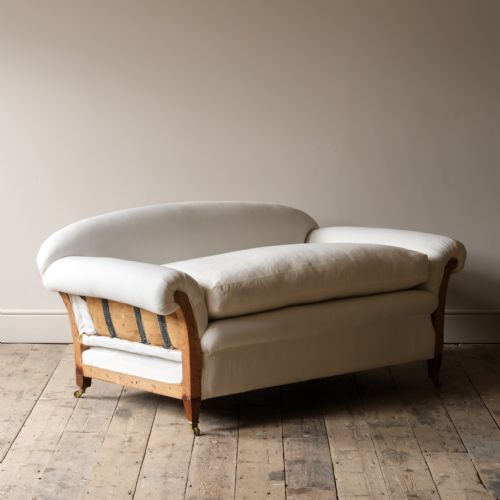
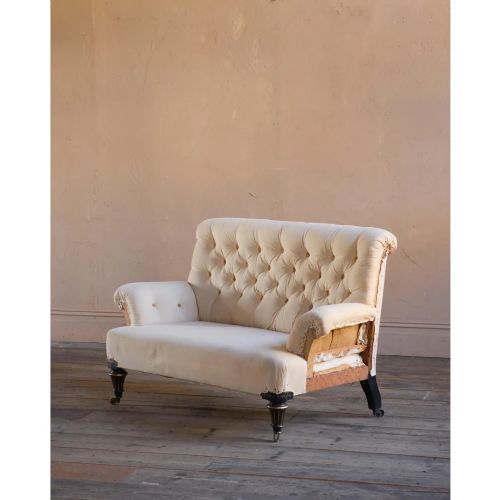
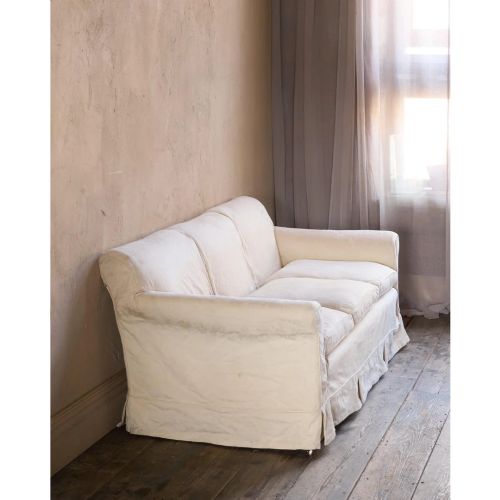
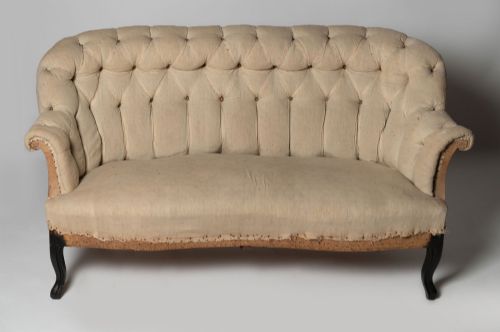
A calico upholstered settee comprises 19th Century, Edwardian, and 1930s seating forms designed for deep comfort in country houses and salons. The selection includes two seater sofas, deep seated country house designs, and Napoleon III chaise longue pieces.
Makers such as Jackson and Graham, Hampton & Sons, Howard and Sons, and Morison & Co of Edinburgh appear alongside French and English country house styles. Buyers encounter both robust 19th Century timber frames and early 20th Century upholstered seating.
How they were made
Frames rely on timber, beech, mahogany, and hardwood to construct durable seating skeletons that support heavy upholstery padding. Brass details sometimes finish the legs or castors on these substantial frames.
Traditional layering employs calico, hessian, and linen as foundations for the upholstery before any top cover is applied. This unbleached cotton calico serves as a sturdy under-upholstery that tightly encases the interior stuffing.
Materials recorded across the inventory include calico, hessian, linen, and brass alongside timber structures.
What varies in quality
Quality rests in the integrity of the underlying hardwood or mahogany frame and the depth of the seating proportions. Pieces bearing stamps from notable workshops demonstrate superior joinery and materials compared to uncredited pieces.
The precision of the internal webbing, hessian layering, and calico tension dictates how well the upholstery holds its shape over decades. Finer examples maintain disciplined lines beneath their calico skin, reflecting skilled cabinetmaking and upholstery traditions.
Jackson and Graham·Hampton and Sons·Howard and Sons·Morison and Co Edinburgh
The Calico Upholstered Settee Glossary
- Calico
- A plain-woven unbleached cotton textile used as an inner lining and upholstery foundation. It provides a tight, neutral base layer before decorative covers are fitted.
- Hessian
- A coarse woven fabric, typically made from jute fibres, utilised inside upholstered seating for webbing and foundation support. It holds the stuffing firmly within the frame.
- Chaise Longue
- An elongated upholstered chair designed for reclining, featuring a backrest and a single arm or scrolled end. Napoleon III examples showcase distinct French aesthetic styling.
- Hardwood
- Dense timber derived from broad-leaved trees, selected for structural frame longevity. It prevents warping in heavily weighted seating pieces.
Calico Upholstered Settee: Frequently Asked Questions
What is a calico upholstered settee?
A calico upholstered settee is a seating piece covered in plain cotton calico, often functioning as a neutral foundational layer ready for top covers or left bare for a minimalist aesthetic.
These pieces span the 19th Century through the 1930s, encompassing English country house sofas and French seating forms.
How were these settees used historically?
These settees served as comfortable lounging furniture in drawing rooms, libraries, and country house reception spaces. Their deep seats accommodated relaxed postures during reading or social gatherings.
Workshop production by firms like Howard and Sons ensured durable construction suitable for daily household use.
How do I live with a calico settee?
Living with a calico settee involves embracing its neutral cotton surface as a tactile, understated element or using it as a direct base for loose slipcovers. The plain fabric integrates smoothly into both traditional and contemporary interiors.
Regular gentle vacuuming helps maintain the tight cotton weave and keeps the underlying padding dust-free.
How do I tell periods apart?
Period identification relies on examining the timber frames, leg shapes, and overall proportions of the piece. Victorian and Napoleon III designs often display more ornate or scrolled woodwork compared to clean-lined 1930s deep seated models.
Maker stamps and labels from firms like Morison & Co or Hampton & Sons also help anchor a piece to its specific era.