

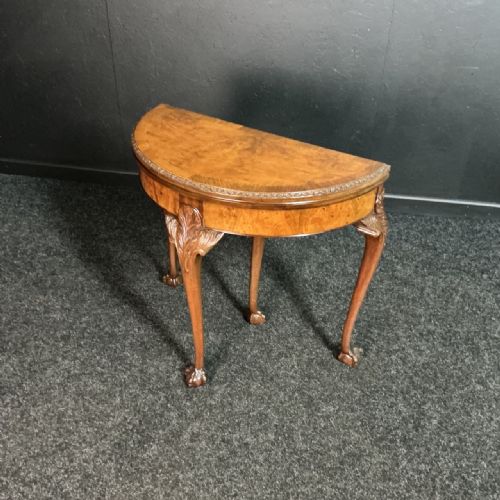
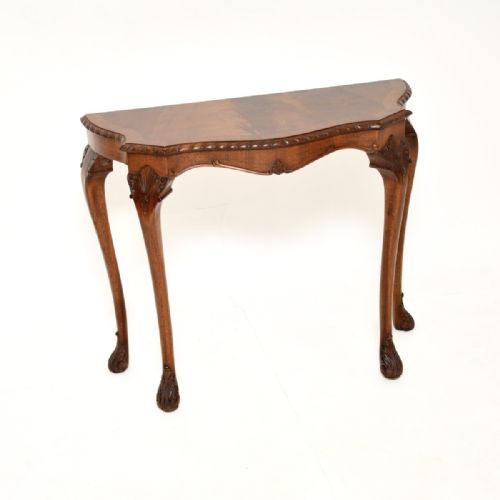


Cabriole Leg Demilune Table
A cabriole leg demilune table offers half-round elegance supported by graceful, curved legs that anchor a room with distinct historical character.
Cabriole Leg Demilune Table
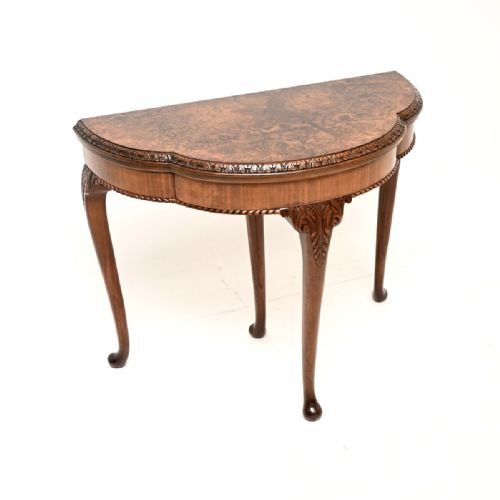
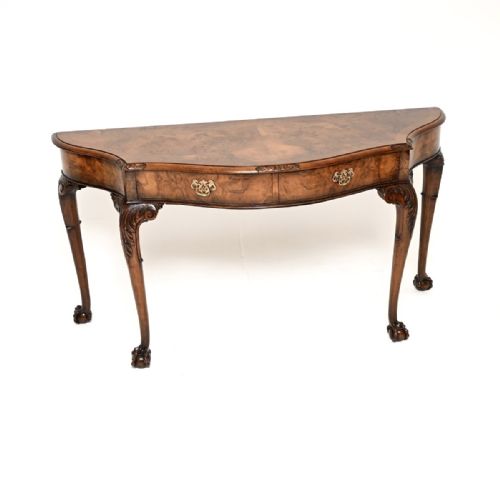
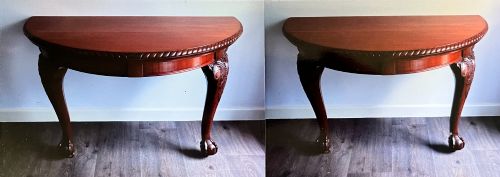
A cabriole leg demilune table combines a semicircular top with distinctive double-curved legs, appearing across console, card, and games forms. These pieces serve practical functions in hallways and living spaces while providing a flat edge against the wall.
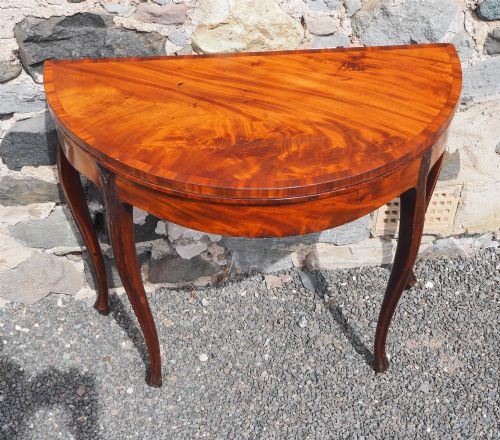
The selection ranges from eighteenth-century examples to later revival pieces from the early twentieth century. Walnut and mahogany predominate, often enhanced by burr walnut or flame mahogany veneers.
Makers frequently channel historical idioms, including Queen Anne, George III, Chippendale, and Louis XV styles. Console and card tables form the vast majority of the pieces encountered in this search.
How they were made
Cabinetmakers construct these tables using solid timbers such as mahogany and walnut, frequently applying decorative veneers like burr walnut and flame mahogany to the semicircular tops. Brass fittings appear on folding mechanisms and hardware.
The distinctive legs require skilled shaping to achieve the characteristic outward knee and inward ankle of the cabriole form. Joinery methods include traditional framing to support folding leaves on card and games tables.
Cabriole Leg Demilune Table Retail Price Guide 2026
Typical asking prices for cabriole leg demilune table among the pieces listed under this phrase on Sellingantiques today, from the lower quarter to the upper quarter. They describe what is for sale here now, not the wider market.
Triple top tables offer three surfaces in one frame, proving that past card players enjoyed options as much as modern ones do.
What varies in quality
Quality rests in the selection of timber figures, where richly patterned burr walnut or matched flame mahogany veneers elevate the visual impact of the top. The crispness of the carving on the cabriole knees also distinguishes finer examples from simpler production.
The precision of the folding mechanisms and the integrity of the structural joints dictate the durability of card and games variations. Balance and proportion in the curve of the leg define the aesthetic success of the piece.
The Cabriole Leg Demilune Table Glossary
- Demilune
- Having the shape of a half-moon or semicircle. This profile allows the table to sit flush against a wall while projecting into the room.
- Cabriole leg
- A furniture leg that curves outward at the knee and tapers inward toward the ankle, mimicking animal limbs. It frequently terminates in pad or claw-and-ball feet.
- Console table
- A table designed to be fixed against a wall, often supported by front legs with the rear secured to the architecture. Many versions in this group are freestanding console tables.
- Foldover top
- A hinged table surface that opens to double its area, commonly found on card and games tables. This mechanism conceals a felt-lined surface or game compartments beneath.
- Veneer
- A thin slice of figured wood applied to a secondary timber base. Burr walnut and flame mahogany veneers provide decorative grain patterns.
Cabriole Leg Demilune Table: Frequently Asked Questions
How were card tables used?
Card tables stayed folded against the wall when not in use, displaying the decorative wood top. Hosts opened them to accommodate guests for evening card games.
Inside, many contained baize-lined surfaces and small wells for coins or counters.
How do I identify a Queen Anne style table?
Queen Anne style tables rely on graceful curves rather than heavy carving, featuring prominent cabriole legs and pad feet. Walnut is the primary timber associated with this aesthetic.
Revival pieces from the early twentieth century often replicate these distinct eighteenth-century proportions.
Where should I place a console table?
Console tables suit entrance hallways, living rooms, and dining spaces where floor space is restricted. Their flat backs sit securely against the wall.
They provide a surface for lamps and decorative objects without obstructing pathways.