


Burr Walnut Tier Shelf
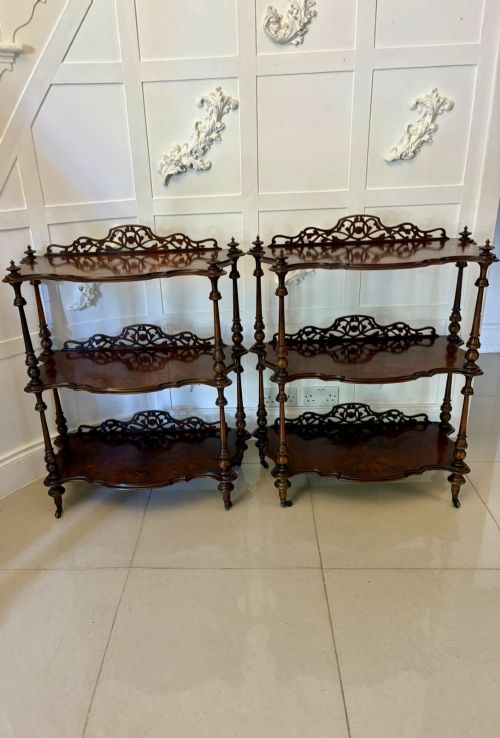
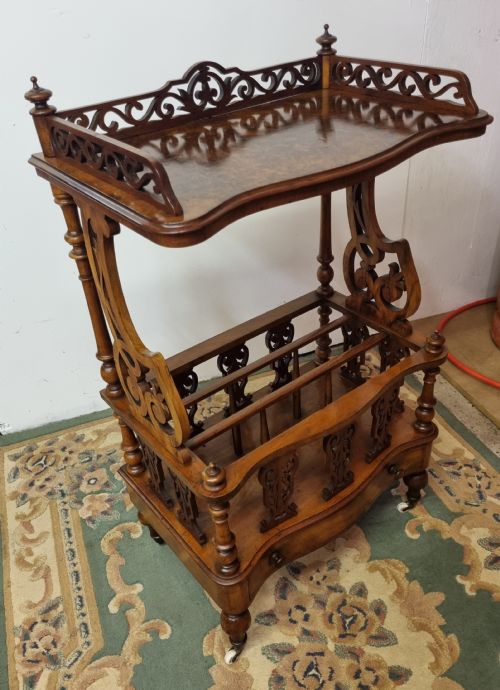
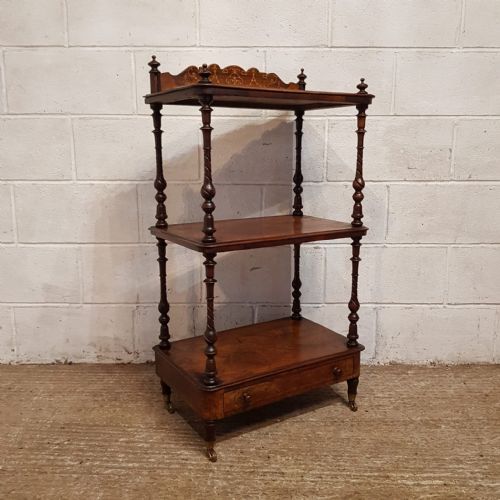
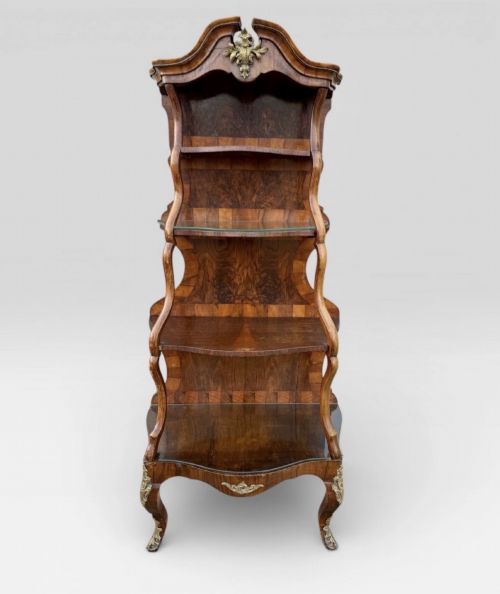
A burr walnut tier shelf provides tiered display space, appearing primarily as Victorian whatnots, etageres, and canterburys defined by rich wood figures.
Burr Walnut Tier Shelf
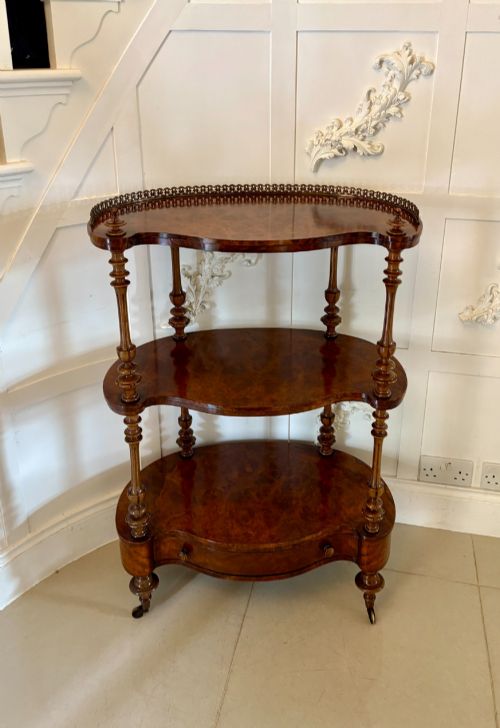
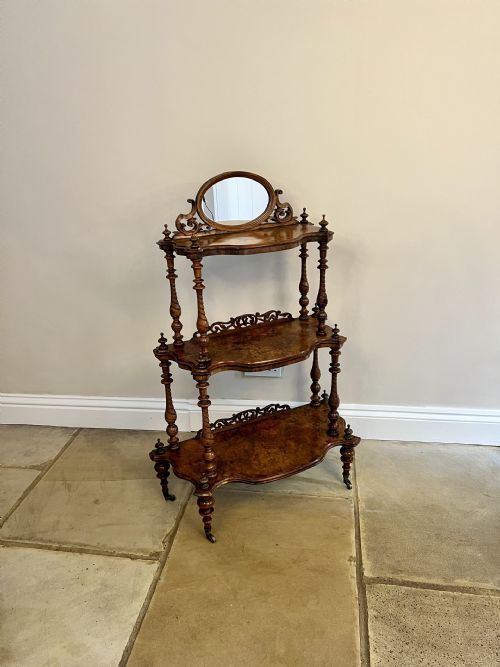
A burr walnut tier shelf is a multi-tiered piece of furniture designed for display and storage, most commonly encountered on this page as Victorian whatnots, etageres, and canterburys. These pieces take various forms including freestanding rectangular units, corner stands, and serpentine shapes dating mainly from the nineteenth century.
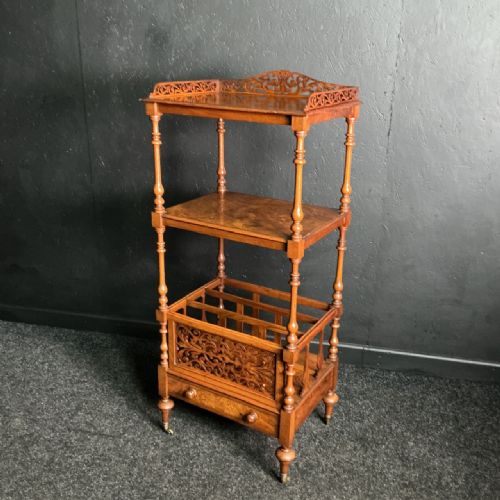
The objects span from the Regency and William IV periods through mid-Victorian and late Victorian eras, with dates clustering around the mid-nineteenth century. Alongside standard tier shelves, the selection includes related forms such as music cabinets, chiffoniers, credenzas, and display consoles incorporating multiple tiers.
Originating predominantly from nineteenth-century British cabinet-making traditions, these tier shelves serve as decorative and functional furniture for parlours and drawing rooms. The typical configuration uses stacked open shelves supported by turned or carved uprights, occasionally integrating drawers or lower cabinet compartments.
Materials and construction
Makers utilised burr walnut veneers applied over solid secondary timbers to achieve richly figured, swirling grain patterns across the main surfaces of the shelves and panels. Ebony inlay, marquetry, and gilt metal details frequently accent the timber framework.
Structural elements incorporate turned wooden supports, brass fittings, and occasional mirror glass backing within the tiered framework. Corner units, serpentine shapes, and demi-lune consoles require precise carpentry to curve and fit the walnut veneers to complex frames.
Several pieces double as music cabinets, proving that nineteenth-century drawing rooms needed somewhere to hide unruly piles of sheet music beneath polite tiers of ornaments.
Distinctions in quality
Quality in a burr walnut tier shelf rests on the density and symmetry of the burr walnut figuring across the tiers, alongside the crispness of any marquetry inlay or ebony stringing. Superior examples display carefully matched veneer sheets that create a harmonious visual pattern across the shelves.
Construction methods determine durability, with finer pieces showing tight joinery in the turned uprights, stable tier platforms, and well-fitted drawers or lower cabinets where included. The presence of exhibition-quality carving or distinctive forms like serpentine and demi-lune shapes elevates the standing of the piece.
Holland & Sons
The Burr Walnut Tier Shelf Glossary
- Burr walnut
- A veneer taken from the wart-like growth on a walnut tree, prized for its swirling, highly figured grain patterns. It provides a decorative surface for high-end nineteenth-century furniture.
- Whatnot
- An open shelving unit with three or more tiers supported by columns or legs, designed for displaying ornaments and books. It gained popularity during the Victorian period.
- Etagere
- A piece of furniture consisting of a set of open shelves for displaying small objects, synonymous with the whatnot in many nineteenth-century listings. These units often feature multiple stacked tiers.
- Canterbury
- A low stand featuring partitioned sections for holding sheet music, folios, or books, frequently surmounted by tiered shelves. Victorian examples often combine this function with a whatnot.
- Serpentine
- A shape characterised by a undulating line with a convex centre flanked by concave curves. This contour appears on the front edges of shelves and tabletops in higher-end pieces.
Burr Walnut Tier Shelf: Frequently Asked Questions
What is a burr walnut tier shelf used for?
These pieces function primarily as open display furniture for ceramics, glassware, and decorative objects in principal rooms. The tiered design allows multiple items to be shown without occupying a large floor footprint.
Certain variations integrate lower compartments, drawers, or partitions for storing sheet music and periodicals. Their decorative surfaces also allow them to function as side cabinets or console tables.
Are these tier shelves suitable for modern homes?
The compact footprint of corner models and slender etageres makes them practical for contemporary interiors where floor space is limited. They provide functional vertical display space while introducing warm timber tones and historic character.
Care should be taken to place them away from direct sunlight and rapid temperature fluctuations to protect the walnut veneer. Regular dusting with a dry cloth maintains the polished finish of the burr timber.
What is the difference between a whatnot and an etagere?
The terms are often used interchangeably in nineteenth-century and modern listings to describe tiered shelving units. Both forms provide open platforms for display, though etagere sometimes denotes lighter, more decorative French-influenced designs.
In practice, British listings apply both labels to multi-tiered stands with turned uprights. The specific configuration of shelves, drawers, or lower cabinets defines the individual piece more than the name.