


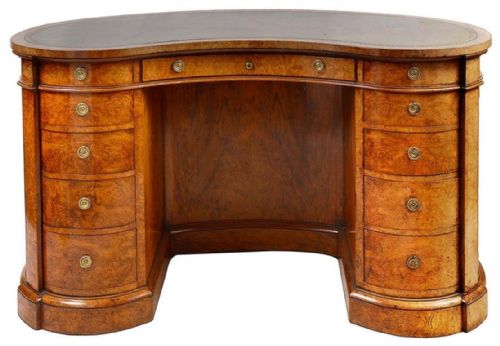


Burr Walnut Kidney Table
A burr walnut kidney table brings together serpentine curves and rich timber figure, serving as a distinctive desk or writing surface.
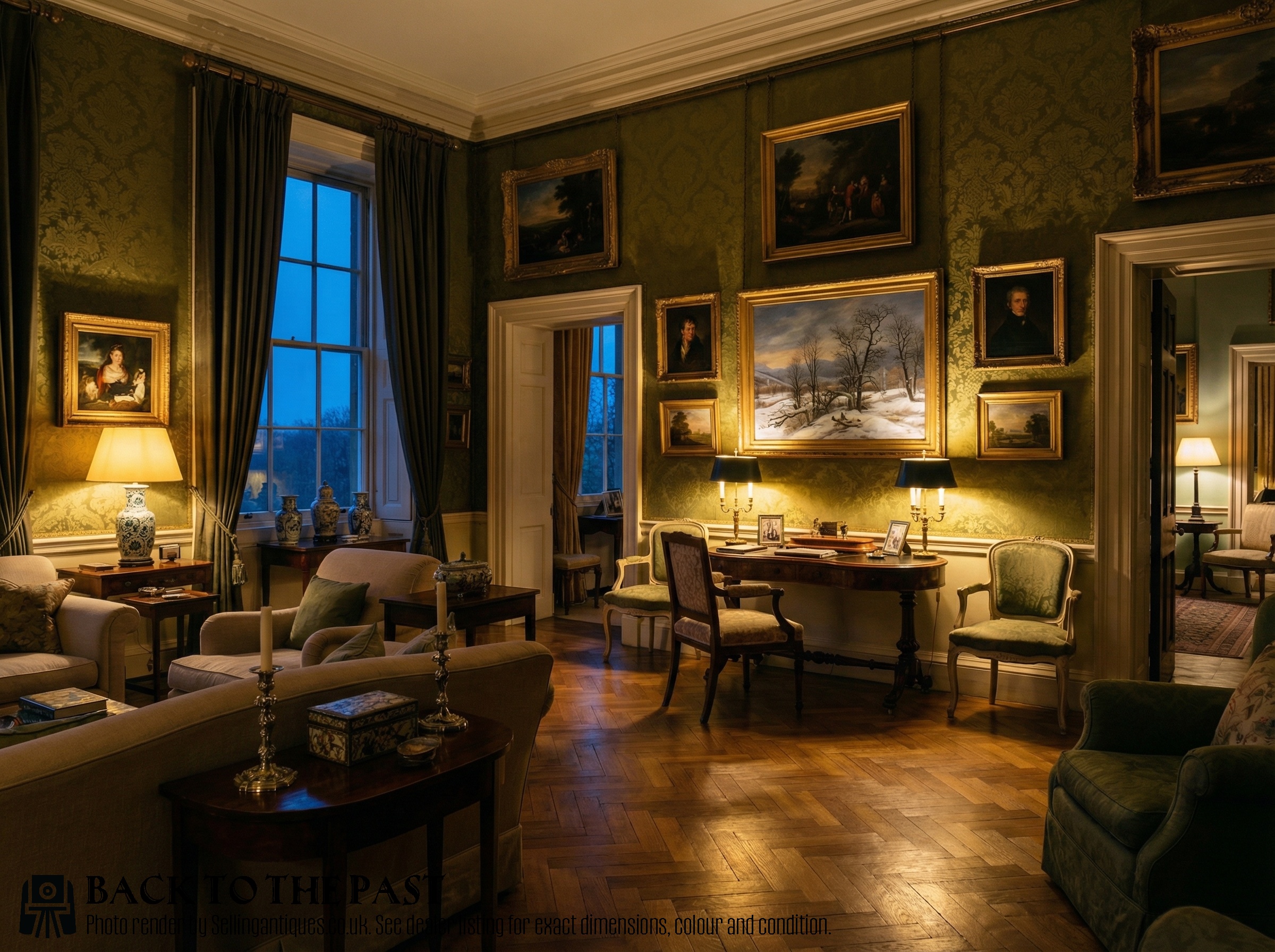
Burr Walnut Kidney Table
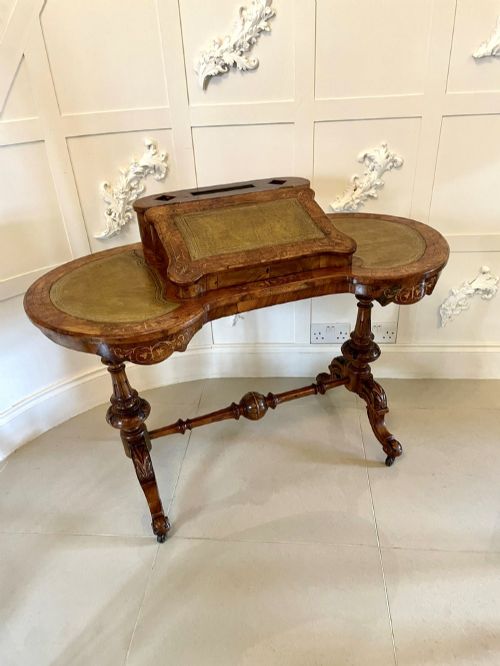
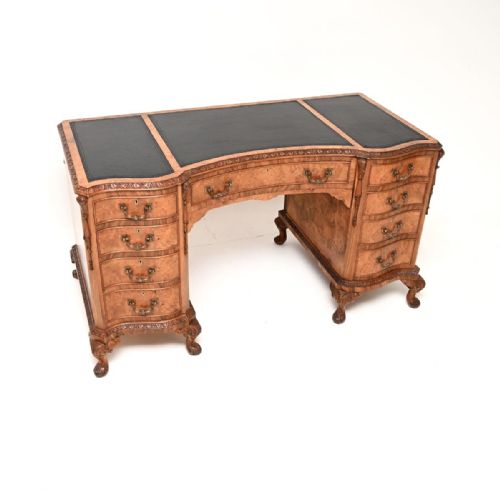
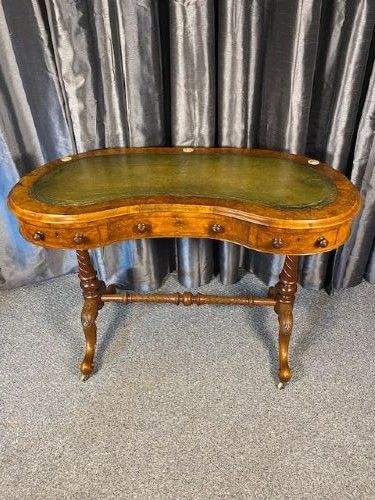
A burr walnut kidney table takes its primary name from its distinctive curved top profile, designed to wrap partially around the user. These pieces appear most frequently as writing desks, library tables, and dressing tables originating from the Victorian period.
Makers shaped these surfaces to function as freestanding centrepieces rather than items pushed against a wall, often incorporating leather inserts or marquetry inlay across the top.
The form spans various nineteenth-century revivals, including Louis XV and Queen Anne styles, alongside later twentieth-century Art Deco interpretations.
Materials and construction
Cabinetmakers utilised burr walnut veneers sliced from tree growths to create intricate grain patterns across the curved tops of these tables. This veneer work was frequently combined with straight-grained walnut for structural framing and carcass work.
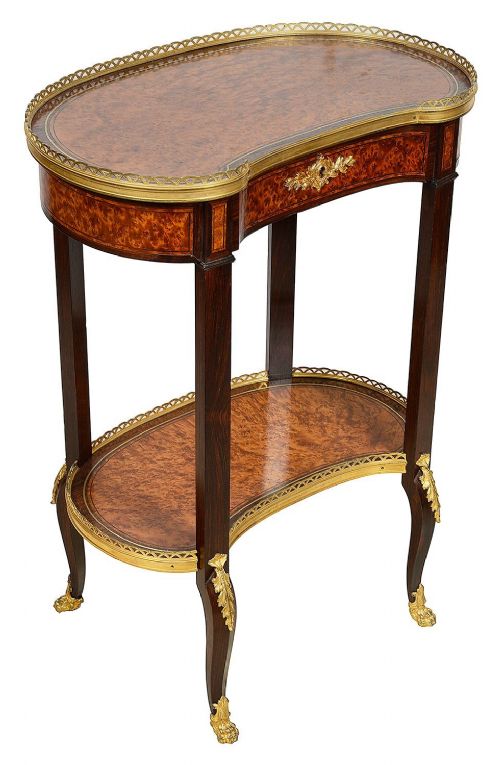
Metal mounts in brass and ormolu were cast to edge drawers, protect corners, or accent legs, while fitted leather writing surfaces were often tooled with gilt borders.
Marquetry inlay added contrasting floral or geometric motifs into the walnut surface, requiring precise hand-cutting of diverse timber species.
Listings feature burr walnut kidney tables spanning the Victorian era, the nineteenth century generally, and early twentieth-century Art Deco production.
Judging execution and finish
Quality rests heavily on the selection and matching of the burr walnut veneer across the kidney-shaped surface, where symmetrical grain patterns demand high skill. Finer examples display meticulous marquetry and careful integration of ormolu mounts rather than plain timber edges.
Structural integrity in the curved framework dictates the longevity of these tables, as the rounded front edge places specific demands on the joinery. The crispness of carved details on legs and stretcher supports further separates standard workshop production from finer cabinet work.
Tehan·Gillows·Maurice Adams
The Burr Walnut Kidney Table Glossary
- Burr walnut
- Timber taken from the abnormal growth of a walnut tree, yielding a swirling, highly figured grain pattern prized for decorative veneering. It forms the primary visual characteristic of these tables.
- Kidney shape
- A curved, asymmetrical top profile resembling a bean or kidney, allowing the user to sit within the curve. This form appeared frequently on nineteenth-century writing and dressing tables.
- Bureau-plat
- A French style of freestanding writing desk featuring a flat top and drawers within the frieze. These tables often share similar proportions and mounts with kidney writing desks.
- Marquetry
- The art of applying small pieces of veneer to a structure to form decorative patterns or pictures. This technique often frames the outer edges of the walnut top.
- Ormolu
- Gilt bronze ornamentation applied to furniture mounts and feet. It provides metallic contrast against the dark walnut timber.
Burr Walnut Kidney Table: Frequently Asked Questions
What is a burr walnut kidney table used for?
These tables served primarily as writing desks, library tables, or ladies' dressing tables within nineteenth-century domestic interiors. Their curved design allowed them to function comfortably as freestanding pieces in the centre of a room.
Many examples incorporate leather inserts, drawers, and compartments specifically arranged for correspondence and personal writing tasks.
How do you date a Victorian kidney table?
Dating relies on examining the construction methods, hardware, and stylistic revival influences present in the piece. Mid-nineteenth-century examples often feature elaborate marquetry and ormolu mounts associated with French revival tastes.
Later Victorian pieces from the 1870s and 1880s frequently show simpler crossbanding and standard pedestal configurations without excessive ornamentation.
Are these tables freestanding?
Most recorded examples feature finished backs and polished veneer all around, confirming they were built to stand away from walls. This freestanding capability made them practical centrepiece furniture for studies and principal rooms.
Their curved shape required finished treatment on all visible angles to maintain a polished appearance from any viewpoint.
What distinguishes a writing desk from a dressing table?
Writing desks usually feature leather-lined tops and stationary drawers built into the frieze or pedestals. Dressing tables within this group often incorporate superstructure elements such as attached mirrors or compartments for cosmetics.
Both variants share the same core kidney shape but differ in their internal fittings and surface treatments.