

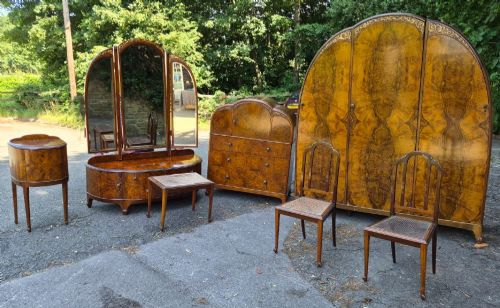


Burr Walnut Dressing Chest
A burr walnut dressing chest brings intense, knotty grain figures and deep warmth into a bedroom.
Burr Walnut Dressing Chest
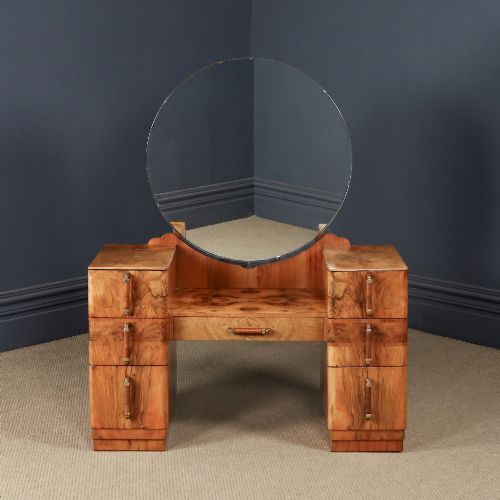
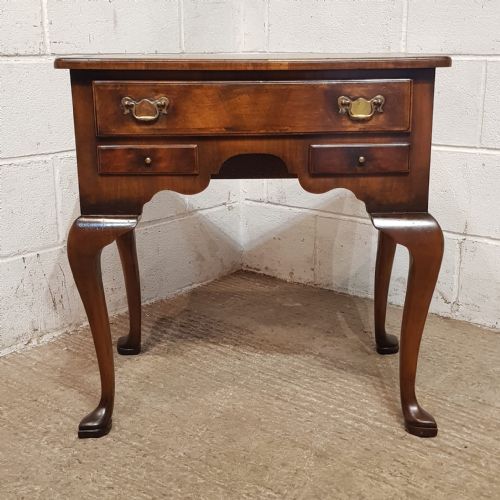
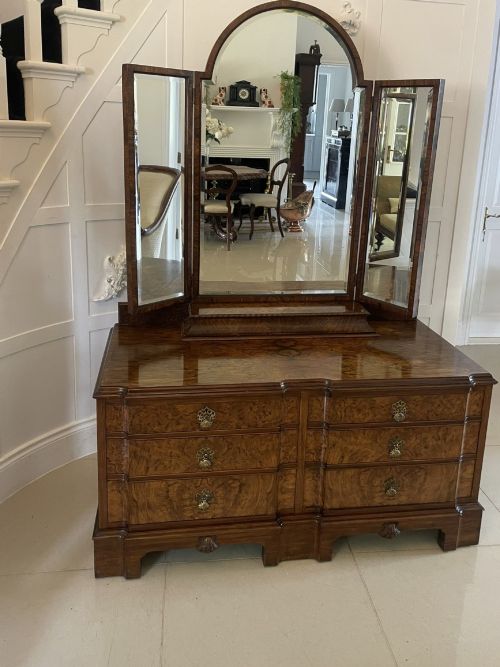
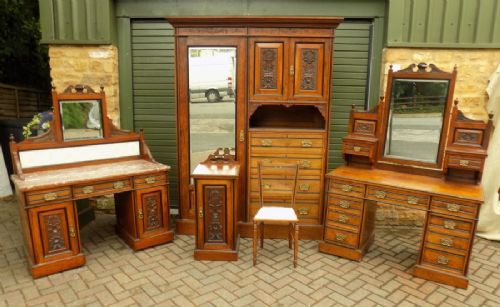
When you search for a burr walnut dressing chest, you encounter case furniture designed for personal grooming and storage, combining drawers with mirrors or writing surfaces. The pieces listed here span the eighteenth century, the Victorian era, and the art deco period of the nineteen-thirties, showing forms that evolved from small kneehole desks and lowboys into full dressing tables and bedroom suites.
You meet a variety of regional and stylistic interpretations on this page, including queen anne revivals, georgian designs, and art deco pedestal tables. Some items integrate adjustable mirrors, while others function as lowboys or compact chests fitted with drawers for accessories.
The materials paired with the core wood include brass hardware, glass mirrors, oak linings, and occasionally velvet or silver fittings, reflecting the practical and decorative needs of their original owners across different centuries.
What varies in quality
The tier of a piece depends heavily on the selection and matching of the burr walnut veneer. Top examples exhibit continuous, mirror-matched grain patterns across multiple drawers, while simpler versions use mismatched cuts.
Construction methods also dictate worth, separating standard production pieces from bespoke workshop creations with fine secondary timbers, hand-dovetailed drawer linings, and integrated original brass or silver hardware.
The listings on this site feature burr walnut dressing chests spanning the Georgian period, the Victorian era, and nineteen-thirties Art Deco.
Frank Taylor and Co·Maurice Adams·Shoolbred and Co·Parkins and Gotto
The Burr Walnut Dressing Chest Glossary
- Burr walnut
- A wood harvested from the irregular growths or burls on walnut trees, creating complex, swirling grain patterns. It is sliced into thin veneers for high-end cabinet work.
- Lowboy
- A small table with drawers, typically standing on four tall legs, frequently used as a dressing table or side table in the eighteenth century and later revivals.
- Kneehole desk
- A compact desk or dressing chest featuring a central recessed space for the legs, flanked by pedestals of small drawers.
- Pedestal dressing table
- A large dressing table supported by two vertical banks of drawers, often incorporating a swivelling mirror attached to the superstructure.
- Satinwood
- A luminous, pale yellow timber used for secondary banding and contrasting string lines in fine antique case pieces.
Burr Walnut Dressing Chest: Frequently Asked Questions
What is a burr walnut dressing chest?
A burr walnut dressing chest is a piece of antique bedroom furniture featuring drawers and a mirror, surfaced with highly figured walnut veneer.
These items range from compact eighteenth-century lowboys and kneehole desks to large Victorian Duchess dressing tables and nineteen-thirties art deco pedestal units.
How do I date a dressing chest?
Dating relies on stylistic clues, hardware, and construction methods. Eighteenth-century pieces often take the form of lowboys or kneehole desks with pad feet.
Victorian and later examples incorporate larger attached mirrors, ornate carved frames, or streamlined art deco geometric pedestals.
Are mirrors original to the chest?
Many dressing chests retain their original tilting or fixed mirror frames, often mounted on scrolling supports or pedestals.
Over the centuries, some mirror plates have been replaced due to degradation of the original mercury backing, which appears as dark speckling.
What woods are used underneath the veneer?
The structural carcass and drawer linings are typically constructed from secondary timbers such as oak or mahogany.
Veneers of burr walnut are applied to the primary visible surfaces to create decorative grain patterns.