



Burgundy Turkmen Carpet
These woven pieces known as a burgundy turkmen carpet bring deep red tones and tribal geometry into a room.
Burgundy Turkmen Carpet
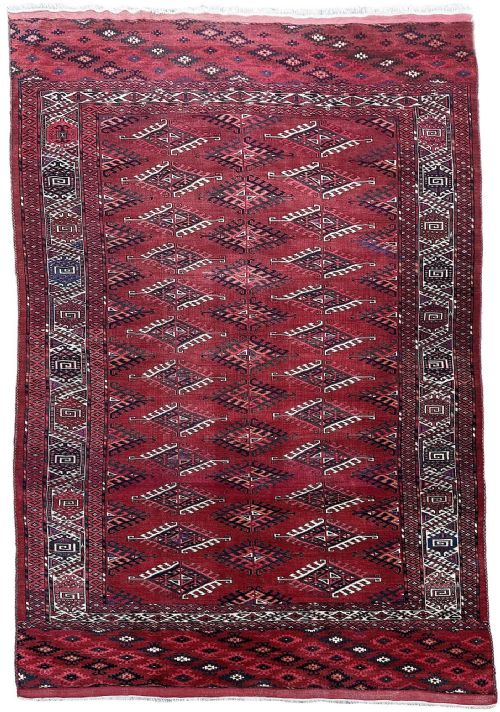
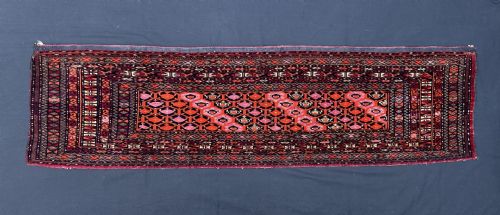
Buyers seeking a burgundy turkmen carpet examine woven textiles originating from Central Asia across the nineteenth and early twentieth centuries. The selection encompasses large carpets alongside smaller domestic pieces such as torbas, chuvals, jollars, and asmalyks.
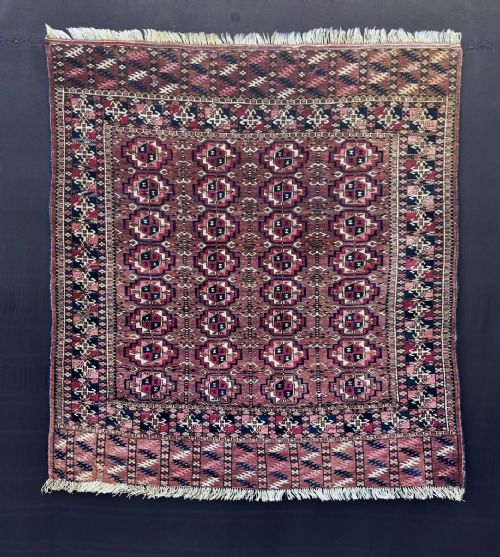
Tribal groups including the Yomut, Tekke, Sariq, Karadashli, and Ersari produced these items utilising distinctive repeat motifs like guls and ensi layouts. Pieces range from full carpets and wedding rugs to tent bands and wall hangings.
The dominant visual weight rests on rich madder-dyed grounds spanning deep red, burgundy, and brown tones, offset by secondary accents in ivory, dark blue, and gold.
Materials and construction
Weavers constructed these textiles primarily using hand-spun wool for the pile, foundations, and flatweave structures, occasionally incorporating cotton foundations and silk highlights.
Natural dyes provide the characteristic colour palette, yielding deep madder reds alongside dark tones that patinate gracefully over time.
Craftspeople employed precise knotting techniques alongside Soumak flatweave methods, particularly on utility bags, tent bands, and kilims.
Camel-mounted bridal processions required decorative asmalyks to travel in style.
Distinctions in quality
Quality rests upon the density and precision of the weave, where tighter knot counts define finer torbas, chuvals, and carpets. The clarity of geometric drawing within the guls and border ornaments also separates standard items from exceptional examples.
The purity and saturation of the natural dyes govern the depth of the red and burgundy fields, influencing how the rug responds to light. Additionally, the survival of complete original elements, such as plain-weave backs on torbas or long kilim ends on flatweaves, elevates a piece.
Yomut Tribes·Sariq Tribe·Teke Tribes·Karadashli Tribe·Ersari Turkmen
The Burgundy Turkmen Carpet Glossary
- Gul
- The primary octagonal medallion repeated across many Turkmen carpet designs. These repeating motifs often identify the specific tribal group that wove the textile.
- Torba
- A small storage bag produced by nomadic tribes for use within the yurt. These rectangular hangings typically feature elaborate gul patterns on the face.
- Chuval
- A large tent bag used for household storage during migrations. They frequently share the design vocabulary of main carpets in a condensed format.
- Asmalyk
- A pentagonal trapping hung inside a wedding yurt or mounted on a camel during bridal processions. They represent some of the most decorative tribal weaving.
- Ensi
- A cruciform-designed rug hung over the entrance doorway inside a Turkmen tent. The layout mimics a gateway with compartmentalised fields.
- Soumak
- A flatweave technique wrapping weft threads over warp threads to create a textured surface. This method appears on kilims and tribal bag faces.
Burgundy Turkmen Carpet: Frequently Asked Questions
What is a gul?
A gul is the repeating octagonal motif characteristic of Central Asian weaving. These medallions form the structural backbone of the design fields.
Different tribal groups developed distinct gul shapes, allowing specialists to attribute pieces to makers such as the Tekke or Yomut.
How were these bags used?
Nomadic families utilised torbas and chuvals inside tents for storing household possessions and bedding. They hung against the lattice walls of the yurt.
Many retain functional construction details, such as plain-weave backs or suspension loops, showing their domestic origin.
Are natural dyes used?
Makers relied on natural dyestuffs, notably madder root, to achieve deep red and burgundy shades. These materials produce rich variations across the wool pile.
Over decades, natural dyes mellow softly, creating the characteristic depth seen in nineteenth-century examples.
How do I date these textiles?
Dating relies on material analysis, structural evidence, and design conventions pointing to the nineteenth and early twentieth centuries. Finer weave and rich madder palettes often indicate earlier periods.
Comparing structural details like wool preparation helps separate nineteenth-century weaving from later village work.