





Brown Wood Okimono
These brown wood okimono are carved Japanese figures and natural forms originating primarily from the nineteenth century and the Meiji period.
Brown Wood Okimono
When you search for brown wood okimono, you are looking at small Japanese carvings depicting figures, deities, animals and natural studies created across the nineteenth century and into the Edwardian era.
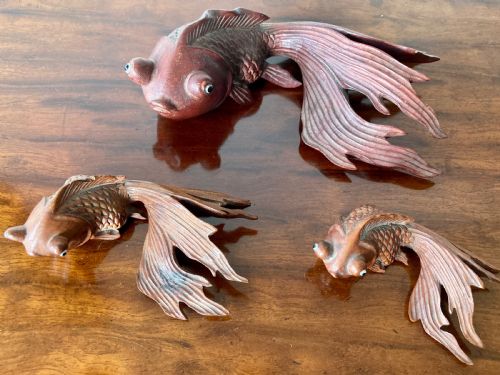
The pieces you are most likely to meet on this page include boxwood netsuke, carved bamboo studies, hardwood animal figures and small sculptures of traditional subjects like deities and fish.
Originating largely from the Meiji and Edo periods, these decorative objects served both functional purposes as toggles or paperweights and purely aesthetic roles as cabinet sculptures.
How they were made
Carvers utilised dense organic materials such as boxwood, bamboo, dark stain and various hardwoods to achieve precise miniature detail without splitting.
Makers employed hand-carving techniques using specialised chisels and knives to shape natural wood grains into expressive human figures, deities, and animals like rabbits, rodents and toads.
Listings feature nineteenth-century and Edwardian pieces created from boxwood, bamboo, horn, and carved hardwood.
What varies in quality
The distinction between ordinary and superior pieces rests entirely in the crispness of the carving and the sensitivity with which the natural grain of the wood serves the subject.
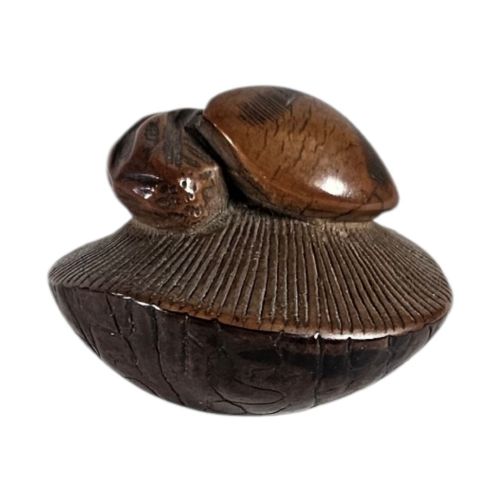
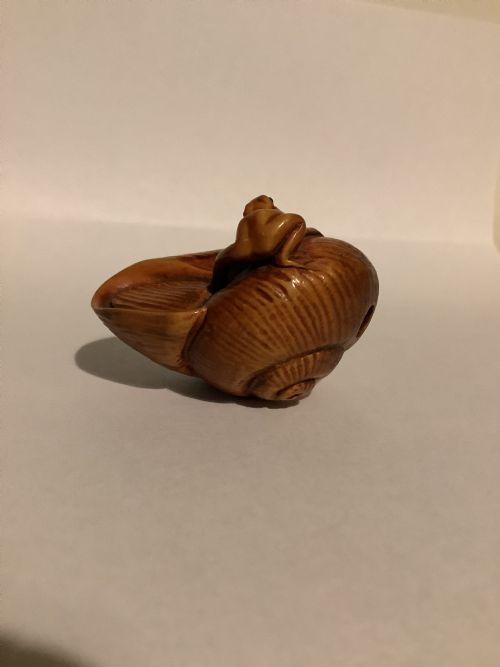
Master carvers achieved life in subjects such as a snail on a mushroom or a cluster of nuts through subtle undercut work and polished surfaces that contrast with stiffer, coarser execution.
Tomochika·Gyoko
The Brown Wood Okimono Glossary
- Okimono
- A Japanese freestanding carving intended for display in a domestic interior rather than for temple use. These decorative sculptures cover subjects ranging from deities to animals.
- Netsuke
- A small carved toggle with perforated channels used to secure a pouch or small container to a traditional Japanese kimono sash. Many examples function equally as miniature okimono.
- Boxwood
- A dense, pale hardwood favoured by Japanese carvers for its fine grain and stability under intricate knife work. It often darkens gracefully with age and handling.
- Meiji Period
- The era in Japanese history spanning from 1868 to 1912, characterised by a flourishing of decorative arts aimed at both domestic patrons and Western export markets.
- Edo Period
- The period of Japanese history lasting from 1603 to 1867, preceding the Meiji era and establishing many of the classic carving traditions seen in these figures.
Brown Wood Okimono: Frequently Asked Questions
What is an okimono?
An okimono is a Japanese freestanding sculptural object made for display in a home rather than for religious rituals.
Carved from materials such as boxwood or bamboo, these pieces depict human figures, animals, and natural subjects with great attention to detail.
How do I care for wooden carvings?
Wooden okimono require stable indoor humidity and protection from direct sunlight to prevent the material from drying out or splitting.
Dust them gently with a soft, dry brush rather than using liquid polishes or damp cloths.
What is the difference between a netsuke and an okimono?
A netsuke is specifically a carved toggle with cord holes designed to fasten a small container to a kimono sash.
An okimono is simply a decorative sculpture intended for display on a shelf or table, though small netsuke are often collected as okimono today.
How can I tell the period of a carving?
Dating relies on the style of the carving, the choice of subject matter, and the natural patina developed on the wood over generations of handling.
Nineteenth-century and Meiji period pieces often display particular fluency in animal and figure studies compared to later work.