


Brown Velvet Settee
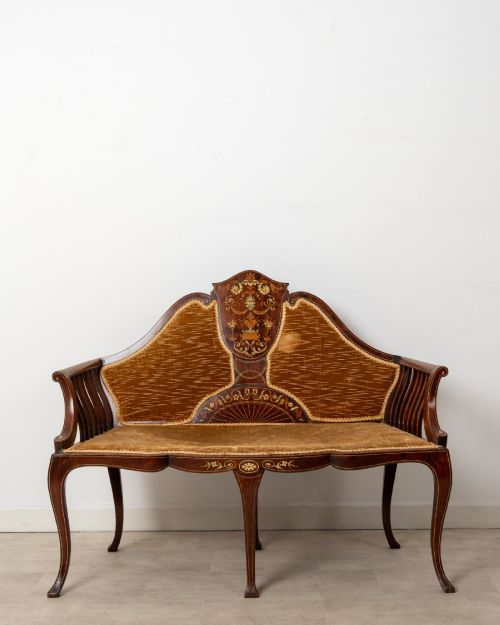
A brown velvet settee brings rich texture and traditional seating to a room, offering deep cushioned comfort wrapped in tactile pile.
Brown Velvet Settee
A brown velvet settee combines upholstered comfort with architectural timber framing, taking forms such as the Edwardian inlaid sofa, the Victorian chaise longue, and the Belle Époque banquette. These pieces span the nineteenth and twentieth centuries, encompassing Victorian Rococo Revival, Georgian Revival, and Art Deco styles.
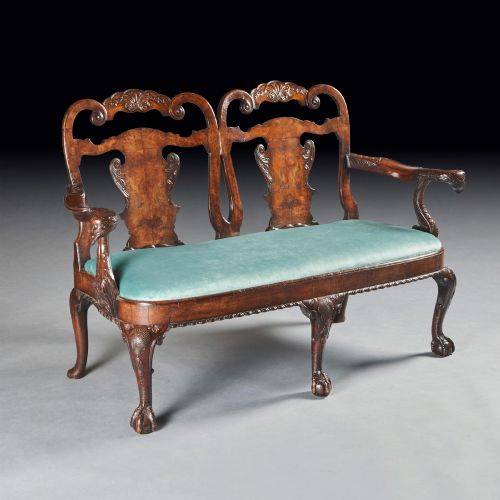
The brown velvet settee you encounter here most frequently appears in mahogany, walnut, or rosewood, often bearing the distinct proportions of Edwardian and Victorian drawing rooms. Certain examples show elaborate satinwood inlay or carved frames, while others present drop ends or twin chair backs inspired by earlier Georgian designs.
Selecting a brown velvet settee involves balancing period woodwork with the tactile appeal of velvet upholstery. Whether you seek the sweeping curves of a French-influenced couch or the straight lines of a salon suite, these seats anchor a formal interior with deep historical character.
Materials and construction methods
The framework of a brown velvet settee relies on dense hardwoods such as mahogany, walnut, and rosewood, chosen for their structural strength and rich grain. Carpenters shaped these timbers through traditional joinery, sometimes adding contrasting satinwood inlay to decorate the show wood.
Upholstery techniques combined sturdy internal webbing and stuffing with sumptuous velvet coverings, occasionally finished with specialised velvet trim or leather accents. Carved rosewood frames and exposed mahogany structures display the hand-carving and polishing skills typical of Victorian and Edwardian workshops.
Some sofas feature drop ends that politely bow downward, accommodating an afternoon nap without disturbing the room's formal symmetry.
Distinctions in craftsmanship and condition
The distinction between average and exceptional examples lies in the crispness of the timber carving and the subtlety of any satinwood inlay work. Superior pieces display harmonious proportions and tight joinery that resists movement across the frame over decades of use.
Surface preservation matters greatly, as original polish on walnut and mahogany contrasts with stripped or heavily refinished timber. The integration of the velvet upholstery with the wooden structure also dictates the overall visual harmony of the finished seat.
James Shoolbred
The Brown Velvet Settee Glossary
- Settee
- A long upholstered seat with a back and arms, designed to accommodate multiple people comfortably. This traditional form serves as a central seating element in formal reception rooms.
- Chaise Longue
- An elongated upholstered chair designed for reclining, featuring a backrest at one end and sometimes a partial arm. Victorian examples often showcase richly carved rosewood frames.
- Banquette Sofa
- A long upholstered bench seating arrangement, sometimes featuring decorative trim. Belle Époque examples combine this form with wood and leather detailing.
- Satinwood Inlay
- Decorative contrasting wood veneer set flush into the primary mahogany or walnut surface of the frame. This technique creates delicate geometric or floral patterns across Edwardian pieces.
- Drop End Sofa
- A sofa featuring an adjustable or hinged arm that lowers to create a daybed configuration. This mechanism adds versatility to late period seating.
Brown Velvet Settee: Frequently Asked Questions
What periods do these pieces span?
The selection encompasses items from the mid-nineteenth century through the Edwardian era and into the late 1920s. This covers Victorian, Belle Époque, and early twentieth-century design movements.
Craftsmen during these periods drew upon earlier Georgian and French Louis XV styles, adapting historical aesthetics for contemporary homes.
What woods are used in the frames?
Frames are constructed from dense hardwoods including mahogany, walnut, and rosewood. Some Edwardian examples feature lighter satinwood inlay.
These timbers provide the structural rigidity needed to support upholstered bodies and decorative carvings.
Are these settees suitable for daily use?
These historical seats were built for formal reception spaces and drawing rooms using traditional joinery and upholstery methods. Their daily suitability depends on the stability of the internal frame and the condition of the padding.
Certain items may require reupholstery to meet modern comfort standards while retaining their period frames.