




Brown Tapestry Screen
These brown tapestry screen pieces provide a practical block against heat and drafts while displaying intricate needlework.
Brown Tapestry Screen
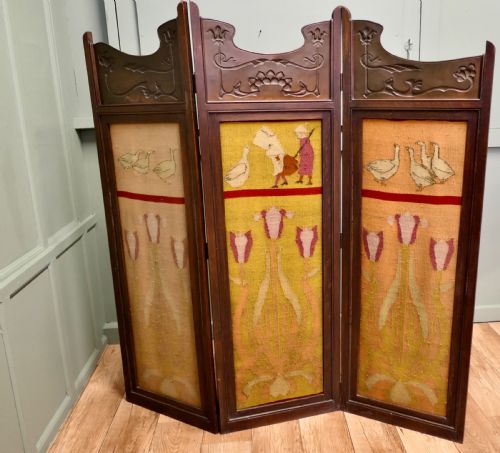
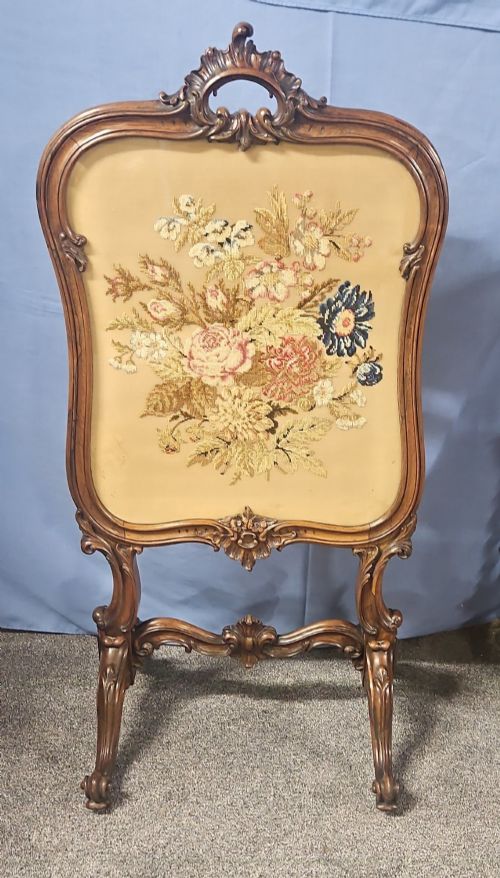
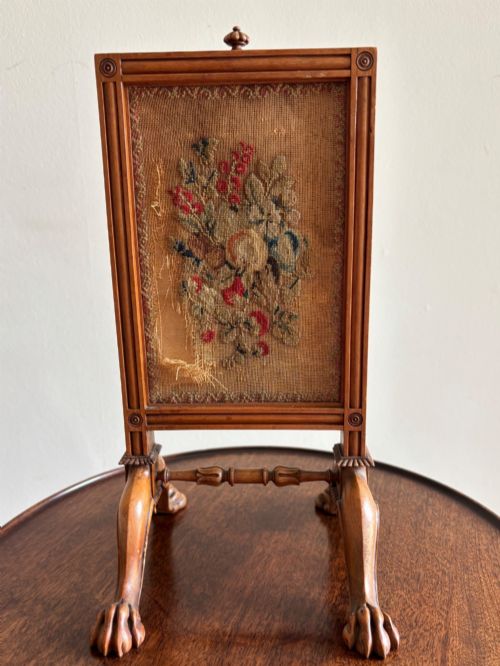
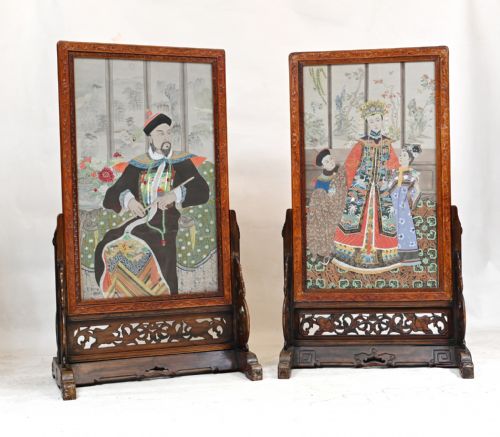
A brown tapestry screen appears across several historical periods, functioning primarily as a room divider or a fireside accessory. These items range from large privacy panels to compact table models and adjustable pole screens designed to shield faces from hearth flames.
The versions most commonly met on this page span the 18th, 19th and early 20th centuries, including Victorian, Regency, William IV and Georgian examples. Forms include folding screens with multiple leaves as well as single panel stands.
Makers utilised various timber frames to hold the textile work, employing mahogany, walnut, oak and palisander. The decorative inserts themselves feature hand-woven tapestry, woolwork, needlepoint and embroidered panels.
Construction and Materials
Carpenters shaped the structural elements from hardwoods such as mahogany, walnut and oak, often incorporating carved details, bobbin turning or brass fittings. Frames range from single adjustable poles on tripod bases to multi-fold hinges connecting several wooden leaves.
Textile panels within these frames rely on hand-stitched needlepoint, woolwork and woven tapestry techniques. Artisans worked wool and silk threads onto a foundation fabric to create pastoral scenes and sampler designs.
The styles represented across these listings span Georgian, Regency, William IV, Victorian, Art Nouveau and Black Forest traditions.
Judging Quality
Quality shows in the precision of the timber carving and the stability of the frame joints. Denser hardwoods like mahogany and walnut provide superior structural integrity compared to simpler secondary woods.
The refinement of the textile work distinguishes finer examples, where dense needlepoint and hand-woven tapestry display tight, uniform stitching. Intricate framing details, such as bobbin-turned supports or brass hardware, further elevate the piece.
The Brown Tapestry Screen Glossary
- Pole screen
- A vertical stand holding an adjustable sliding panel designed to block radiant heat from a fireplace. The height is altered by moving the textile screen up and down the wooden shaft.
- Needlepoint
- A type of canvas work embroidery stitched by hand using a needle and yarn. It forms the dense decorative panels seen on many fireside screens.
- Palisander
- A dense, dark timber resembling rosewood utilised for high-status cabinet work and furniture frames during the Regency period.
- Bobbin turned
- A method of woodturning that produces a series of rounded, spool-like shapes along the length of a support leg or stretcher. This decorative technique appears on several 19th-century frames.
Brown Tapestry Screen: Frequently Asked Questions
How do I use a fire screen?
A fire screen sits between occupants and the hearth to block excessive heat when a coal or wood fire burns too fiercely. They also protect room furnishings and decorative needlework from stray sparks.
Many examples feature adjustable panels on vertical poles or folding leaves that can be angled to suit the seating arrangement.
Where should I place a room divider?
Folding screens work well to segment large living spaces, create private corners or conceal doorways and storage areas. Their multiple hinged panels allow them to stand independently in a zig-zag configuration.
Ensure the panels remain clear of damp walls and direct sunlight to protect the aged timber and textile inserts.
What is the difference between a pole screen and a folding screen?
A pole screen consists of a single vertical shaft on a base with an adjustable panel that slides up and down. They were traditionally personal accessories placed beside individual chairs.
Folding screens comprise two or more connected panels that open out to form a wide barrier, suiting larger spaces and room division.