





Brown Rosewood Card Table
A brown rosewood card table brings rich grain and clever folding leaves to a room, offering both a surface for play and a piece of formal furniture.
Brown Rosewood Card Table
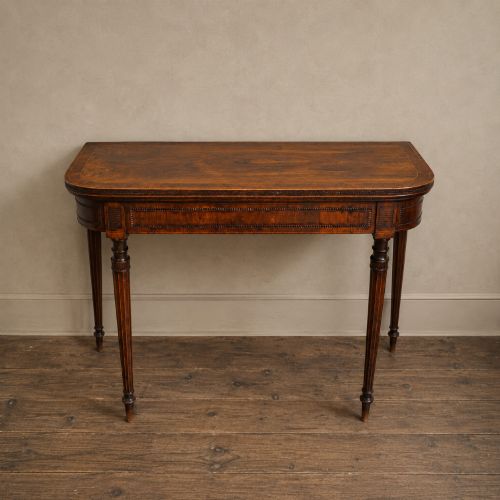
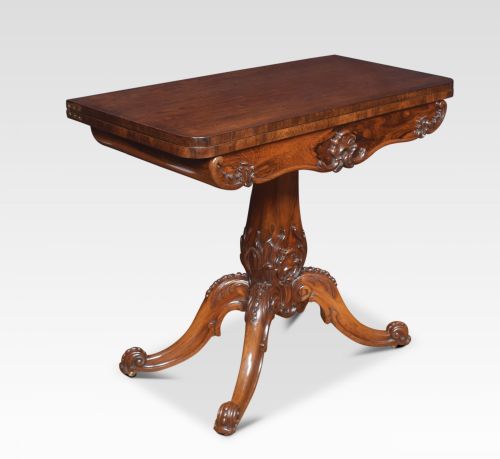
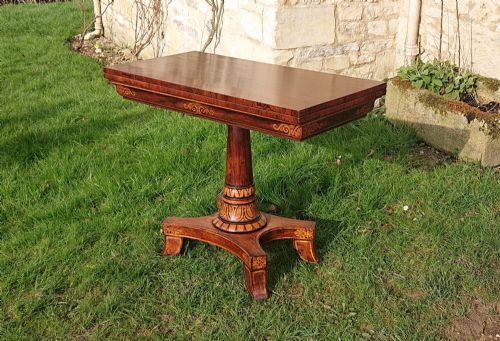
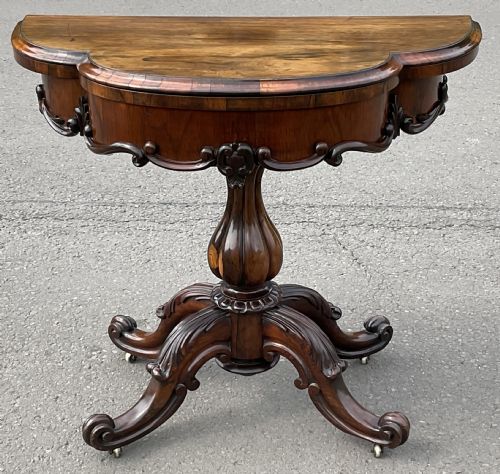
A brown rosewood card table is a folding piece designed for gaming or tea, appearing chiefly across Regency, Victorian, and Georgian periods. These tables frequently employ rosewood as the primary timber, sometimes paired with mahogany or timber carcases.
The most common formats on this page feature swivel tops or fold-over leaves that conceal a baize-lined playing surface beneath. Makers also produced envelope forms and occasional tables designed to sit against a drawing room wall.
Origins stretch from George III and Regency workshops through to late nineteenth century examples by firms such as Maple and Co. Buyers encounter forms ranging from strict classical lines to serpentine Victorian interpretations.
Judging quality in rosewood tables
Quality rests upon the selection of the rosewood veneer and the precision of the crossbanding in burr yew, kingswood, or boxwood. Superior examples display striking natural grain patterns that match symmetrically across the fold-over top.
The integrity of the pivoting mechanism and the crispness of brass inlay or wood marquetry separate finer workshop output from simpler commercial pieces. Construction stability in the legs and pillar ensures the heavy top opens and closes without sagging.
Listings feature rosewood card tables spanning the Regency, Victorian, and Georgian periods, incorporating brass inlay, boxwood, and burr yew.
Maple and Co.·William Trotter·George Bullock·Gillows
The Brown Rosewood Card Table Glossary
- Crossbanding
- A strip of veneer applied across the grain of the main surface to form a contrasting border. This technique frames the top of a card table with woods like burr yew or boxwood.
- Swivel top
- A table top that rotates ninety degrees on its base to reveal a concealed compartment or to provide support for a folded leaf. The mechanism allows the upper surface to open flat.
- Envelope card table
- A square table featuring four triangular flaps that fold inward like an envelope to cover the playing surface. Unfolding one flap draws open the others simultaneously.
- Goncalo Alves
- A dense exotic hardwood with distinctive dark brown figuring, sometimes used alongside or in place of rosewood. It yields a rich, contrasting grain on nineteenth-century tables.
- Sabre leg
- A curved, outwardly tapering leg of square or rounded section that resembles a cavalry sabre. Regency makers frequently used this form to support card and games tables.
Brown Rosewood Card Table: Frequently Asked Questions
How do I open the top?
Most brown rosewood card tables feature a swivel mechanism where the top leaf rotates ninety degrees on the frieze before folding out flat. A second pair of legs or a concertina action swings out to support the extended leaf.
Take care to lift the leaf slightly as it turns rather than forcing it, as antique hinges rely on careful alignment.
What games were played on them?
These surfaces accommodated popular card pastimes of the Georgian and Victorian eras, including whist, quadrille, and cribbage. The interior lined well often held counters, cards, and dice.
When closed, the table served as a console or tea table against the drawing room wall.
How do I date a table?
Examine the leg style, secondary timbers, and inlay motifs to determine the period. Regency examples often display brass inlay and sabre legs, while Victorian versions favour heavier serpentine forms and elaborate floral marquetry.
Cabinetmaker stamps or paper labels inside the frieze drawer can also point to a specific workshop or decade.
Can I use it daily?
A brown rosewood card table functions well as a hall console, occasional desk, or a dining surface for two when closed. Avoid placing hot cups or wet glasses directly on the polished timber to protect the historic finish.
Opening the leaves occasionally helps keep the wooden hinges and pivot mechanisms moving smoothly.