
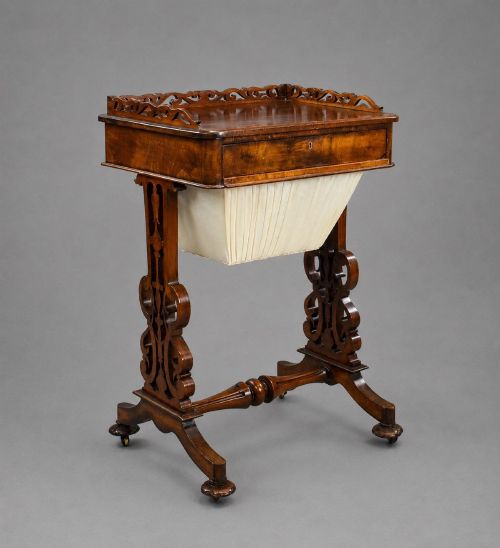
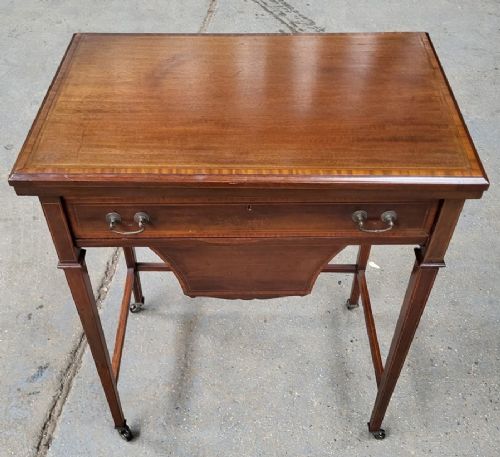
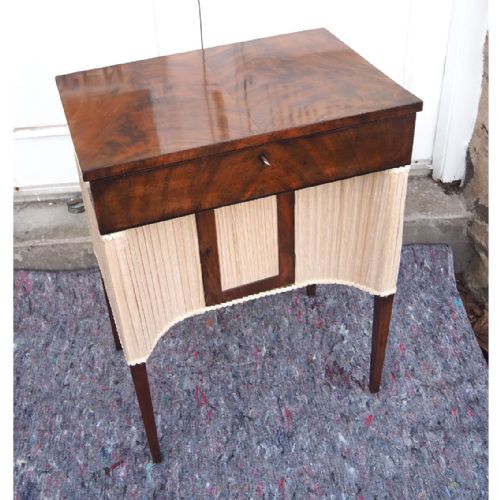
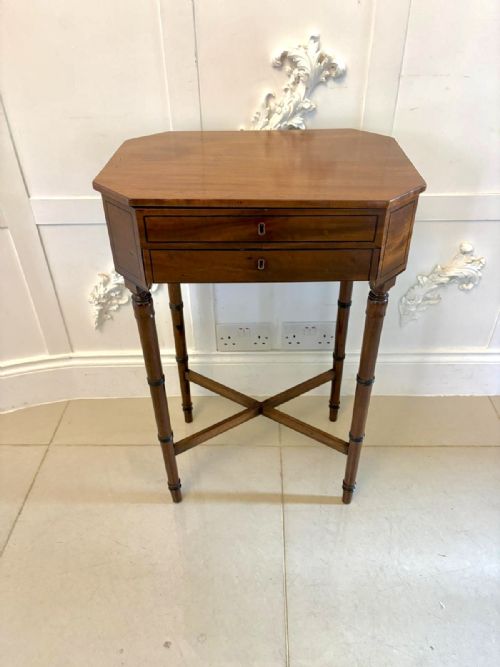


Brown Mahogany Worktable
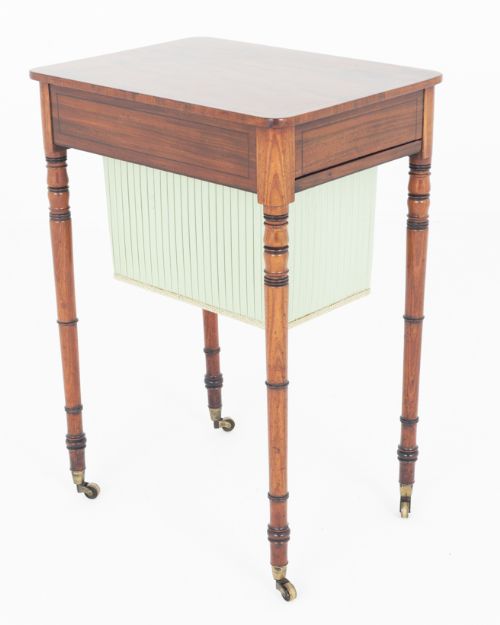
A brown mahogany worktable is a versatile piece of refined furniture designed for sewing and needlework, offering subtle storage alongside a stable writing surface.
Brown Mahogany Worktable
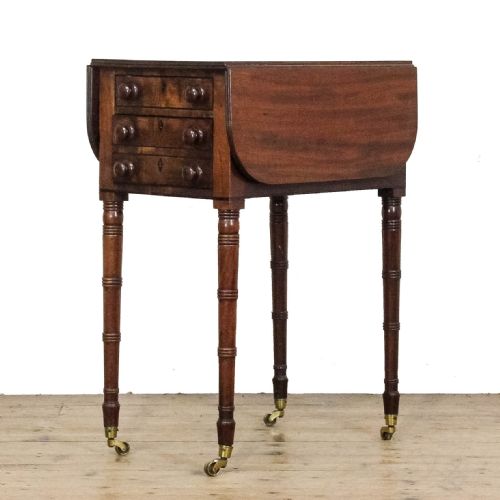
A brown mahogany worktable combines practical storage with domestic elegance, appearing frequently across Regency, Georgian, and Victorian periods. Buyers exploring this category encounter sewing tables, drop leaf pembroke variants, and occasional tables fitted with internal compartments.
The pieces emerge from the nineteenth century in various forms, including pedestal designs, vanity tables, and lamp stands. Makers of the Regency and Georgian eras often incorporated fitted interiors specifically for sewing implements.
Later Victorian and Edwardian examples maintain the functional lineage while introducing cross banding, satinwood, and boxwood inlay. The fundamental domestic purpose remains consistent across these stylistic transitions.
Materials and construction
Solid mahogany and flame mahogany veneer provide the primary structural surfaces, often accented with boxwood and satinwood inlay. Timber selection emphasises rich grain patterns across drop leaves and table tops.
Brass fittings, fabric linings, and silk components furnish the internal compartments and removable sewing baskets. Joinery techniques secure drop leaf mechanisms and pedestal bases designed for daily domestic use.
Many sewing tables retain their original removable fabric baskets, ready to catch dropped threads after two centuries.
Craftsmanship and proportion
Quality rests in the precision of the timber veneer matching and the subtlety of boxwood inlay. Finer examples display meticulous attention to the internal arrangement of the sewing compartments and the integrity of the pedestal or leg joints.
Proportion and stability separate standard utility pieces from exceptional workshop output. The crispness of carved details and the preservation of original brass hardware indicate higher standards of period manufacture.
Gillows
The Brown Mahogany Worktable Glossary
- Pembroke table
- A small occasional table featuring two hinged drop leaves on opposing sides. It often includes one or more drawers for storage.
- Flame mahogany
- A veneer cut from the fork of the mahogany tree to produce a dramatic, flame-like grain pattern. It was widely utilised on prominent surfaces during the nineteenth century.
- Cross banding
- A decorative border of veneer laid around the perimeter of a table top with the grain running perpendicular to the centre. This technique frames the primary timber.
- Pedestal table
- A table supported by a central column resting on a footed base rather than four corner legs. It allows greater clearance underneath.
- Boxwood inlay
- Narrow strips of pale boxwood inserted into grooves cut into darker mahogany to form geometric lines or motifs. It provides visual contrast.
Brown Mahogany Worktable: Frequently Asked Questions
What is a brown mahogany worktable?
A brown mahogany worktable is a compact nineteenth-century piece designed for needlework, sewing, and small writing tasks. It typically incorporates a drawer or a hanging fabric bag beneath the top.
These tables bridge the gap between utility and parlour furniture, offering discrete storage for domestic tasks while maintaining an elegant appearance suitable for a drawing room.
How were worktables used originally?
In Georgian and Victorian households, these tables served ladies engaged in sewing, embroidery, and correspondence. The fitted compartments kept threads, needles, and papers organised.
Over time, many adapted to function as lamp stands or occasional tables beside seating areas, absorbing multiple small domestic duties within the home.
How do I style a worktable today?
A worktable fits easily beside a sofa or armchair as an occasional surface, or functions as a compact writing desk in a bedroom. The enclosed storage keeps clutter out of sight.
Allowing the timber grain to show clearly without heavy ornamentation lets the piece complement both traditional and contemporary room schemes.
How can I tell the period?
Regency and Georgian examples often display cleaner structural lines and restrained brass mounts, while Victorian pieces can be heavier and incorporate fabric bags or elaborate pedestals. Edwardian models frequently feature lighter inlaid decoration.
Examining the secondary timbers inside the drawers and the construction of the drop leaf hinges provides further clues to the decade of manufacture.