


Brown Mahogany Piano Stool
These brown mahogany piano stool pieces offer solid timber construction and period character, providing adjustable seating or duet space for historic instruments.
Brown Mahogany Piano Stool
A brown mahogany piano stool brings timber warmth and practical seating to domestic spaces, drawing from 19th Century, Regency, Victorian, and Edwardian periods. Pieces range from single rotating seats to wider duet stools designed for shared seating during musical performance.
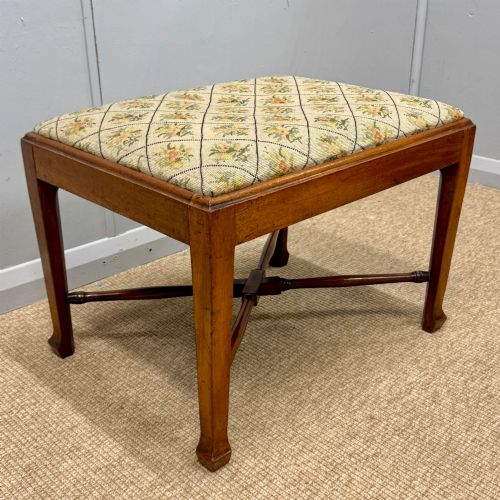
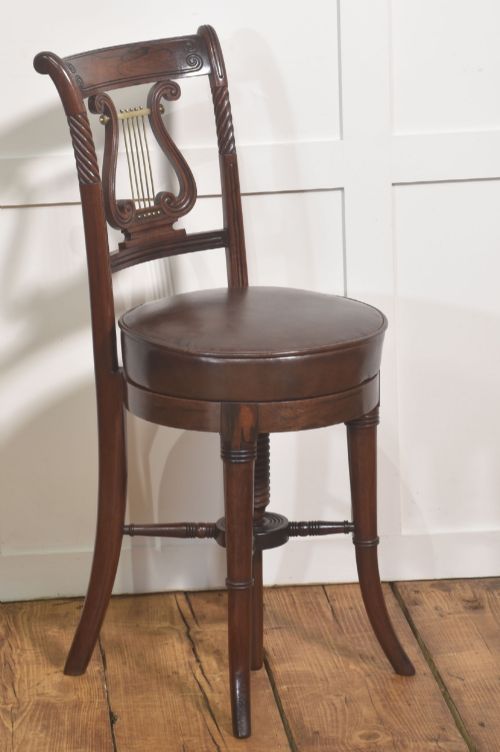
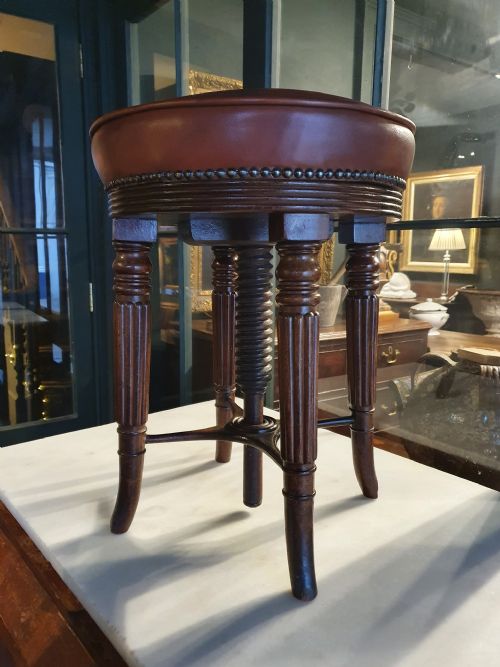
Most examples on this page date from the Victorian and Edwardian eras, alongside earlier Regency or George III interpretations and later 1930s variants. Forms include revolving music chairs, dressing table stools, window seats, and tall circular stools with cross stretchers.
Makers and workshops of the past constructed these forms in solid mahogany, frequently incorporating upholstered pads in leather, velvet, tapestry, or original fabric. Buyers find both simple turned legs and inlaid surfaces reflecting Georgian Revival and Edwardian Sheraton Revival styles.
What varies in quality
The sophistication of the turning, carving, and timber selection dictates the distinction between standard production and superior workshop output. Finer examples display crisply executed brass inlay, balanced proportions, and robust mechanical adjustment screws that operate smoothly.
The retention of original upholstery fabric, leather, or tapestry influences authenticity and historical integrity. Pieces retaining original textiles or stamped maker details demonstrate greater preservation than those altered by later recovering.
Listings feature mahogany timber across Victorian, Edwardian, and Regency periods, combined with fabric, leather, velvet, and brass inlay.
James Shoolbred
The Brown Mahogany Piano Stool Glossary
- Duet stool
- A wide seating bench designed to accommodate two pianists side by side during piano practice or performance. These longer formats often feature hinged lids hiding music storage compartments beneath.
- Revolving stool
- A seat featuring a central screw mechanism that allows the top to rotate and adjust in height. This mechanism enabled musicians to find a comfortable playing posture.
- Cross stretcher
- Wooden rails connecting the lower legs of a stool to provide structural stability and rigidity. They often intersect in an X-shape beneath the centre of the seat.
- Cabriole leg
- A furniture leg that curves outward in a convex arc and then tapers inward in a concave arc, ending in a pad or foot. This stylistic element appears frequently on Victorian pieces.
- Sheraton Revival
- A late 19th and early 20th century design movement drawing inspiration from the lighter furniture styles of the late 18th century. It frequently incorporates delicate mahogany inlay and refined proportions.
Brown Mahogany Piano Stool: Frequently Asked Questions
How do I adjust the height on an antique piano stool?
Many period stools feature a revolving top that winds up or down on a central wooden or metal screw thread. Turning the seat clockwise or counter-clockwise alters the height to suit the player.
Other variants use side handles or internal ratchets. Care should be taken not to force vintage mechanisms beyond their natural stopping points.
What is the difference between a solo and duet stool?
Solo stools are compact square or circular seats intended for one person. Duet stools are elongated rectangular benches built to seat two musicians simultaneously.
Duet versions frequently incorporate lift-up lids for sheet music storage, whereas solo revolving variants focus on adjustable seating height.
Can I use a piano stool as a dressing table chair?
These compact wooden stools fit well beneath dressing tables or desks due to their modest proportions. Adjustable revolving models offer practical height flexibility for grooming or writing.
Their timber frames and upholstered pads coordinate easily with traditional bedroom furniture.
How do I identify a Victorian piano stool from an Edwardian one?
Victorian examples often feature heavier proportions, darker polished mahogany, and cabriole or turned legs with deep upholstery. They frequently utilise revolving screw mechanisms for height adjustment.
Edwardian pieces tend to display lighter framing, occasional satinwood or line inlay inspired by Sheraton revivals, and simpler tapering legs.