
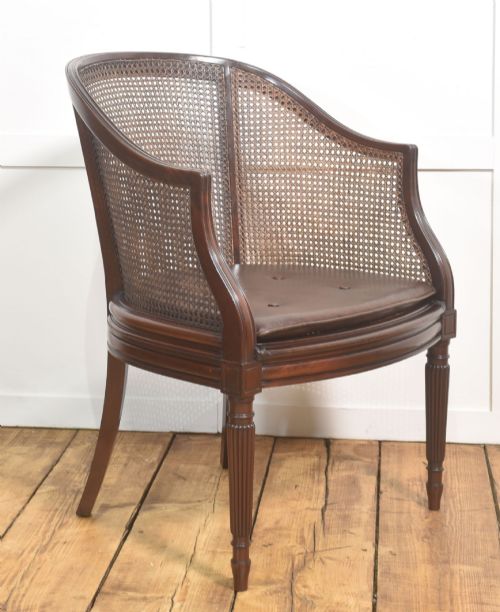


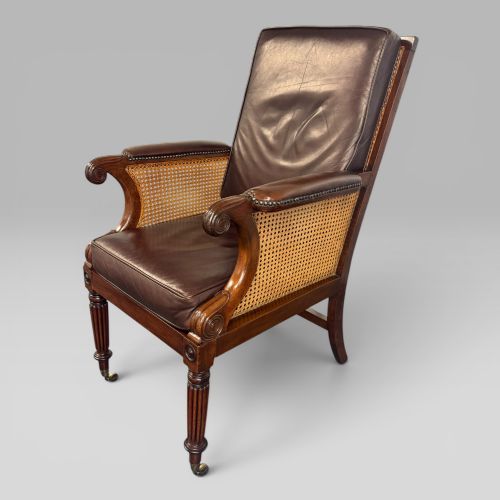
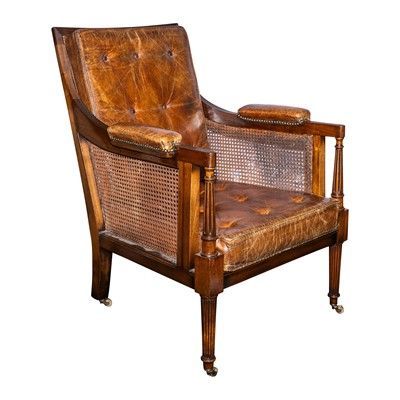


Brown Leather Bergere Chair
A brown leather bergere chair combines deep-seated comfort with woven cane and rich timber frames, offering a sturdy yet graceful seat for the library or study.
Brown Leather Bergere Chair
A brown leather bergere chair brings traditional library seating into the room, combining supportive timber frames with open cane work and upholstered cushions. When you search for a brown leather bergere chair, you are looking at substantial armchairs designed for reading and writing, often featuring low seats and swept arms.
The versions most commonly met on this page span the nineteenth century through the early twentieth century, drawing on Regency, William IV, Edwardian, and French provincial styles. Makers constructed these library chairs using solid timbers like mahogany and oak, pairing wooden frames with woven cane panels and fitted leather seat pads.
How they were made
Cabinet makers built the structural frames using dense hardwoods such as mahogany and oak, often shaping the timber with carved details or brass inlays. Many examples incorporate traditional joinery alongside steam-bent components to form the characteristic rounded back and arm rests.
The distinctive caning was woven tightly by hand through drilled holes along the frame to create a flexible, supportive backing. Workshops then added fitted leather cushions, sometimes finished with buttoning and brass tack details, to complete the seating surface.
Listings feature mahogany, oak, hardwood, and brass combined with cane and leather across nineteenth and twentieth century periods.
What varies in quality
The refinement of the timber carving and the precision of the joinery set the finer pieces apart from standard workshop production. Regency and William IV examples often display more sophisticated turning on the legs and crisper moulding along the arm rails.
The tightness and regularity of the hand-woven cane panels indicate the skill level of the original maker. Additionally, the quality of the leather and the depth of its grain contribute significantly to the overall presence of the chair.
Gillows
The Brown Leather Bergere Chair Glossary
- Bergere
- An enclosed upholstered armchair with wooden or caned sides, originating in France. These chairs typically feature a low seat and an integrated back and armrest structure.
- Caning
- The craft of weaving plant material through frame holes to create a light, supportive mesh. This technique appears on the back and side panels of library armchairs.
- Regency
- A British design period spanning the early nineteenth century, characterised by classical restraint and neoclassical motifs. Furniture from this era often utilises dark mahogany and brass accents.
- William IV
- A British furniture style from the 1830s featuring heavier proportions and robust carved details. Pieces from this period lean towards substantial library seating.
- Inlay
- A decorative technique where contrasting materials are set flush into the wooden surface. Makers used this method to outline panels and highlight structural lines on mahogany frames.
Brown Leather Bergere Chair: Frequently Asked Questions
What is a bergere chair?
A bergere chair is a traditional upholstered armchair featuring enclosed sides and a low seat. These seats were designed for comfortable lounging in libraries and drawing rooms.
Unlike standard armchairs, they incorporate woven cane panels along the back and frame to keep the substantial wooden structure visually light.
How do I identify a Regency chair?
Regency chairs date from the early nineteenth century and typically display clean classical lines inspired by ancient Greece and Rome. Makers relied heavily on dark mahogany and subtle brass details.
Look for refined turned legs and restrained carving rather than heavy ornamentation.
Where should I place this chair?
These armchairs suit studies, libraries, and living rooms where their classic timber frames and leather pads can anchor the space. Their low profile makes them ideal for placing beside a fireplace or a reading table.
Ensure the room has stable humidity to protect the vintage leather and organic cane materials.
How do I care for the leather?
Vintage leather requires gentle cleaning with a damp cloth and occasional treatment with appropriate conditioning balms to maintain flexibility. Avoid placing the chair in direct sunlight to prevent the hide from drying out.
Regular light dusting keeps the leather surface and the cane weave free from debris.