






Brown Earthy Landscape Canvas
A brown earthy landscape canvas brings the quiet tones of fields, rivers and farmyards straight onto your wall.
Brown Earthy Landscape Canvas
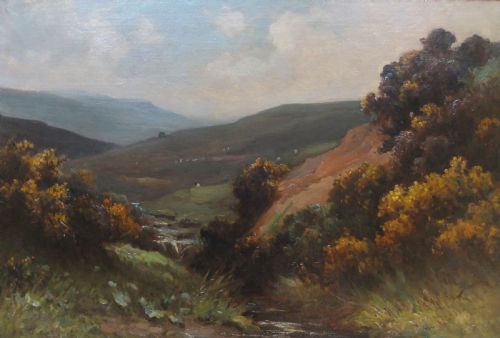
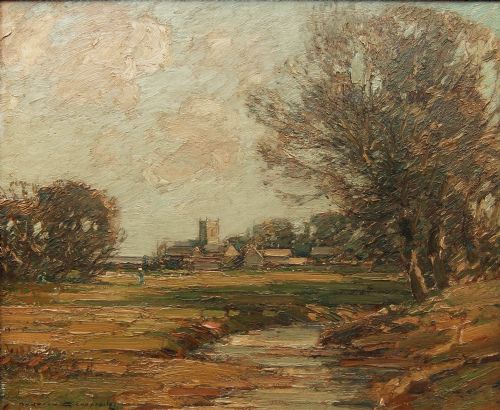
A brown earthy landscape canvas captures rural scenes, pastoral river views and farmyards through traditional oil painting. When you search for a brown earthy landscape canvas, you encounter works spanning the nineteenth century through the mid-twentieth century, encompassing British Impressionism, the Barbizon School and French Provincial styles.
The subjects on this page typically feature working horses, cattle in woodland, moorland streams, village views and agricultural daily life. These canvases document rural topography and agrarian routines with subdued palettes dominated by natural earth tones.
Most pieces date from the Victorian era up to the 1950s, representing academic, impressionist and naive approaches to countryside scenery. The selection balances established regional painters with atmospheric depictions of domestic and European rural life.
Materials and construction
These works rely primarily on oil paint applied to woven canvas stretched over wooden frames, occasionally utilising board supports. Artists built up textures using brushwork and impasto to render the substance of soil, foliage and animal coats.
The underlying support materials dictate the physical structure, with traditional wooden stretchers holding the canvas taut behind the painted surface. Framed examples often retain period wooden mouldings that complement the deep pigments of the composition.
The listings on this page span the nineteenth century, Victorian era, and decades up to the 1950s using canvas, board and oil paint.
Factors of distinction
Quality rests in the handling of light and the fidelity of the composition, where confident brushwork brings movement to water, livestock and foliage. Masterful tonal control separates ordinary decorative scenes from works with genuine atmospheric depth.
The strength of the provenance and the clarity of the artist's hand elevate certain pieces above anonymous works. Structural preservation of the canvas and the integrity of the paint layer also define the standing of each painting.
William H Myers·Raimond Louis Lecourt·Herbert Royle·John Frederick Herring·Robert Finley McIntyre·William Traies·Ernest Higgins Rigg·Frederick William Jackson·Kershaw Schofield·William Greaves·Owen Bowen·Maurice Wagermans·Benjamin Williams Leader·Edward J Cobbett·Edward John Niemann·Frederick Underhill·Thomas Creswick·Maurice Sijs·James William Booth
The Brown Earthy Landscape Canvas Glossary
- Canvas
- A heavy woven fabric stretched across a wooden frame to serve as a support for oil painting. It provides the flexible base upon which the artist applies priming and pigment.
- Impasto
- Paint applied thickly to a canvas so that it stands out from the surface. This technique allows brush or palette knife marks to retain their three-dimensional texture.
- Stretcher
- The wooden frame that holds a canvas tight under tension. Inscribed notes and signatures often appear on this wooden structure.
- Barbizon School
- A nineteenth-century movement focused on tonal realism and direct observation of nature. Painters within this circle favoured earthy palettes and open-air pastoral subjects.
- Provenance
- The documented history of ownership surrounding an artwork. It establishes authenticity and traces the journey of the piece through time.
Brown Earthy Landscape Canvas: Frequently Asked Questions
What periods do these paintings cover?
The works span from the nineteenth century through the early twentieth century, including Victorian, Edwardian and 1950s examples.
They reflect shifts in European and British landscape painting traditions over more than a century.
How should I hang an oil canvas?
Hang the canvas away from direct sunlight and damp walls to protect both the wooden stretcher and the oil pigments.
Ensure the wall fixings match the weight of the frame and the mounted artwork safely.
Are these works signed by the artists?
Many of the listed canvases bear signatures, inscriptions or stretcher notes identifying the creator and location.
Others represent naive or anonymous school traditions without explicit attribution.
What subjects appear most frequently?
Common subjects include agricultural farmyards, working horses, rivers, moorland streams and rural village scenes.
Animals and human figures often animate the foregrounds of these pastoral compositions.