


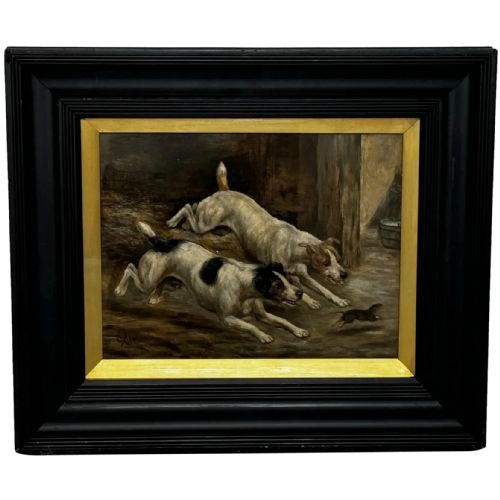


Brown Barn Oil Painting
These brown barn oil painting works capture rural life on canvas, offering a direct view into historical farming scenes.
Brown Barn Oil Painting
A brown barn oil painting presents rural and agricultural subjects, focusing on farmyards, stables, and livestock shelters executed in traditional mediums. These works span from the eighteenth century through the early twentieth century, showing pastoral life across Britain.
The most common examples on this page date from the Victorian era and the early twentieth century. They typically portray animals, farm workers, and rustic architecture rendered in realistic or impressionistic styles.
Makers in this category include named artists such as Julius Caesar Ibbetson, Thomas Sidney Cooper, and George Armfield. Their works capture the texture of rural buildings and the daily routines of the countryside.
Assessing quality
Quality rests upon the skill of the brushwork and the accuracy of animal and architectural depiction. Stronger pieces display confident handling of light within dark stable interiors and farmyards.
The presence of a clear signature or attribution to a recorded artist elevates a work. The integrity of the original canvas and frame also influences the standing of each piece.
Listings feature canvases spanning from the eighteenth century to 1920, utilising traditional oil paint and giltwood frames.
Julius Caesar Ibbetson·Thomas Sidney Cooper·John Percy Cooke·George Armfield·Ernest Higgins Rigg·Herbert Royle·Nora Munro Summers·Owen Bowen·Anthonij Anton Mauve·Frank Moss Bennett·Edward Armfield·Louis Marie Dominique Robbe·William Shayer Snr·James Kyd·Percival Glenfern
The Brown Barn Oil Painting Glossary
- Canvas
- A heavy woven fabric used as a surface for oil painting. It is typically stretched tightly across a wooden frame before application of the ground layer.
- Giltwood
- Wood carved and covered with a thin layer of gold leaf. This material is standard for traditional picture frames housing nineteenth-century artworks.
- Gesso
- A plaster-like mixture applied to wooden frames as a base before gilding. It provides a smooth surface for gold leaf adherence.
- Oil paint
- A slow-drying paint made by mixing pigments with oils such as linseed. This medium allows artists to achieve rich colour depths and subtle tonal gradations.
Brown Barn Oil Painting: Frequently Asked Questions
What subjects appear in a brown barn oil painting?
These works typically show farmyard scenes, livestock shelters, and stable interiors with horses, sheep, or terrier dogs. Rural workers and agricultural implements also frequently feature.
The focus remains on ordinary rural life and agricultural architecture, captured by artists working across different regions of Britain and Europe.
How should I care for an oil painting on canvas?
Keep the artwork away from direct sunlight and steady humidity levels to protect both the canvas and the wooden frame. Avoid using chemical cleaners on the painted surface.
Dust the frame gently with a dry, soft brush. Professional conservation is recommended for any major structural repairs to the canvas.
How can I tell the period of these paintings?
Stylistic clues such as brushwork, clothing styles of any figures, and the construction of the wooden stretcher frame help indicate the date. Victorian works often show high realism or genre scenes.
Twentieth-century pieces frequently display looser impressionistic techniques. Signatures and stretcher marks often provide further historical context.
Were these paintings created outdoors?
Artists often made preliminary sketches in the field, observing farmyard lighting and animal behaviour directly. The final oil paintings were typically completed inside a studio setting.
This method allowed painters to develop complex compositions of barns and livestock using their drawn studies and memory.