

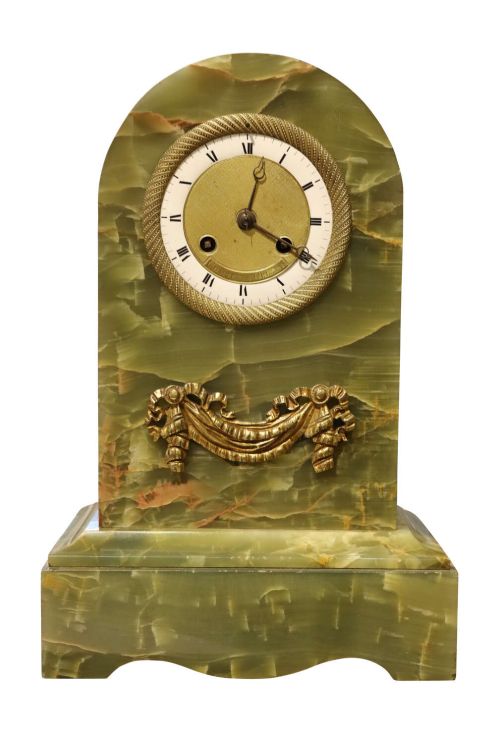


Bronze Mounted Marble Clock
A bronze mounted marble clock brings architectural weight and classical polish to a mantelpiece, combining heavy stone bodies with chased metallic enrichment.
Bronze Mounted Marble Clock
A bronze mounted marble clock combines solid carved stone bodies with cast metal mounts, uniting the cold weight of quarried material with the warmth of gilded or patinated bronze. These decorative timepieces span nineteenth-century French workshops and Victorian production, drawing heavily on classical revival vocabulary and French design traditions.
The marble body frequently appears in rouge, white, green onyx, slate, and alabaster forms, housing mechanical movements behind enamel dials. Many examples are accompanied by matching garnitures such as candelabras or vases, creating a symmetrical decorative scheme for a drawing room or salon.
Makers ranged from notable Parisian horologists to British provincial retailers, utilising styles that extend from Louis XVI revival to French Second Empire and Victorian classical designs. The resulting objects function simultaneously as reliable timekeepers and sculptural centrepieces.
Quality factors
The refinement of the bronze or ormolu chasing largely dictates the distinction between standard production and top-tier workshop output. Crisp, deeply undercut cast mounts with varied surface textures require extensive hand-finishing, unlike softer castings with uniform polish.
The selection and matching of the marble influence the visual presence of the piece, with harmonious veining and solid stone construction marking superior examples. Structural integrity in the heavy stone housing and the presence of original signed movements further separate standard items from exceptional survivals.
Listings feature nineteenth-century French and Victorian pieces utilising rouge marble, white marble, green onyx, slate, and alabaster alongside gilt bronze mounts.
Charles à Orléans·Louis Goret·Auguste Moreau·Achille Brocot·Ferdinand Berthoud·James Ritchie and Son
The Bronze Mounted Marble Clock Glossary
- Ormolu
- Gilded bronze produced by applying a mercury-gold amalgam to a cast bronze base and heating it until the mercury vaporised. This historic technique creates a rich, matte gold surface that resists tarnishing.
- Garniture
- A set of matching decorative objects designed to be displayed together, typically comprising a central clock flanked by two vases, urns, or candelabras. These matched groupings create visual balance on a mantelpiece.
- Lyre clock
- A timepiece shaped like the ancient musical instrument, featuring a symmetrical frame suspended with pendulum components visible through the centre. The design became particularly popular in nineteenth-century French workshops.
- Fusee
- A conical grooved pulley inside a clock movement that equalises the diminishing pull of the mainspring as it unwinds. This mechanical device improves timekeeping accuracy across the duration of the wind.
- Spelter
- A zinc alloy frequently used as a cost-effective substitute for bronze in decorative figures and mounts. It takes patination and gilding well, though it is softer and lighter than genuine bronze.
Bronze Mounted Marble Clock: Frequently Asked Questions
What is a bronze mounted marble clock?
These decorative timepieces consist of a heavy stone housing made from marble, onyx, or slate, decorated with cast bronze, ormolu, or brass mounts. They were produced primarily during the nineteenth century in various classical revival styles.
The mechanical movements are typically driven by springs or weights, housed behind enamel dials with Roman or Arabic numerals, and often accompanied by matching garniture sets.
How do I care for a marble clock?
Keep the heavy stone body clean by dusting gently with a soft dry cloth, avoiding abrasive cleaners or excess water that can damage porous marble surfaces. Metal mounts should also be treated with care to preserve their original patination or gilding.
Mechanical movements require professional servicing every few years to ensure the gears and escapements remain lubricated and accurate.
How are different periods identified?
Stylistic clues such as the severity of the architectural lines, the presence of specific revival motifs like Egyptian or Louis XVI details, and maker signatures on the movement backplates help establish dates. The choice of stone and the casting technique of the bronze mounts also point toward specific decades.
Nineteenth-century Victorian interpretations often display heavier proportions and distinct regional British adaptations compared to French salon pieces.
What is a clock garniture?
A clock garniture is a matched suite of decorative objects designed to sit together on a mantelpiece, consisting of a central clock flanked by a pair of candelabras, urns, or vases. These sets share identical stone materials and bronze mount styles to create a cohesive display.
They were popular in wealthy nineteenth-century interiors to anchor the visual weight of a fireplace.