


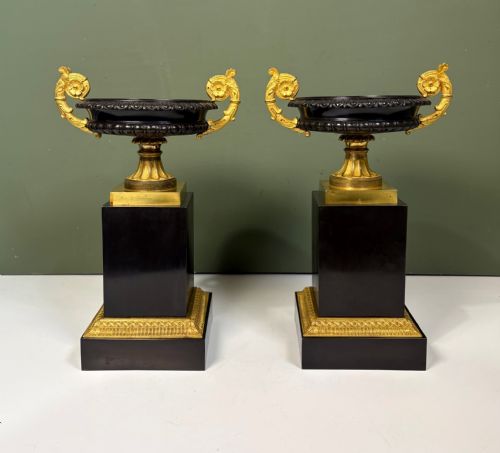


Bronze Centerpiece Urn
A bronze centerpiece urn anchors a dining table or sideboard with classical authority, bringing heavy metal, polished stone and decorative presence together.
Bronze Centerpiece Urn
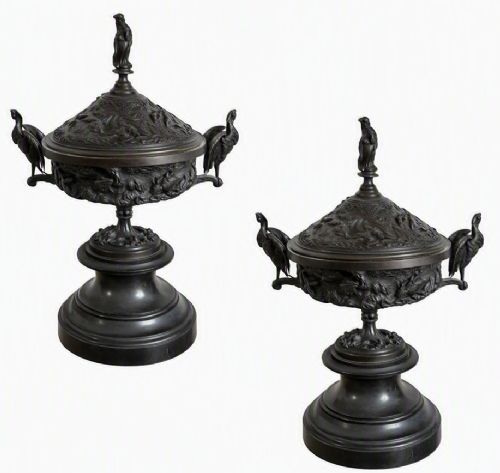
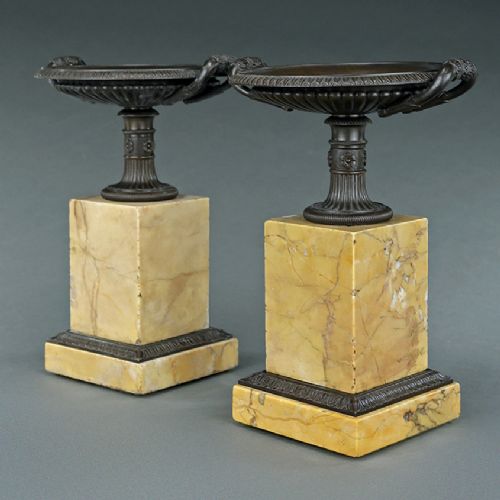
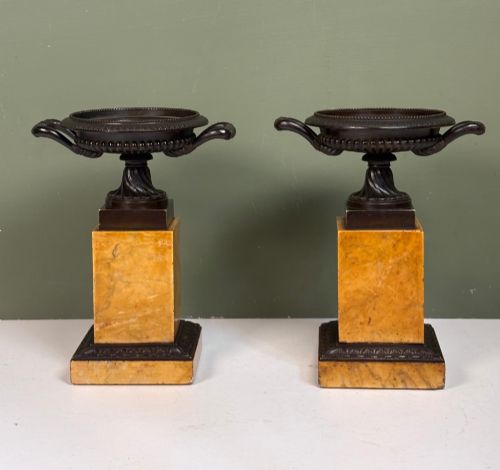
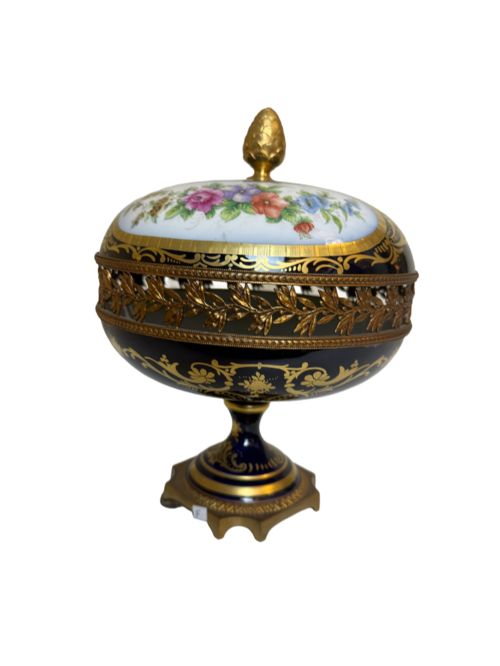
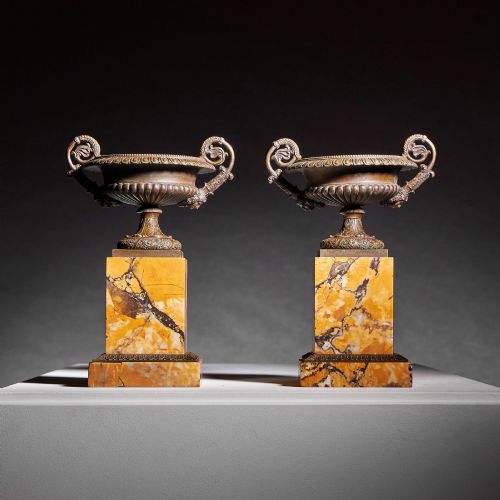
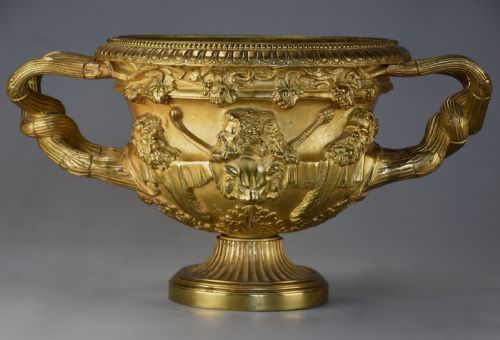
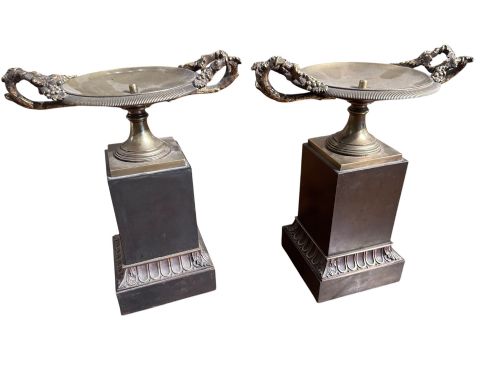
A bronze centerpiece urn covers a broad category of decorative vessels, tazzas, compotes and footed bowls designed to sit in the middle of a room or table. Most examples seen here originate from nineteenth-century France, Italy and Britain, drawing heavily on classical antiquity and the Grand Tour tradition.
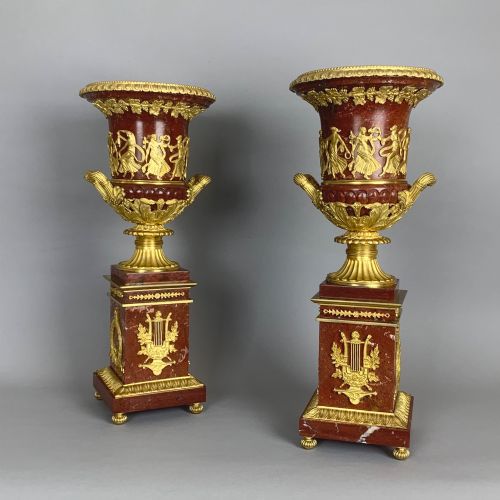
The objects take several distinct shapes, ranging from lidded campana urns and shallow tazzas to twin-handled vessels and garniture components. Buyers frequently encounter French Empire and Regency interpretations alongside Italian souvenirs cast after ancient models.
Materials combine frequently, pairing cast bronze with white or rouge marble bases, porcelain bowls, and gilt or ormolu mounts. These pieces function primarily as decorative focal points rather than utilitarian vessels.
Materials and Technique
Casting forms the structural core of these objects, utilising both bronze and patinated or silvered variations to achieve dark or reflective surfaces. Founders then employed fire-gilding or applied ormolu mounts to create high-contrast highlights against the dark metal.
Stone elements such as marble, green onyx and alabaster were turned on lathes and polished to form solid bases and columns that support the heavier metal vessels above. Porcelain components, including Limoges and Sevres style bodies, were hand-painted and sometimes combined with champlevé enamel work.
Assembly relied on threaded rods and pins to secure metal mounts, stone plinths and porcelain bowls together into a stable, multi-part composition.
Some nineteenth-century French sculptors cast bronze storks directly onto soup bowls, naming the result a coupe aux cigognes.
Craftsmanship and Proportion
The refinement of the casting and chassering separates superior examples from ordinary production, visible in the crispness of leaf tips, figurative details and drapery folds. Lesser pieces often display soft, smoothed details where the chasing tool has barely touched the cooled metal after removal from the sand mould.
Proportion and weight dictate the presence of the piece, with better objects utilising dense marbles and heavy bronze walls that anchor the composition firmly to the surface. Mediocre items rely on thin gauge metals and hollow bases that lack the substantial heft expected of period metalwork.
The integration of mixed materials reveals the maker's skill, particularly where ormolu mounts fit flush against curved porcelain surfaces or stone plinths without visible gaps or excessive pinning.
Jules Moigniez·Lerolle Fres·Henry Dasson
The Bronze Centerpiece Urn Glossary
- Ormolu
- Gilded bronze produced by applying a mercury and gold amalgam to a bronze base and heating it until the mercury vaporised. This historic technique leaves a distinctive, matte golden surface that differs sharply from modern electroplating.
- Tazza
- A shallow bowl or cup mounted on a stem and foot, originating in ancient pottery and metalwork. Nineteenth-century examples often served as ornamental centrepieces or fruit dishes.
- Grand Tour
- A cultural journey undertaken by wealthy young Europeans through France and Italy to study classical antiquities. Souvenirs purchased on these trips included bronze reductions of famous sculptures and ancient vessels.
- Champlevé
- An enamelling technique where troughs or cells are hollowed out of the metal surface and filled with vitreous enamel before firing. The surrounding metal walls remain visible to form a patterned outline.
- Garniture
- A set of three or more matching decorative objects, typically comprising a central urn or vase flanked by matching smaller urns or candlesticks. They were designed to decorate mantelpieces and sideboards in formal rooms.
Bronze Centerpiece Urn: Frequently Asked Questions
What is a tazza?
A tazza is a shallow decorative vessel raised on a central stem and a circular foot. It functions primarily as a table centrepiece or a display dish.
Historically inspired by classical Roman and Greek tableware, nineteenth-century versions were cast in bronze and mounted on marble or onyx bases for visual impact.
How do I clean bronze and ormolu?
Cleaning requires only a soft, dry microfibre cloth to remove dust and airborne particles. Avoid water, modern metal polishes and chemical cleaners entirely.
Stronger agents will strip away the historic patination and damage the delicate mercury-gilt surfaces of ormolu mounts.
What is a Grand Tour souvenir?
A Grand Tour souvenir is a period copy of a famous ancient monument, sculpture or architectural element purchased by travellers in Italy during the nineteenth century. These objects include miniature bronze urns, tazzas and reduced copies of antique vases.
They were produced by Italian workshops specifically for foreign visitors seeking academic and artistic mementos of their travels.
Where should I place a centerpiece urn?
These urns suit large dining tables, entrance hall consoles and heavy wooden sideboards where their weight and height balance the surrounding room. They require a sturdy surface capable of supporting dense combinations of bronze and stone.
Keep them away from direct sunlight and moisture to protect vulnerable stone bases and enamel details.