

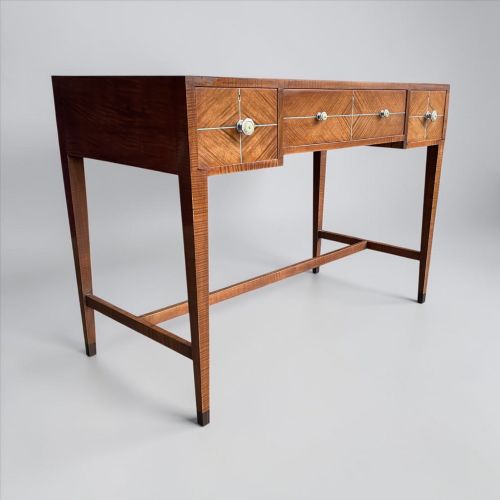
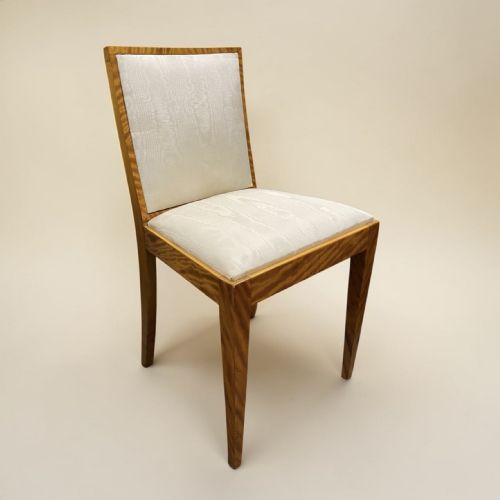


British Art Deco Cabinet
A british art deco cabinet brings distinct geometric lines and rich veneers into a room, offering both practical storage and striking modernist design.
British Art Deco Cabinet
A british art deco cabinet encompasses diverse forms designed during the interwar years, spanning cocktail units, bookcases, sideboards, and tallboys. These pieces reflect the modernist shift of the 1920s and 1930s, prioritizing clean architectural silhouettes over Victorian ornamentation.
The versions most commonly met on this page originate from the 1930 period, featuring stepped profiles and functional compartmentalisation. Buyers encounter specialised variants like bedside tables, wardrobe units, and sideboards alongside traditional bookcase formats.
Makers utilise specific architectural gestures such as stepped cornices and tiered shelving to define the aesthetic. The objects serve dual roles as decorative focal points and functional storage solutions within contemporary interiors.
Materials and Construction
Cabinet makers constructed carcasses using sturdy foundational timbers before applying decorative surfaces. Wood veneer remains the primary facing material, showcasing intricate grain patterns across large flat doors and drawer fronts.
Workshops utilised walnut, burr walnut, and oak to achieve contrasting visual textures and warm natural tones. Details in brass provide metallic accents, while occasional elements incorporate glass panels and durable bakelite fittings.
British Art Deco Cabinet Retail Price Guide 2026
Typical asking prices for british art deco cabinet among the pieces listed under this phrase on Sellingantiques today, from the lower quarter to the upper quarter. They describe what is for sale here now, not the wider market.
Listings feature items utilising walnut, burr walnut, oak, glass, brass, and bakelite across the 1920 and 1930 periods.
Evaluating Quality
The distinction between standard commercial output and superior craftsmanship rests on the selection and matching of wood veneers. Master workshops aligned grain patterns symmetrically across doors and drawers to create cohesive geometric compositions.
Internal joinery and the integration of specialised hardware, such as brass hinges and handles, separate basic production from exceptional studio pieces. The precision of stepped architectural transitions dictates the overall visual success of the construction.
Bath Cabinet Makers·Betty Joel·Heals of London·Harry and Lou Epstein·Hamptons of Pall Mall London·Bowman Brothers·Hille
The British Art Deco Cabinet Glossary
- Stepped
- An architectural profile featuring sequential receding levels. It defines the characteristic tiered silhouettes seen in modernist furniture design.
- Limed oak
- A timber treatment that leaves a whitish finish in the open grain of oak. This process lightened the wood tone for contemporary interwar interiors.
- Tallboy
- A vertical storage unit combining a chest of drawers with an upper cupboard section. It maximises vertical capacity within compact footprints.
British Art Deco Cabinet: Frequently Asked Questions
What defines a british art deco cabinet?
These pieces are characterised by geometric forms, stepped outlines, and prominent wood veneers dating primarily from the 1920 and 1930 periods.
They combine utilitarian storage with the distinct aesthetic of the modernist movement in Britain.
How do I use a cocktail cabinet?
Cocktail cabinets typically feature drop-down preparation surfaces, mirrored interiors, and dedicated storage for glassware and bottles.
They function as social focal points in living rooms and dining spaces.
What is limed oak?
Limed oak is a wood finishing technique that deposits a white pigment into the open pores of the timber.
This treatment creates a pale, muted surface popular in British interwar furniture.
How do I identify a Betty Joel piece?
Betty Joel pieces often exhibit clean modernist lines, refined proportions, and expert use of native and exotic veneers.
Her London workshops produced functional furniture favored by progressive clients.