


Bright Cut Tea Spoons
Bright cut tea spoons are small silver utensils defined by faceted engraving, offering a refined touch to the ritual of afternoon tea.
Bright Cut Tea Spoons
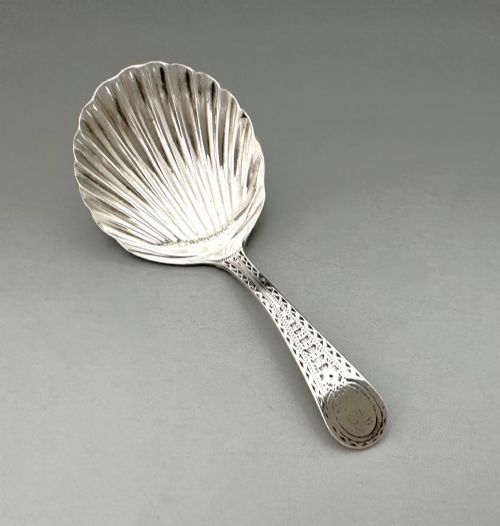
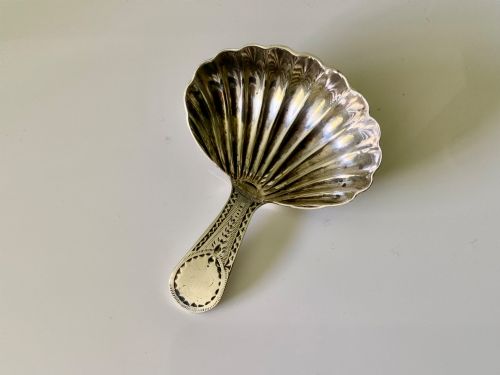
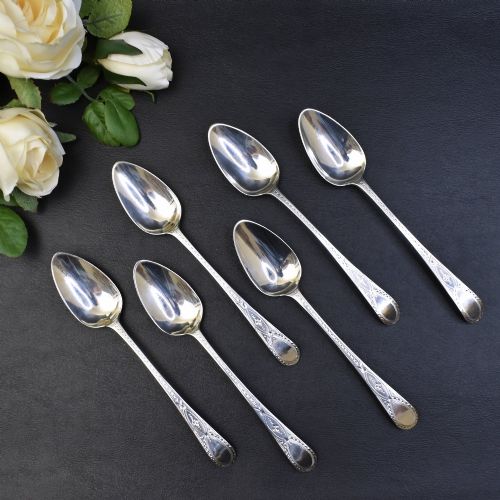
Bright cut tea spoons are small silver implements encountered primarily in Georgian and Victorian forms. When collectors search for bright cut tea spoons, they find individual caddy spoons alongside matched sets of teaspoons.
The objects span the eighteenth century and the nineteenth century, including specific years from the late Georgian period and early Victorian eras. Most examples originate from London, while regional provincial pieces also appear.
Caddy spoons and teaspoons dominate the selection, often grouped in sets of six or offered individually as tea collectables.
How they were made
The makers formed these pieces from sterling silver, shaping bowls and handles before applying the distinct decorative technique. Engravers used faceted cuts to catch the light, creating geometric patterns and borders directly onto the metal surface.
Makers shaped specific forms including shell bowls for caddy spoons and slender stems for teaspoons. Hallmarks were stamped directly into the silver to record the assay office, date letter, and maker's mark.
Some caddy spoons feature handles shaped like delicate shells, designed to mimic the natural curiosities collected in the eighteenth century.
What varies in quality
Quality rests upon the crispness of the engraved facets and the preservation of the original silver surface. Crisp geometric lines indicate a skilled hand, whereas worn engraving signals heavy use or over-polishing.
The integrity of the maker's mark and hallmarks contributes to the standing of a piece. Complete sets of matched teaspoons demonstrate a higher level of original commissioning than assembled groups.
Hester Bateman·P A W Bateman·George Unite
The Bright Cut Tea Spoons Glossary
- Bright-cut engraving
- A surface decoration technique using faceted cuts made with a graver to reflect light from various angles. This method creates geometric borders and patterned stems on silver items.
- Caddy spoon
- A short-handled spoon specifically designed for measuring loose tea leaves from a caddy into a pot. These spoons often feature wide, shell-shaped bowls.
- Sterling silver
- An alloy consisting of silver and other metals, traditionally copper, standard for British silverware. Items made to this standard carry specific hallmarks.
- Hallmark
- A stamp or series of marks applied to precious metals indicating the standard of purity, the assay office, and the date of manufacture. These marks help identify the origin of the silverware.
- Assay office
- An official body that tested and marked the purity of precious metals. London and Newcastle are notable offices recorded on these pieces.
Bright Cut Tea Spoons: Frequently Asked Questions
What is a bright cut tea spoon?
A bright cut tea spoon is a silver utensil decorated with faceted engraving that catches the light. These pieces date predominantly from the Georgian and Victorian eras.
They were produced as individual items or matched sets for domestic tea service.
How were caddy spoons used?
Caddy spoons served to measure loose tea leaves from a storage container, known as a caddy, into the teapot. Their short handles and wide bowls suited them for reaching inside small canisters.
Collectors often group them with teaspoons due to their shared silver materials and decorative styles.
How do I date these silver spoons?
Dating relies upon the stamped hallmarks, which include specific letters corresponding to the year of assay. Additional clues come from the shape of the bowl and the style of the engraving.
Georgian examples often display neoclassical motifs, while Victorian pieces show different stylistic preferences.
Are these spoons made of solid silver?
Yes, the pieces recorded here consist of solid sterling silver rather than plated base metals. They carry standard hallmarking to verify the metal purity and origin.
This material ensured durability during daily domestic use in tea preparation.