
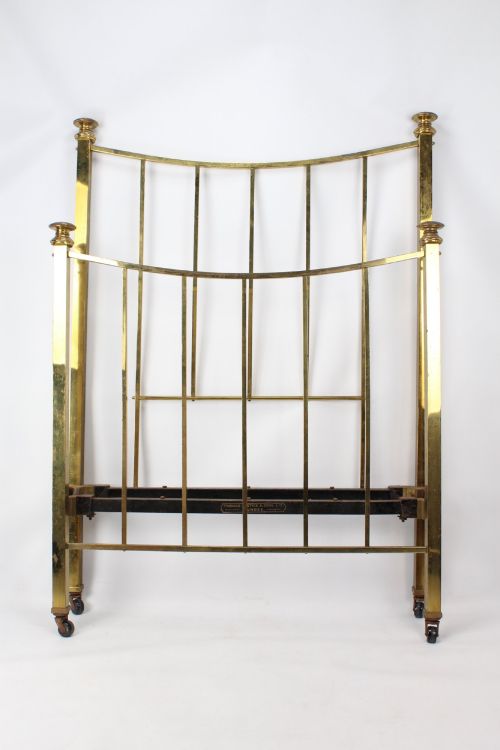
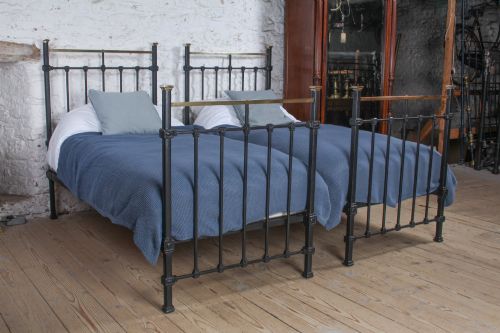
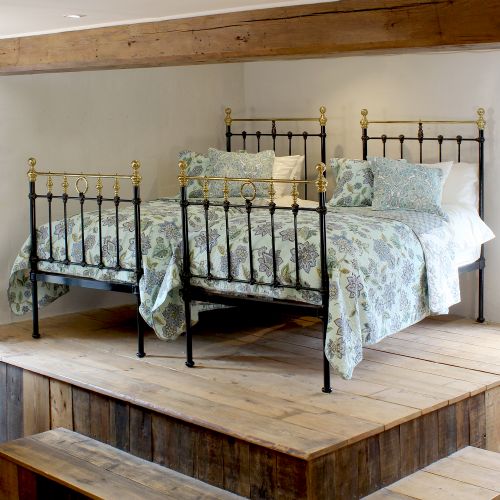
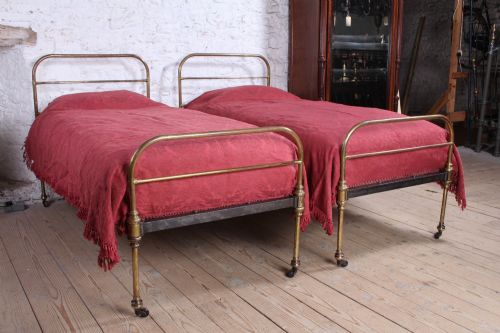
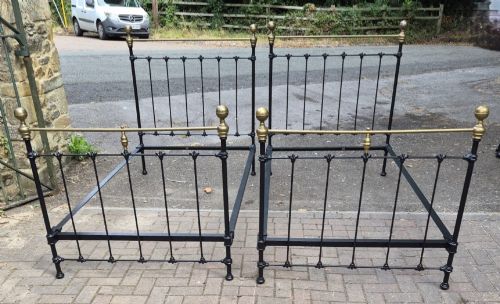
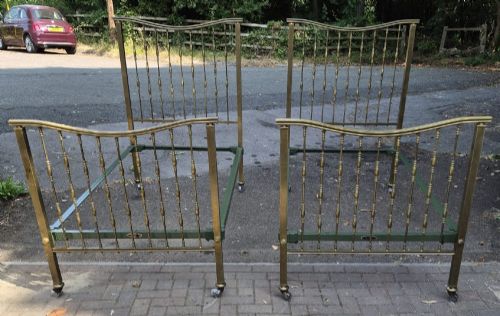


Brass Twin Bed Frame
A brass twin bed frame offers practical sleeping quarters and strong Victorian or Edwardian character for a bedroom.
Brass Twin Bed Frame
A brass twin bed frame brings period metalwork into the bedroom, drawing on single beds, bedsteads, and paired frames from the Victorian and Edwardian eras. These pieces often feature single or twin formats that can be joined together to form a larger sleeping arrangement.
The versions most commonly met on this page span the late nineteenth and early twentieth centuries, including works by makers such as Hoskins & Sewell and R W Winfield. Forms range from all-brass single beds to combinations of brass and iron, white or black cast iron, and wooden elements like walnut.
Buyers encounter styles rooted in Victorian and Edwardian design alongside Portuguese traditional examples. These metal bedsteads serve as functional furniture while displaying distinctive period details like rings and decorative metalwork.
Materials and Construction
Construction relies heavily on brass and iron, utilising cast iron and wrought iron for structural strength alongside polished brass tubing for visual appeal. Some variations incorporate painted finishes on iron and panels of walnut for added texture.
Makers shaped square and round metal tubes into headboards and footboards, often integrating ceramic components as decorative details. Many of these single beds and bedsteads were engineered with joints that allow individual frames to be joined together securely.
Listings feature periods spanning from 1870 through the Victorian and Edwardian eras up to 1910, incorporating brass, iron, ceramic, paint, and walnut.
Evaluating Quality
Quality rests on the integrity of the metal construction and the preservation of original materials like brass, cast iron, and walnut. Frames that retain their original joinery systems and manufacturer stampings demonstrate higher craftsmanship.
The crispness of the brass decoration and the condition of painted or polished surfaces distinguish finer examples. Matched pairs and signed pieces by makers like Hoskins & Sewell or R W Winfield represent a higher standard than unmarked single frames.
Hoskins & Sewell·R W Winfield
The Brass Twin Bed Frame Glossary
- Bedstead
- The framework of a bed, comprising headboard, footboard, and side rails. This structural framework supports the mattress and bedding.
- Cast Iron
- An iron-carbon alloy poured into a mould to create rigid shapes. It provides sturdy support for Victorian and Edwardian bed frames.
- Wrought Iron
- Iron beaten into shape with tools rather than cast. This material offers durability and structural resilience in period bed construction.
- Twin Bed
- A single-size sleeping frame often utilised in pairs. These beds frequently include mechanisms allowing them to be joined together.
Brass Twin Bed Frame: Frequently Asked Questions
Can these twin beds be joined together?
Several listings feature single beds designed to be joined together to form a larger sleeping arrangement. Buyers should check individual descriptions for specific joining mechanisms.
These paired configurations offer flexibility for guest rooms while retaining their original period hardware and dimensions.
What materials are used in these frames?
Construction primarily combines brass and iron, utilising both cast iron and wrought iron for the main framework. Some examples incorporate painted finishes and walnut accents.
Fittings may also include ceramic elements alongside metal tubing to complete the decorative appearance of the bedstead.
How do I identify a Victorian bed?
Victorian frames typically date from the nineteenth century and display distinct period casting techniques, robust ironwork, and polished brass components. Maker attribution stamps often help confirm the date.
These pieces reflect the manufacturing styles popular during the reign of Queen Victoria, ranging from plain utility designs to ornate decorated frames.
What is an Edwardian brass bed?
Edwardian frames date from the early twentieth century, a period following the Victorian era. They often feature lighter proportions and square tube construction.
These beds maintain traditional metalworking methods while introducing cleaner lines suited to twentieth-century domestic interiors.