
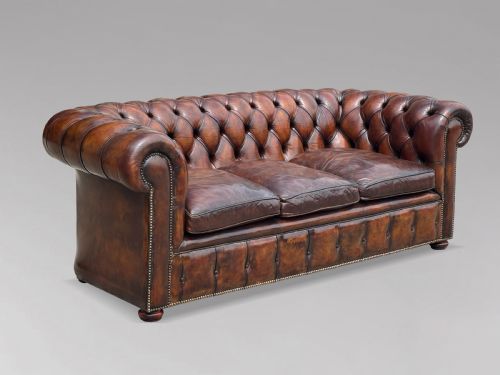


Brass Studded Leather Sofa
A brass studded leather sofa brings warmth and heavy character to a room through deep buttoning and sturdy timber frames.
Brass Studded Leather Sofa
A brass studded leather sofa encompasses traditional chesterfields, drop-arm knoll sofas, and club settees originating from the Victorian, Regency, and Edwardian eras. These seating forms rely on substantial proportions, low backs, and rolled arms designed for domestic comfort and reception rooms.
The variations on this page span multi-seater Chesterfields, two-seat button-backed settees, and matching suites incorporating armchairs. Dark brown, whiskey brown, and red hides dominate the choices alongside occasional interpretations in amethyst leather or velvet.
Stylistic influences stretch from George II revivals to Moroccan seating and Art Deco club furniture, providing distinct regional shapes within the standard leather and metal-trimmed framework.
Construction and materials
The structural carcass relies on hardwood, mahogany, and general timber framing, providing the rigid skeleton necessary to support heavy upholstery. Traditional stuffing materials such as horsehair sit beneath the surface to maintain shape over decades of use.
Hides are stretched across the frame and secured by individual brass studs driven by hand along the seams and borders. Many examples feature deep buttoning and coil sprung interiors that require careful tying to distribute weight evenly.
One unexpected settee arrives upholstered in Alfa Romeo leather, proving that vintage cars and classic seating occasionally share the same hide.
Assessing quality in antique seating
Quality rests upon the depth of the timber frame and the integrity of the internal springing, which determines whether the seat retains its proper support. Hand-dyed leather finishes show subtle variations in tone that develop richer patinas compared to flat, uniform modern treatments.
The precision of the brass studding work and the retention of original stuffing methods, like horsehair filling, separate standard workshop output from exceptional cabinet maker pieces.
Howard & Sons
The Brass Studded Leather Sofa Glossary
- Chesterfield
- A traditional sofa style characterised by arms and back of the same height, typically featuring deep button tufting. It remains a defining form in British seating history.
- Knoll sofa
- A settee featuring adjustable or drop arms that can be lowered on one or both sides via wooden ratchets or metal hinges. This mechanism offers versatility for reclining.
- Moustache back
- A decorative upper wooden or upholstered frame rail shaped with sweeping curves resembling a Victorian moustache. It adds distinct visual flair to gentleman's club seating.
- Deep buttoning
- An upholstery technique where twine is pulled tight through the padding to secure buttons in a diamond pattern. This method creates characteristic folds and secures the internal stuffing.
Brass Studded Leather Sofa: Frequently Asked Questions
What is a chesterfield sofa?
A chesterfield is a traditional seating form where the back and rolled arms share an equal height, traditionally accented with deep button tufting and individual brass studs.
Originating in British domestic interiors, this design offers upright support combined with padded comfort across two, three, or four-seater lengths.
How do I care for antique leather?
Antique leather benefits from regular dusting and occasional applications of suitable leather balms to maintain flexibility in older hides.
Keeping the leather away from direct heat sources and strong sunlight prevents the material from drying and cracking over time.
What is a drop arm sofa?
A drop arm sofa incorporates hinged or ratchet mechanisms on one or both ends, allowing the armrest to fold downwards into a horizontal position.
This functional design lets the user adjust the seating space into a daybed configuration for resting.
How are different periods told apart?
Earlier Regency and George II revival pieces often feature exposed carved wooden frames, lighter proportions, and specific leg turnings.
Victorian and later Edwardian examples tend towards heavier proportions, fully upholstered frames, and coil-sprung interiors paired with horsehair stuffing.