


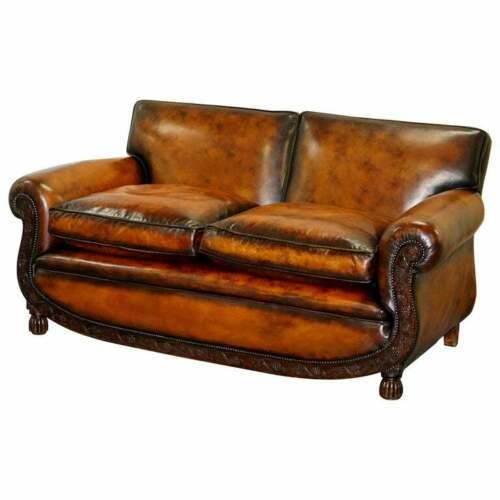


Hand Dyed Leather Sofa
A hand dyed leather sofa brings deep character and rich colour to a room, offering comfort that hardens into timeless elegance.
Hand Dyed Leather Sofa
A hand dyed leather sofa provides a commanding seating option shaped by traditional forms like the Chesterfield and the wing back. These pieces emerge from periods spanning the Victorian era through to the 1930s, reflecting English country house and traditional English aesthetics.
Most examples encountered here are Chesterfield sofas featuring tufted upholstery, deep buttoning, and generous proportions designed for formal and informal spaces alike. Buyers also find variations including serpentine fronts, drop arm designs, and two to four seater configurations.
The materials reflect sturdy construction, utilising hardwood and timber frames paired with traditional stuffing. The combination of period framework and bespoke hand applied dye gives each sofa a distinct presence.
How they were made
Construction relies on solid hardwood and timber frames built to endure generations of daily use. Interior padding traditionally incorporates materials such as horsehair alongside fully loose coil springing to ensure lasting support and resilience.
Leather hides form the exterior surface, often applied in raw states before receiving custom hand applied finishes and colouring. Details like brass tacks and hand carved floral woodwork punctuate the frame and upholstery edges.
Hand Dyed Leather Sofa Retail Price Guide 2026
Typical asking prices for hand dyed leather sofa among the pieces listed under this phrase on Sellingantiques today, from the lower quarter to the upper quarter. They describe what is for sale here now, not the wider market.
The archive includes classic seating forms ranging from standard two-seaters to expansive four-seater drop arm configurations.
What varies in quality
Depth and nuance in the colour application separate standard finishes from superior work, where skilled layering creates natural variations across the hide. The richness of the brown, whisky, green, or amethyst tones depends entirely on the precision of the dyeing process.
Frame integrity and upholstery methods dictate longevity, marked by the quality of the internal coil springs and traditional horsehair stuffing. Superior pieces retain balanced proportions, crisp hand carvings on wooden elements, and robust joinery.
Hampton & Sons of Pall Mall
The Hand Dyed Leather Sofa Glossary
- Chesterfield
- A traditional sofa style characterised by deep button tufting, rolled arms of the same height as the back, and generous upholstery.
- Horsehair
- A traditional animal hair filling utilised in period upholstery to provide firm and resilient internal padding for seats and backs.
- Serpentine front
- A furniture silhouette featuring a distinctive undulating S-curve along the front rail, adding formal movement to the piece.
- Knoll drop arm
- A sofa design incorporating movable sides that can be lowered independently to create a daybed or lounging surface.
Hand Dyed Leather Sofa: Frequently Asked Questions
How do I care for a hand dyed leather sofa?
Keep the leather nourished with appropriate conditioning balms to maintain its flexibility and depth of colour over the years.
Position the sofa away from direct sunlight and strong heat sources to prevent the hand dyed finish from fading prematurely.
What periods do these sofas come from?
The available selection primarily spans the Victorian era, the 19th century, and the early decades of the twentieth century up to the 1930s.
Each period brings distinct stylistic nuances, from ornate carved wooden details to classic Chesterfield proportions.
Are these sofas comfortable for daily use?
Period construction relies on traditional coil springing and supportive internal stuffing like horsehair to deliver a firm yet accommodating seat.
Generous depths and high backs make these pieces well-suited for extended sitting in living rooms and studies.
How do I identify a Victorian piece?
Victorian examples often display heavier timber frames, detailed hand carvings, and classic silhouettes such as serpentine fronts or traditional Chesterfields.
Examining the underlying construction methods and materials helps confirm the historical provenance of the frame.