



Brass Pan Balance Scales
Brass pan balance scales are functional weighing instruments of brass and iron that bring industrial character and historic utility to modern interiors.
Brass Pan Balance Scales
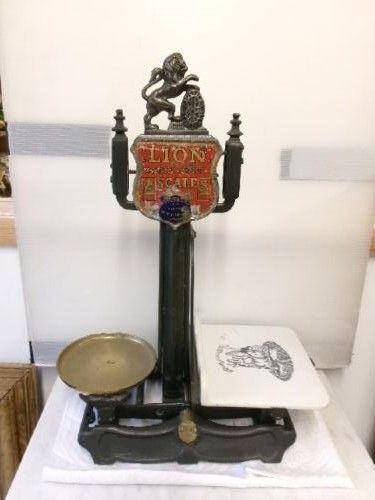
Brass pan balance scales encompass utilitarian weighing devices originating from the Victorian era, the Edwardian period, and the early twentieth century. These pieces include butcher scales, grocer scales, shopkeeper balances, and free-hanging beam designs.
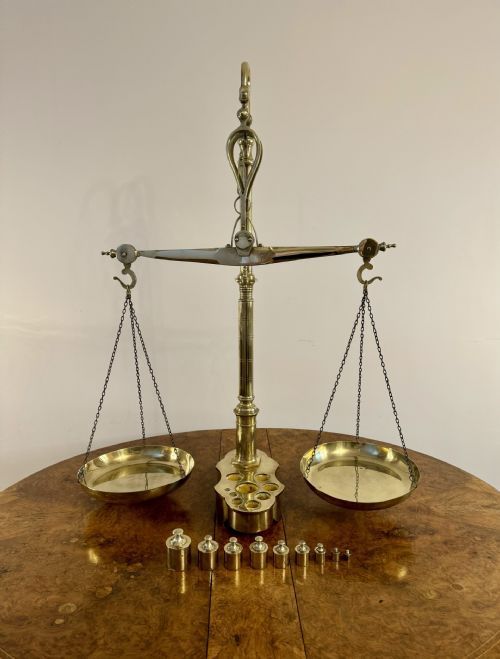
The most common examples on this page are Victorian and nineteenth-century French commercial balance scales featuring polished brass pans suspended from robust iron or brass beams. They reflect working commercial origins from grocers, butchers, and general merchants.
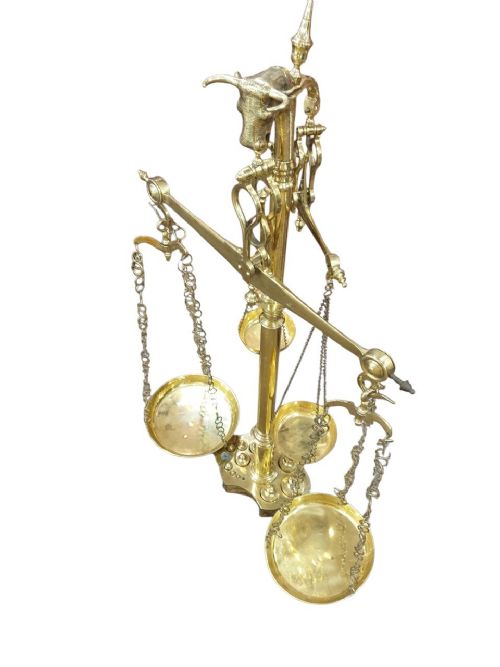
Regional variations span British shop counters to Dutch traditional interiors and nineteenth-century French grocery shops. Buyers encounter both tabletop beam arrangements and hanging configurations designed for practical trade.
Construction and materials
Makers utilised cast iron for structural bases and support frames, combining this heavy metal with forged steel for pivot points to ensure mechanical stability under load. Brass formed the pans, beams, and decorative elements, offering corrosion resistance and a bright finish.
Wooden components appear in structural bases, notably mahogany, providing a stable platform for delicate balance mechanisms. Copper also surfaces alongside brass in specific decorative and garden scale variants.
Listings feature materials spanning brass, iron, cast iron, copper, steel, mahogany, and bronze across Victorian, Edwardian, and twentieth-century periods.
Judgments of quality
Quality rests in the precision of the beam pivot and the integrity of the original metal components, where crisp casting and balanced movement separate utilitarian workhorses from finer showroom pieces. Maker attribution elevates a piece, particularly when bearing the stamp of established manufacturers like Bartlett & Sons or De Grave & Co.
The choice of secondary materials marks the distinction between standard shop items and superior examples, such as the use of rich mahogany bases alongside heavy cast iron and polished brass. Proportional harmony and the survival of matching original pans dictate the overall presence of the object.
Bartlett & Sons·De Grave & Co London
The Brass Pan Balance Scales Glossary
- Beam scale
- A weighing device utilising a central fulcrum and a horizontal beam from which two pans are suspended at equal distances. This traditional mechanism measures mass by comparing an unknown weight against known standards.
- Fulcrum
- The central pivot point upon which the balance beam rests and swings. Its precision determines the sensitivity and accuracy of the scale.
- Free hanging
- A suspension method where the entire balance mechanism hangs from a hook or ceiling bracket rather than resting on a counter. This style is often associated with traditional Frisian designs.
- Cast iron
- An iron-carbon alloy poured into moulds to create heavy, rigid bases and frames for commercial scales. It provides the necessary mass and stability to support the weighing mechanism.
Brass Pan Balance Scales: Frequently Asked Questions
How do balance scales work?
Balance scales operate on the principle of equilibrium, where an object placed on one pan is measured by adding standard weights to the opposite pan until the horizontal beam levels.
The central fulcrum allows the beam to tilt freely, demonstrating the precise moment equal mass is achieved on both sides.
Where were these scales used?
These instruments served commercial purposes in Victorian grocery shops, butcher counters, and general merchant stores for daily retail transactions.
Larger variants weighed produce or meat, while specialised hanging versions operated in domestic or regional European markets.
How do I date antique scales?
Dating relies on stylistic clues, manufacturing materials, and any stamped maker marks or assay stamps found on the brass beam or iron base.
Victorian and Edwardian pieces often display distinct casting techniques and ornamentation typical of their respective decades.
Can I style these in a modern kitchen?
Brass pan balance scales function well on open shelving, kitchen islands, or sideboards, introducing warm metallic tones and historical texture.
They pair effectively with rustic country decor or industrial interiors as sculptural decorative objects.