
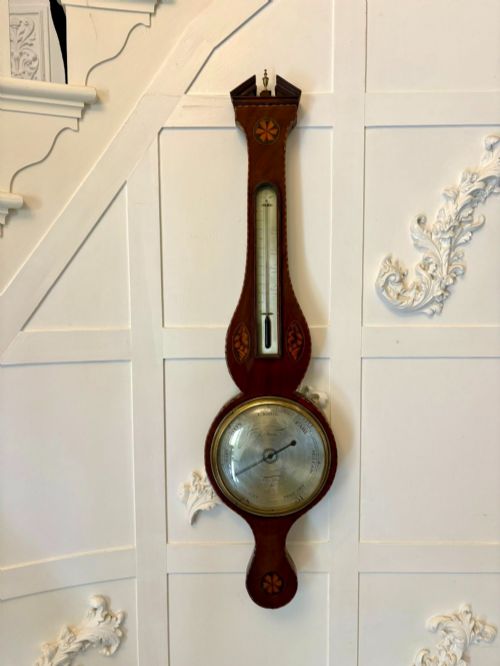

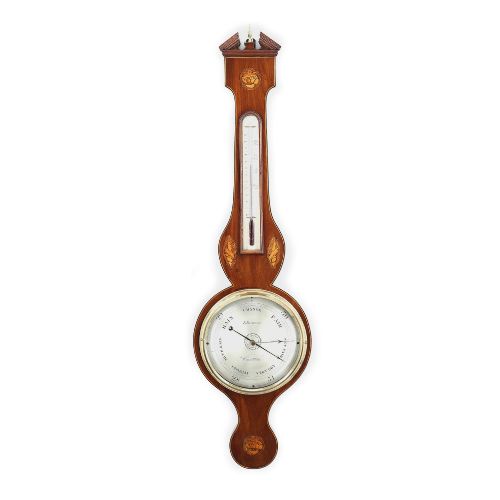


Brass Mercury Barometer
A brass mercury barometer is a classic weather instrument that measures atmospheric pressure through a column of liquid metal, prized for its mechanical honesty and period charm.
Brass Mercury Barometer
When you search for a brass mercury barometer, you encounter precision weather instruments housed in wooden cases that span the eighteenth, nineteenth, and early twentieth centuries. These pieces record atmospheric pressure changes using a column of liquid metal balanced against glass and brass fittings, serving as both functional tools and striking interior fixtures.
The selection on this page centres heavily on Georgian and Victorian examples, featuring distinct forms such as upright stick barometers, wider wheel barometers, and marine designs. Woods such as mahogany, rosewood, and walnut frequently form the main body, accented with silvered metal dials and brass indicators.
Makers ranged from provincial English towns to London workshops, producing domestic wall instruments alongside robust marine versions for sea travel. Collectors also find occasional desk clocks and specialised angle barometers that demonstrate the mechanical ingenuity of the period.
Materials and construction methods
Craftsmen built these instruments using dense cabinet timbers like mahogany, rosewood, and oak, frequently shaping them into slender trunks or expanded wheel bodies. Selected woods often received shell inlay or fine grain finishing to enhance the domestic appearance of the wall case.
The functional core relies on mercury sealed within glass tubes, paired with engraved silvered metal scales for reading barometric pressure. Brass components form bezels, vernier pointers, and gimbal mounts, providing durable framing for the delicate internal glasswork.
Listings feature eighteenth and nineteenth-century examples spanning the Georgian, Regency, and Victorian periods, constructed in mahogany, rosewood, oak, and walnut.
Factors of distinction
Quality rests upon the crispness of the engraved silvered dial and the precision of the maker's hand on the brass scale. Finer examples display meticulous cabinetwork with well-matched wood grains and sharp inlay, rather than purely utilitarian construction.
The reputation of the maker inscribed on the face elevates certain pieces, particularly those signed by established London or provincial workshops. Preserved original components, from the glass tubes to the brass bezels, separate standard instruments from those altered over time.
B. Besozzi of Weymouth·Blunt·Ganthony of London·Prada of High Wycombe·Alexander Wright·Fagioli of Clerkenwell London·Giana Shrewsbury·Bate of London·Jenkins Of Old Swindon·Negretti and Zambra·James H Kelly of Glasgow·Watkins·H Marks High Street Bloomsbury·Sandrino of Liverpool·Vecchio and Co of Shaftsbury·Gilbert London·S and B Solomons of London·Bianchi Ipswich·Ciresa of Milan·A Rivolta·Alexander Adie·Bassi·Luisetti of London·Charles Aiano London·Gowland London
The Brass Mercury Barometer Glossary
- Stick barometer
- An upright instrument where the mercury column rises and falls in a straight vertical tube, showing direct barometric pressure without mechanical amplification. This form offers the most direct reading of atmospheric changes.
- Wheel barometer
- A round dial instrument that uses a float on the mercury to turn a needle via a pulley and weight system, often incorporating a thermometer or hygrometer. These wider frames allowed for more decorative woodwork and domestic display.
- Silvered metal
- A brass or copper plate treated with a silver solution to create a matte white reading surface for engraved numbers and scales. It provides high contrast against dark cabinet woods.
- Marine barometer
- A specialised hanging instrument designed with gimbal mounts to remain vertical on rolling ships at sea. These versions typically feature heavy brass cisterns and robust protective cases.
- Vernier scale
- A sliding auxiliary scale that allows the user to read barometric pressures down to precise fractions of an inch or millimetre. It is operated by a small brass knob on the instrument face.
Brass Mercury Barometer: Frequently Asked Questions
How do I read a brass mercury barometer?
You read the height of the mercury column against the engraved silvered scale, using the brass vernier pointer to note precise measurements. Rising levels generally indicate improving weather conditions, while falling levels suggest approaching storms.
Many wheel barometers also feature a secondary hand set by the user to track whether the pressure has risen or fallen since the last observation.
Where should I hang a wall barometer?
Choose an interior wall free from direct sunlight, central heating vents, and heavy vibrations to ensure accurate pressure readings and protect the wooden case.
Height matters for daily viewing, so mount the instrument at eye level where the silvered dial catches indirect room light clearly.
How do stick and wheel barometers differ?
Stick barometers display pressure directly through an open vertical tube, offering a purer scientific presentation favoured in Georgian and Victorian hallways.
Wheel barometers translate the mercury movement through a mechanical pulley to a circular dial, providing a more decorative domestic appearance often accompanied by a thermometer.
Can these barometers still be used today?
These instruments continue to track atmospheric pressure accurately provided the mercury column remains intact and unbroken within the glass tube.
Moving them requires care to secure the mercury reservoir, and many owners consult specialist conservators if relocation involves long distances.