
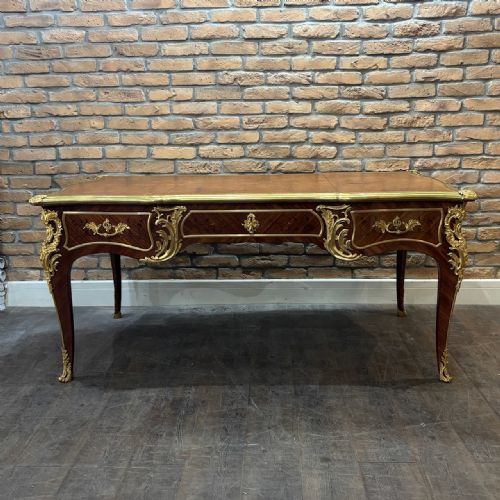


Brass Marquetry Writing Table
A brass marquetry writing table brings together fine cabinet timbers and intricate metal inlay to serve as a distinguished surface for correspondence.
Brass Marquetry Writing Table
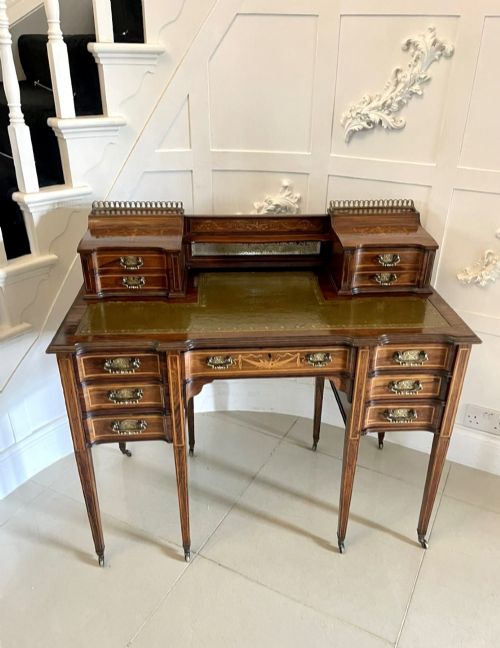
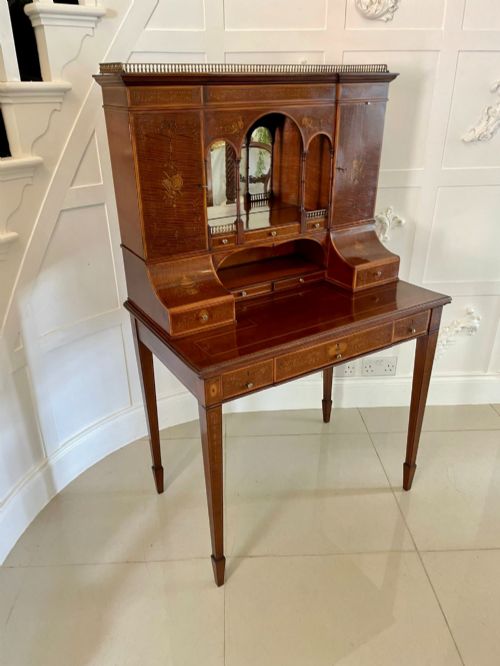
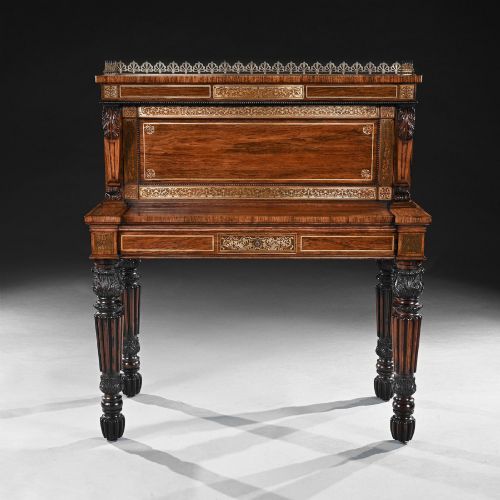
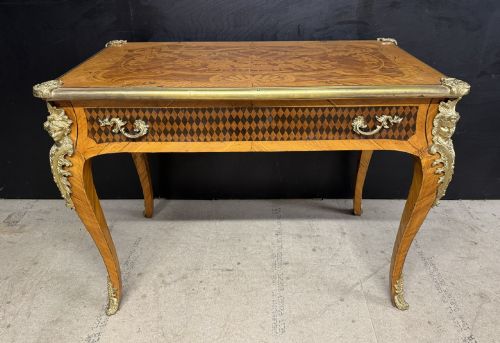
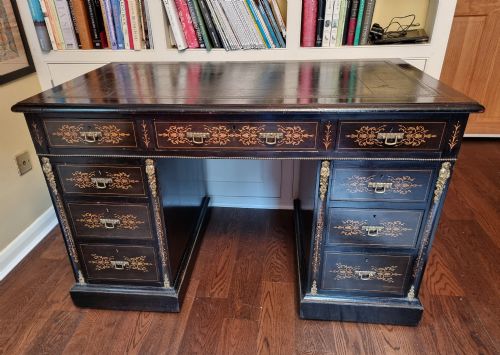
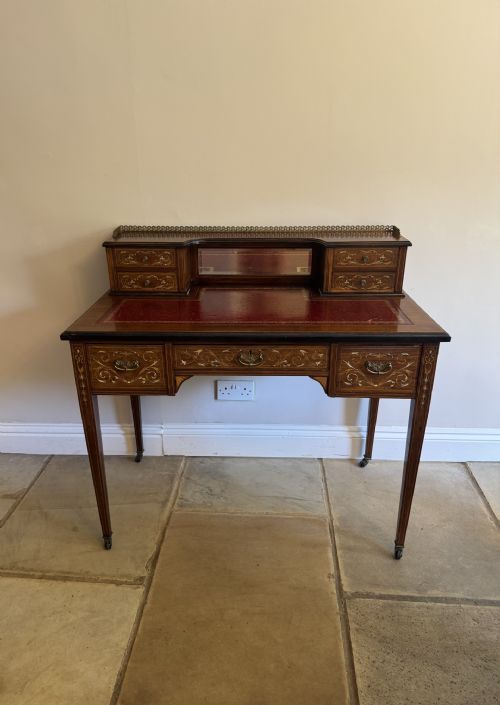
A brass marquetry writing table takes several forms across the nineteenth century, ranging from French bureau plat designs to freestanding Victorian centre tables and Sheraton Revival desks. These pieces originate primarily from English and French workshops, utilising rich timber carcasses designed to sit centrally within a room.
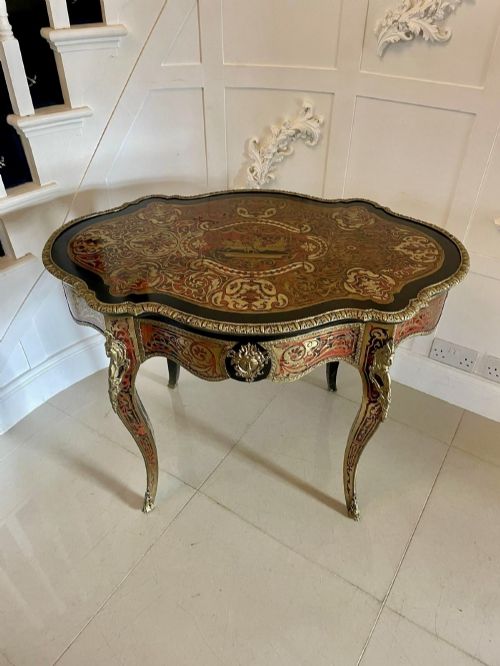
The most common examples encountered on this page date from the Victorian era and the nineteenth century, often reflecting French Louis XV or Louis XVI revival styles. Buyers frequently find kidney-shaped tables, bureau de dame forms, and drum tables equipped with fitted writing surfaces.
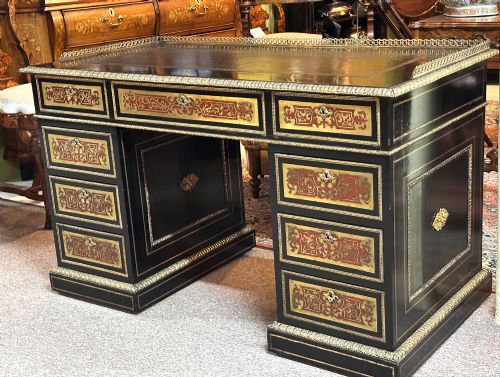
The integration of brass inlay with exotic woods defines the character of these items, whether executed in precise geometric patterns or elaborate Boulle work. They functioned historically as private writing surfaces for correspondence in libraries, boudoirs, and principal reception rooms.
Materials and Technique
Cabinetmakers constructed these tables using dense foundation timbers such as mahogany, walnut, rosewood, and kingwood, often veneered onto secondary woods to provide stable surfaces for intricate decoration. Master artisans then channelled the timber veneers to receive fine brass and gilt-metal inlay, alongside tortoiseshell in traditional Boulle work.
Ornaments of cast or chased ormolu and gilt-metal mountings were applied to edges, corners, and legs to accentuate the curvilinear contours of French revival pieces. Leather inserts frequently formed the writing surface, tooled with gilt borders to complement the exterior metalwork.
The selection includes specialised forms such as Carlton House desks, bureau de dame tables, and drum tables dating from the Regency to the Edwardian era.
Assessment of Quality
The calibre of a brass marquetry writing table rests upon the crispness of the metal cutting and the precision with which the brass sits flush within the timber veneer. Superior examples display seamless integration between the delicate inlay work and the underlying grain of rosewood, walnut, or mahogany.
The standard of the secondary mounts, whether cast ormolu or gilt-metal, distinguishes exceptional workshop production from standard commercial output. Refinement in the shaping of the timber carcass and the structural integrity of freestanding joints further mark out the upper tier of surviving pieces.
Maple & Co.·Gillows Oxford Street Workshop·Edwards & Roberts·Maison Millet·Linke·A. Beurdeley
The Brass Marquetry Writing Table Glossary
- Boulle work
- A form of marquetry utilising brass and tortoiseshell inlaid in contrasting patterns, named after the famed French cabinetmaker André-Charles Boulle.
- Bureau Plat
- A formal freestanding writing table fitted with drawers, originating in France and typically finished on all sides for placement in the centre of a room.
- Ormolu
- Gilt bronze mounted onto furniture or decorative objects, providing polished metallic highlights against dark cabinet woods.
- Marquetry
- Decorative patterns formed by fitting contrasting veneers of wood, brass, or other materials onto a structural carcass.
- Parquetry
- Geometric mosaic woodwork arranged in repeating patterns such as squares, cubes, or chequers across a table top.
Brass Marquetry Writing Table: Frequently Asked Questions
Where should I place a freestanding writing table?
These tables are finished on all sides, making them ideal for positioning in the middle of a study or library rather than pushed against a wall.
Ensure the surface receives indirect natural light to protect both the leather insert and the polished brass inlay from excessive heat and fading.
How do I care for the brass inlay?
Dust the surface regularly with a soft, dry cloth to prevent particles from settling into the micro-grooves around the metalwork.
Avoid abrasive cleaners or excessive moisture, using only specialist micro-wax suitable for antique wood and metal finishes when necessary.
What distinguishes a bureau plat from a standard desk?
A bureau plat is a specific French form featuring a broad writing surface supported by cabriole or tapered legs, with one or more frieze drawers.
Unlike utility desks meant for office work, these pieces were designed for salons and reception rooms with decorative refinement equal to their utility.
How do I identify a Victorian Sheraton Revival piece?
Sheraton Revival furniture from the Victorian period adopts the lighter proportions, satinwood veneers, and classical symmetry associated with eighteenth-century design.
Look for refined floral marquetry, bellflower swags, and tapered legs that imitate earlier Georgian aesthetics while retaining nineteenth-century construction methods.