



Brass Mantle Candlesticks
Brass mantle candlesticks bring hearthside warmth and polished metallic lustre to a room, spanning styles from Georgian simplicity to Victorian ornamentation.
Brass Mantle Candlesticks
Brass mantle candlesticks encompass lighting devices designed to sit on mantelpieces, featuring forms ranging from mid eighteenth century seamed ejector pairs to tall Victorian balusters and nineteenth century neoclassical gilt bronze and marble pieces.
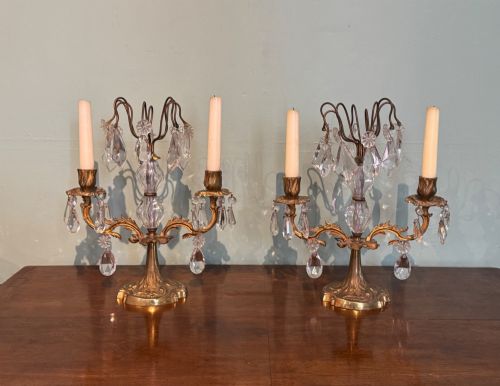
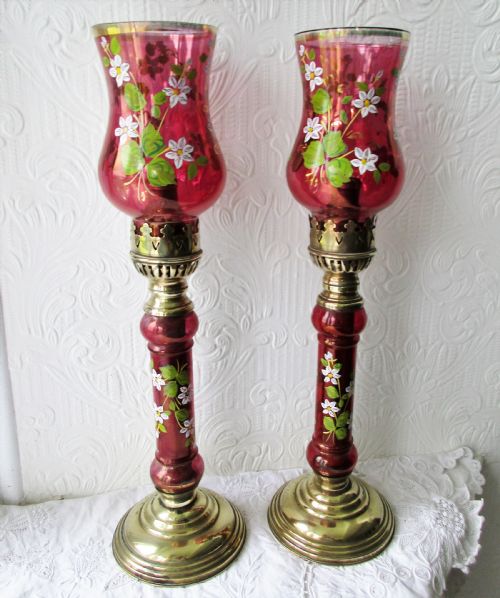
The selection includes multi-branch candelabra, candle lamps with glass shades, and lustre pairs with hanging glass drops, alongside related garnitures and mantel clock sets.
Originating across periods including Georgian, Regency, and Victorian eras, these items reflect both English domestic production and French revival styles like French Rococo and Empire.
Materials and construction methods
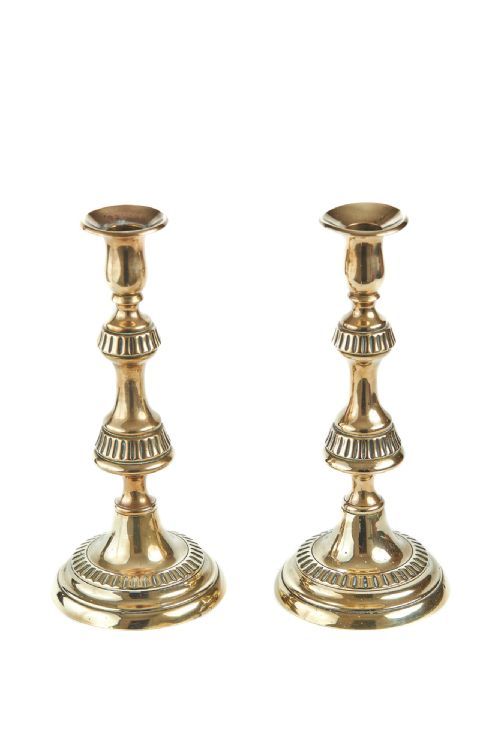
Makers utilised brass and polished brass as foundational metals, often casting pieces in sections such as baluster stems or incorporating seamed construction techniques visible in eighteenth century examples.
Decoration extended to combinations with other materials, pairing the metal with cut crystal, cranberry glass, porcelain, enamel, and marble to create ornate domestic furnishings.
Gilding techniques, including gilt brass, gilt bronze, and ormolu finishes, were applied to achieve rich metallic surfaces, frequently complemented by glass lustre drops and storm shades.
Beehive candlesticks from 1893 bring an unexpected insect-inspired silhouette to the Victorian mantelpiece.
Distinctions in quality and execution
Quality reveals itself in the crispness of casting detail and the weight of the metal, distinguishing mass-produced items from finely chased French Empire gilt bronze or heavily ornamented Victorian pieces.
The integration of secondary materials, such as genuine cut crystal, hand-selected marble bases, and intact cloisonné enamel or porcelain inserts, marks the division between standard domestic items and high-end decorative objects.
Wm. Tonks & Sons·Finnigan Manchester
The Brass Mantle Candlesticks Glossary
- Ejector
- A mechanism inside seventeenth and eighteenth century candlesticks featuring a small internal push-rod to lift out the remaining candle stump.
- Lustre
- A decorative tabletop candlestick or candelabrum hung with cut glass prisms or pendants designed to reflect candlelight.
- Gilt Bronze
- Bronze metal coated with a thin layer of gold, frequently employed in French Empire and neoclassical lighting for a rich, matte finish.
- Baluster
- A moulded architectural shaft with a swelling lower portion, commonly found on nineteenth century brass stems.
- Candelabra
- A branched candlestick holding multiple candles from a single base, appearing in various metal and glass combinations.
Brass Mantle Candlesticks: Frequently Asked Questions
How do I clean antique brass candlesticks?
Dust gently with a soft dry cloth to preserve the natural aged patina and any historical surface treatment.
Avoid abrasive polishes or harsh chemical dips that strip away centuries of character and reduce the historic value.
Were these candlesticks meant for dining tables?
While many similar designs served various rooms, mantle candlesticks and candelabra were specifically proportioned for display on drawing room mantelpieces.
Their substantial height and decorative glass shades or lustre drops suited the elevated placement above a hearth.
How can I tell a Victorian pair from a Georgian one?
Georgian examples often display simpler seamed brass construction and restrained neoclassical lines.
Victorian pieces tend toward heavier ornamentation, incorporating baluster shapes, floral motifs, or mixed materials like porcelain and glass.
What is a garniture set?
A garniture set comprises a central mantel clock flanked by matching decorative objects such as candelabra or vases.
These coordinated ensembles created a balanced, symmetrical display on nineteenth-century drawing room mantelpieces.