


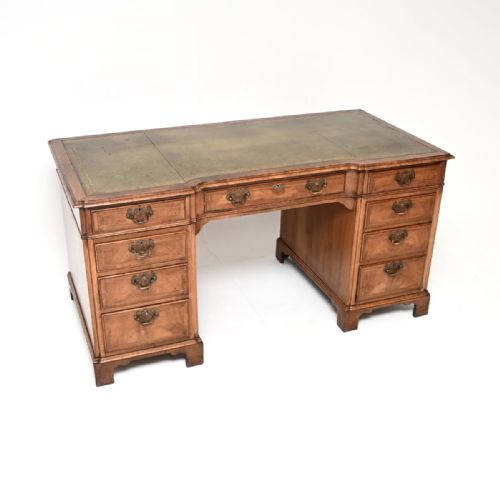
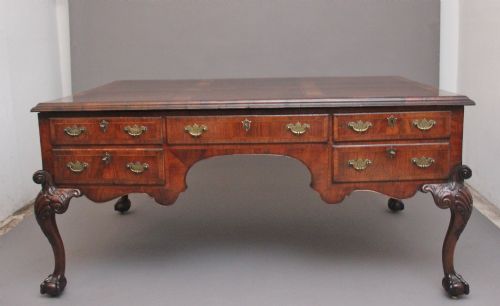
Brass Handle Pedestal Desk
A brass handle pedestal desk brings architectural presence and generous workspace to a study, built from solid timbers with distinctive hardware.
Identifying your brass handle pedestal desk
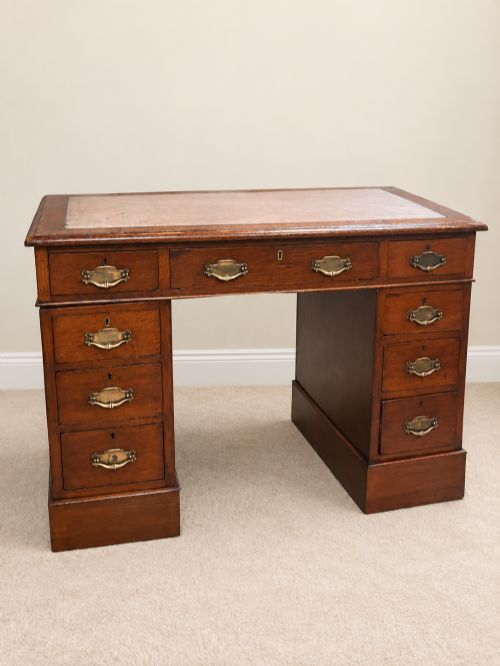
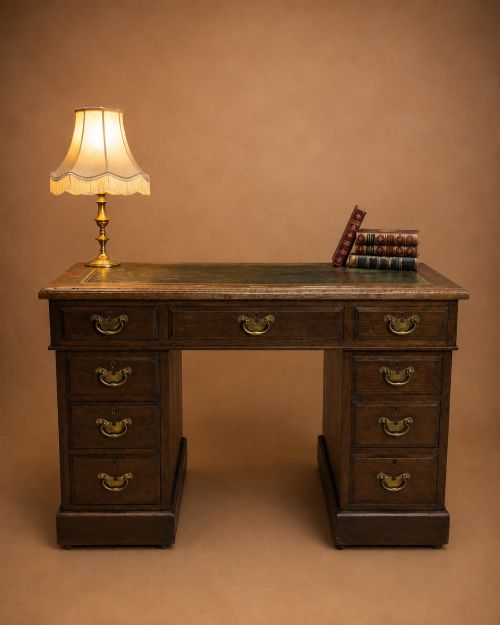
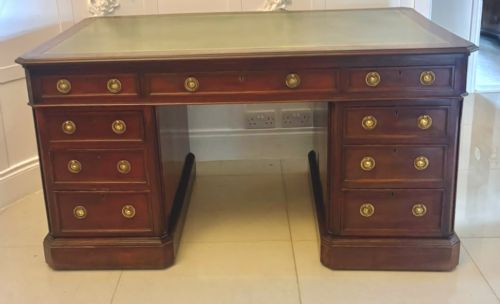
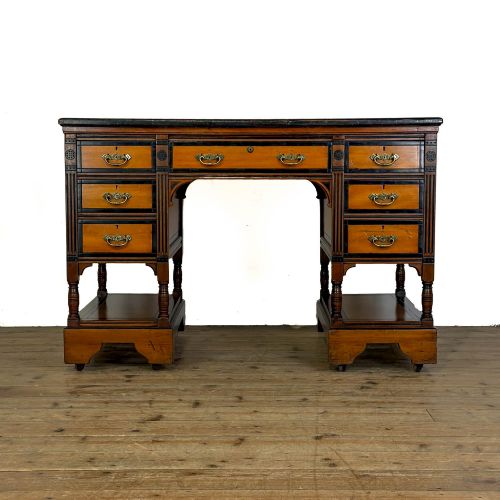
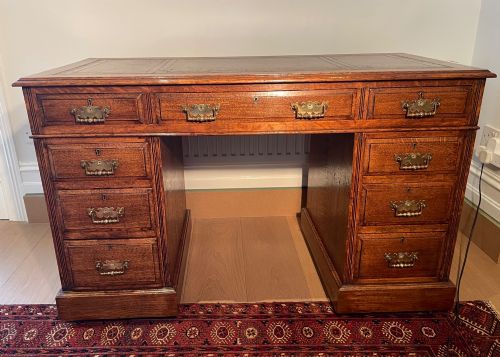
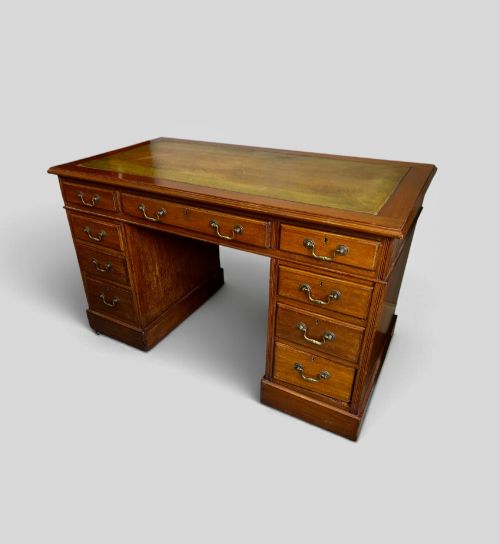
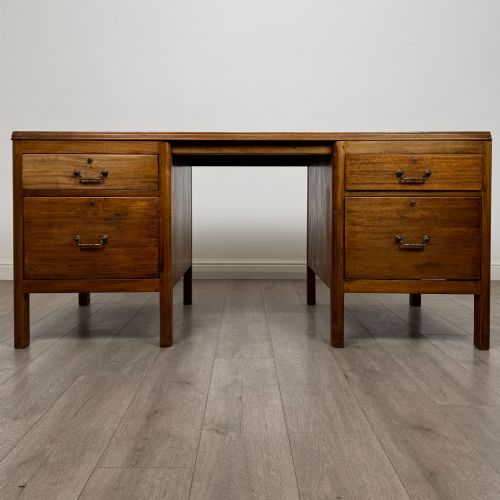
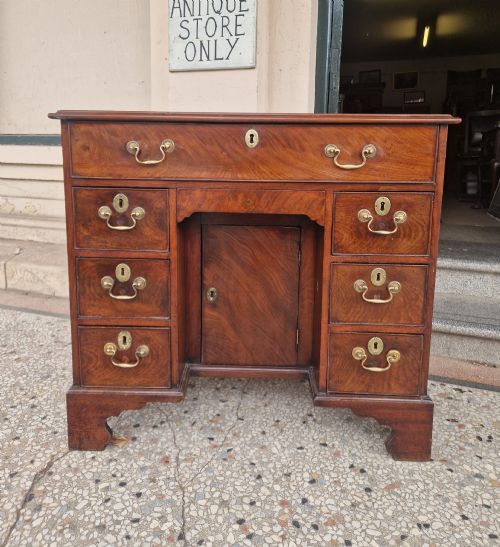
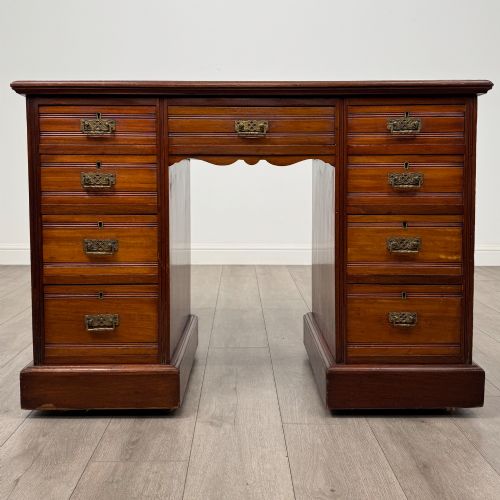
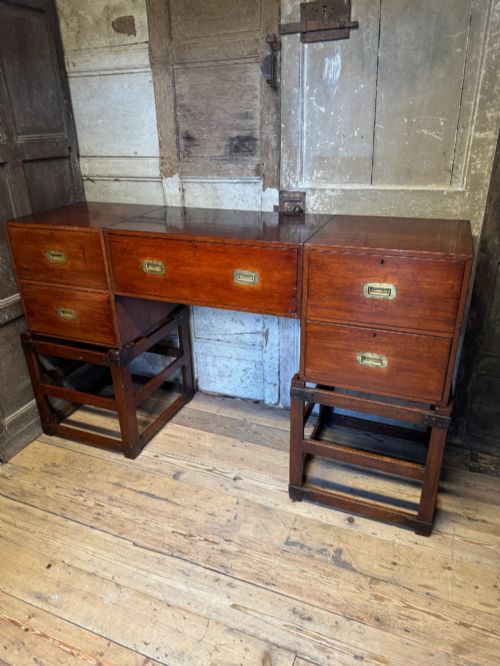
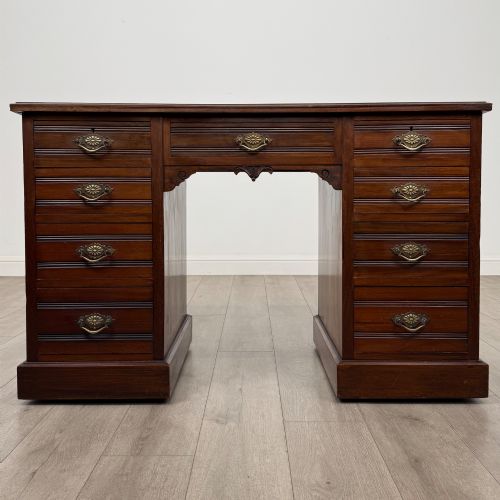
A brass handle pedestal desk combines a central writing surface with two banks of drawers underneath, offering substantial storage and organisation. These pieces emerge from the eighteenth, nineteenth, and early twentieth centuries, spanning periods from George III through the Victorian and Edwardian eras.
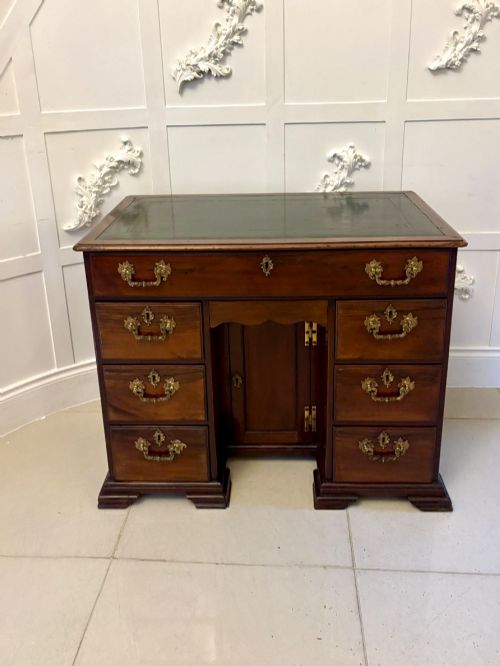
The most common examples you will encounter on this page are constructed from mahogany or oak, often finished with inset tooled leather writing surfaces. Formats range from twin pedestal configurations to compact kneehole desks and partner desks designed for two users.
Materials and construction methods
Cabinet makers utilised dense hardwoods such as mahogany, curl mahogany, walnut, and oak to build the robust carcases and drawers of these desks. Surfaces frequently feature crossbanding or panelled sides, paired with plinth bases or reeded edges.
Hardware consists of solid brass handles, taking forms such as ring drop handles, oval plate handles, or swan neck handles fixed to the drawer fronts. Leather writing inserts were traditionally applied by hand and tooled with gold leaf borders.
Retail Price Guide 2026
Typical UK retail prices for brass handle pedestal desk, calculated from the Sellingantiques database of over a million retail prices indexed since 2003. This retail price guide relies exclusively on Sellingantiques data; no external sources or auction records are used, so the figures do not describe the wider market.
Listings feature mahogany, oak, and walnut timbers, with styles spanning George III, Victorian, Edwardian, and 1930s periods.
Distinguishing quality across the range
Quality rests upon the selection of timber figures, such as curl mahogany or crossbanded walnut, compared to plainer oak or standard mahogany boards. Finer execution shows in the precision of the drawer dovetails, the crispness of reeded edges, and the presence of original solid brass hardware.
Construction divisions also separate standard single-piece carcases from superior three-part modular desks designed for easier transport up staircases. The depth of the leather tooling and the architectural treatment of panelled sides further divide utilitarian workshop output from top-tier cabinet work.
The Brass Handle Pedestal Desk Glossary
- Pedestal desk
- A freestanding writing desk comprising two separate drawer pedestals supporting a central top section. This arrangement provides stability and extensive storage capacity beneath the work surface.
- Kneehole desk
- A smaller version of a pedestal desk featuring a central recess for the user's legs, flanked by single or multiple banks of drawers. It offers a compact footprint while retaining the structural layout of larger desks.
- Partners desk
- A double-sided variant built to accommodate two people sitting opposite one another, featuring drawers on both faces of the pedestals. These large pieces were traditionally used in libraries and banking halls.
- Crossbanding
- A decorative border of veneer laid perpendicular to the grain of the primary desktop or drawer surface. This technique creates a contrasting frame that highlights the central wood selection.
- Swan neck handle
- A traditional furniture fitting shaped like a graceful curve, secured by two vertical posts through the drawer front. It was widely used on eighteenth and nineteenth-century drawer furniture.
Frequently Asked Questions
How do I care for the leather top?
Clean the leather gently with a slightly damp cloth and nourish it periodically with a specialised neutral leather cream. Avoid placing hot cups or moisture directly onto the surface to prevent staining.
Keep the desk away from direct sunlight and radiators to prevent the leather from drying out and cracking over time.
Are these desks easy to move?
Many larger examples, particularly Edwardian and Victorian models, are built in three separate sections comprising two pedestals and a top. This modular construction allows for manageable transport and repositioning within a room.
Simpler or earlier desks may be constructed as a single solid unit, requiring careful lifting and multiple people to move safely.
How do I distinguish an Edwardian desk from a Victorian one?
Victorian desks tend to feature heavier timbers, deep reddish mahogany tones, and robust plinth bases with straightforward joinery. They often prioritize utilitarian strength and dark, rich finishes.
Edwardian pieces frequently incorporate lighter mahogany or walnut, sometimes with refined details like crossbanding, canted edges, and delicate reeding that reflect revivalist design tastes.
Can I use a partner desk in a modern room?
A partner desk works exceptionally well in the centre of a room rather than pushed against a wall, as it is finished on both sides. Its substantial size makes it a striking focal point for a large study or open plan space.
Ensure you measure your floor space carefully, as these double-sided desks have a significantly wider footprint than standard single-sided writing tables.