
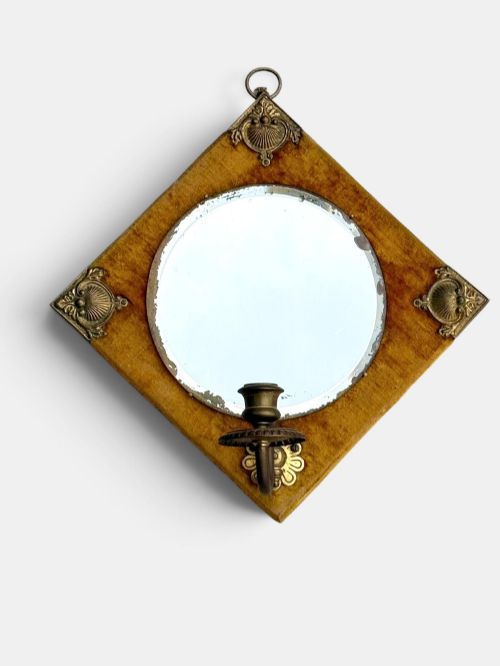
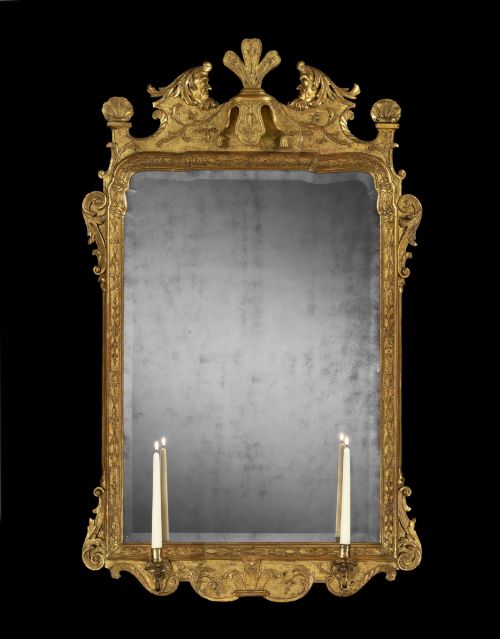
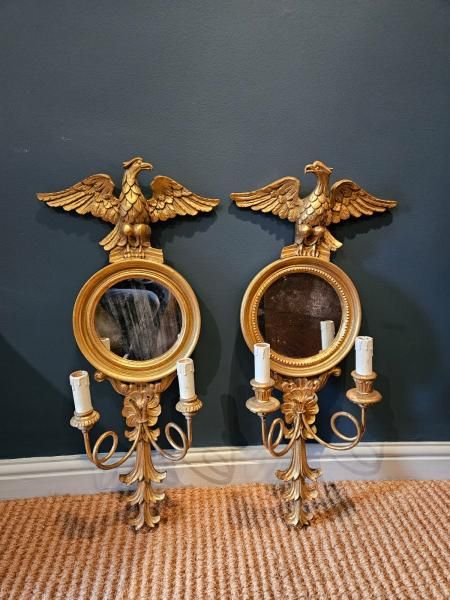
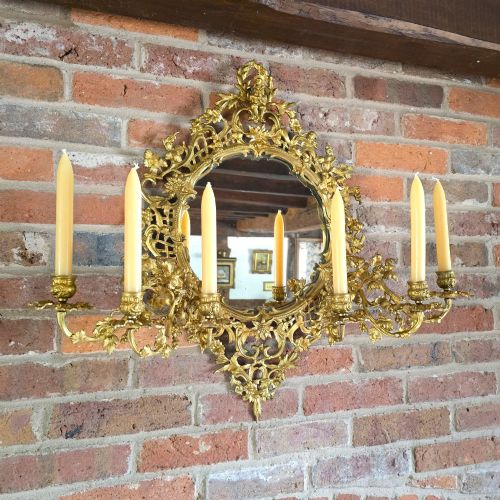

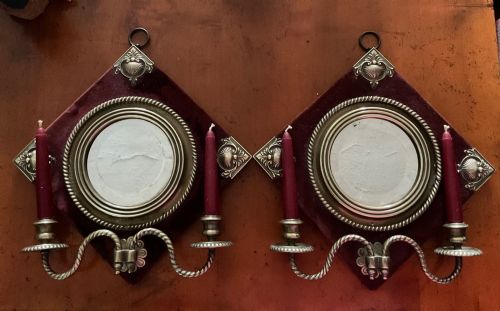


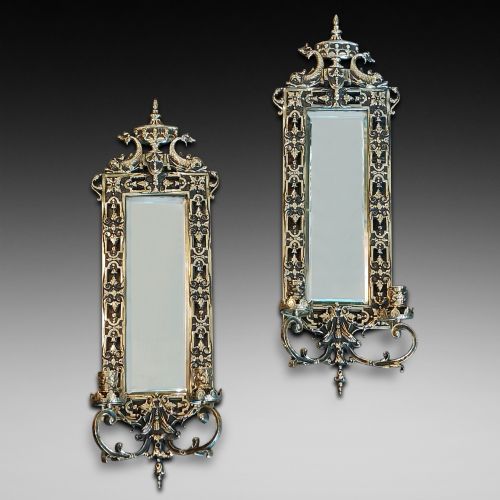

Brass Girandole Wall Mirror
These brass girandole wall mirrors combine reflective glass with integrated candle sconces to throw warm candlelight across a room.
Brass Girandole Wall Mirror
A brass girandole wall mirror serves as both a reflective surface and a light source, combining mirror glass with attached candle arms. When searching for a brass girandole wall mirror, buyers encounter forms ranging from simple Victorian brass frames to elaborate French rococo revival designs with multiple branches.
The pieces listed span periods from the eighteenth century to the early twentieth century, including Edwardian, Victorian, and nineteenth-century examples. Alongside standard wall mirrors and wall sconces, many examples appear as pairs featuring twin or six-branch candelabra.
Origins vary across English and French workshops, utilising styles such as Arts and Crafts, Regency, Chinoiserie, and French rococo. The primary function remains the same across these periods: catching and multiplying the flicker of candles within a decorative metal frame.
How they were made
Makers constructed these pieces using brass, bronze, and gilt metal, often pairing the metalwork with mirror glass and wooden elements. Gesso and giltwood appear alongside velvet backing in specific Edwardian and eighteenth-century examples.
Casting, carving, and hand-beating shaped the metal frames, while ormolu and gilding provided surface finish. Candle branches were securely fixed to the main frame to support the weight of burning candles without compromising the glass.
Listings feature brass, giltwood, and bronze alongside velvet and gesso across eighteenth-century to 1920s periods.
What varies in quality
The refinement of the casting and carving separates standard production pieces from finer works. Detailed chased work on brass or bronze frames indicates superior craftsmanship compared to simpler pressed metal alternatives.
The integration of the candle arms and the condition of the original gilding or patination define the upper tier of the range. Complete sets of matching arms and well-preserved mirror glass elevate individual pieces.
William Tonks
The Brass Girandole Wall Mirror Glossary
- Girandole
- A decorative wall mirror fitted with one or more candle branches attached to the frame. This dual function allowed rooms to maximise the illumination from a single candle.
- Ormolu
- Finely ground high-carat gold applied to a bronze base using a mercury amalgamation process. This technique gives the metal a rich, deep yellow lustre.
- Gesso
- A plaster-like mixture applied to wood surfaces as a base for gilding or painting. It allowed craftsmen to carve intricate relief details before applying gold leaf.
- Sconce
- A wall-mounted lighting fixture designed to hold candles or lamps. In these pieces, the sconce arms project directly from the mirror frame.
Brass Girandole Wall Mirror: Frequently Asked Questions
How were brass girandoles used?
These mirrors were hung on walls between windows or above mantelpieces to reflect natural daylight during the day. In the evening, the attached candle branches were lit to multiply the ambient light in the room.
The reflective glass amplified the glow of the candles, making them practical lighting solutions before electricity became common in homes.
Are the candle branches original?
Examining the mounting points where the branches attach to the main frame helps determine originality. Consistent patination and matching cast construction between the mirror frame and the arms indicate they belong together.
Replacement branches often show slight differences in brass colour, filing marks, or screw types compared to the primary frame.
How do I tell Victorian from eighteenth-century pieces?
Eighteenth-century examples, such as George I gesso pieces, feature hand-carved wooden construction and distinct gesso layering. Victorian and later nineteenth-century pieces often utilise heavier cast brass or bronze with distinct revival styling.
Looking closely at the backboards, fixings, and glass bevelling provides further clues to the manufacturing decade.