



Brass Desk Scales
These brass desk scales are heavy, working instruments of the writing desk, combining utility with the crisp detail of nineteenth-century engineering.
Brass Desk Scales
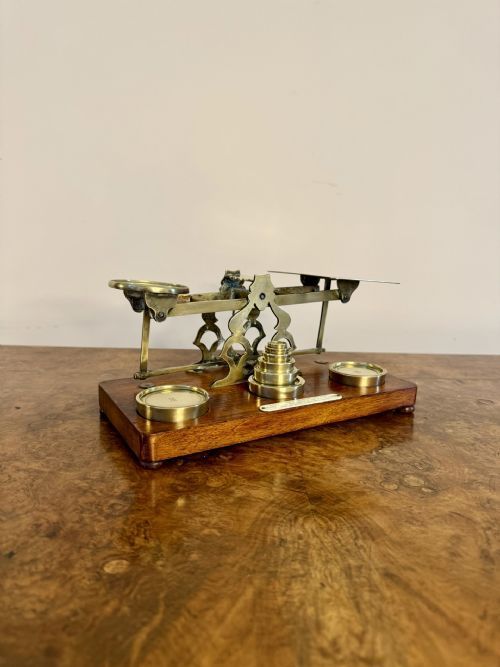
Brass desk scales are functional nineteenth-century writing accessories designed to weigh correspondence accurately before postage. When searching this phrase, a buyer encounters various forms, primarily postal scales mounted on timber bases with matching weights.
The material combination typically pairs polished metal with substantial wooden plinths. Examples range from compact Victorian designs to larger Edwardian sets housed in oak or mahogany.
Beyond standard letter balances, the category occasionally spans related desk ornaments and scientific instruments from the same eras. The core pieces remain those intended for domestic and commercial correspondence.
How they were made
Makers constructed these instruments using cast or sheet brass for the beam and pans, paired with seasoned hardwoods such as mahogany and oak for the bases. Iron and bronze appear in supporting mechanisms and applied details.
Foundry casting created the structural arms and weight sets, while woodworkers turned and polished the plinths to accommodate the matching brass weights neatly in fitted recesses.
Some nineteenth-century makers doubled as scientific instrument houses, bringing unexpected optical precision to the humble task of weighing morning letters.
What varies in quality
Quality rests in the precision of the balance mechanism and the density of the timber base. Superior examples exhibit crisp casting marks, intact original lacquer on the brass, and dense hardwoods like mahogany or oak.
Maker attribution elevates a piece significantly, particularly when signed by known London makers on the metalwork or timber. Complete sets of matching weights further distinguish finer iterations from assembled ones.
S Mordan Co London·Ratcliff Birmingham·Negretti Zambra London·W Watson Sons London
The Brass Desk Scales Glossary
- Postal Scales
- Weighing devices specifically calibrated for letters and small parcels, featuring a balanced beam and flat platforms.
- Plinth
- The solid wooden base, often mahogany or oak, which supports the brass weighing mechanism and fitted weight compartments.
- Beam
- The horizontal metal arm that pivots on a central fulcrum to register the weight of items placed on the pans.
- Weights
- The matching calibrated metal pieces, usually stored in dedicated slots on the wooden base, used to measure postal loads.
Brass Desk Scales: Frequently Asked Questions
How do brass postal scales work?
These instruments operate on a simple balance beam principle where letters are placed on one platform and calibrated weights on the other. The pivoting metal arm levels out to indicate the correct postal rate.
Most domestic sets handled letters up to a few ounces, reflecting nineteenth-century postal regulations. The moving parts rely on a central fulcrum knife-edge to ensure smooth movement.
Are the weights usually original?
Many surviving sets retain their matching brass weights, often nestled into fitted circular slots carved directly into the wooden base. These weights frequently match the manufacturer's stamp found on the metal beam.
Replacement weights appear often because individual pieces were easily lost in daily office use. Buyers seeking completeness should check that the stamp matches the scale housing.
How do I clean brass desk scales?
Maintenance requires only a soft, dry cloth to remove dust from the brass and polished timber surfaces. Aggressive metal polishes strip away the aged patina that collectors prefer.
If the brass requires attention, non-abrasive cleaners applied sparingly will preserve the underlying detail of the casting. The wooden base benefits from occasional application of furniture wax.
What woods were used for the bases?
Mahogany and oak form the most common timber foundations for these Victorian and Edwardian desk instruments. Walnut also appears occasionally among the heavier bureau accessories.
These dense woods provided the necessary weight and stability to anchor the metal mechanisms firmly. The timber was typically finished with a dark polish to complement the warm tone of the brass.