



Victorian Postal Balance
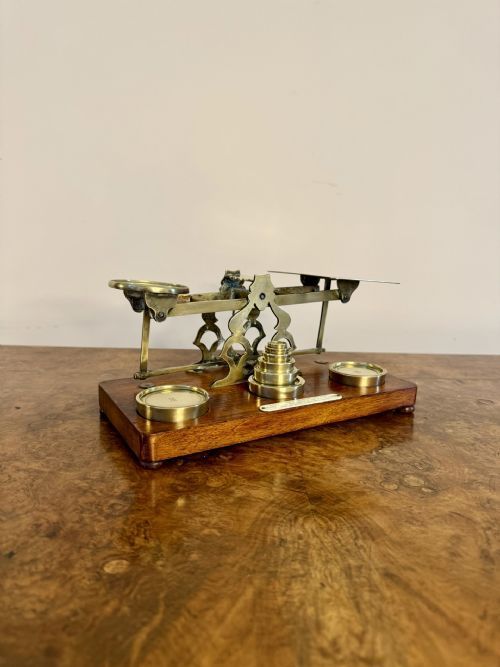
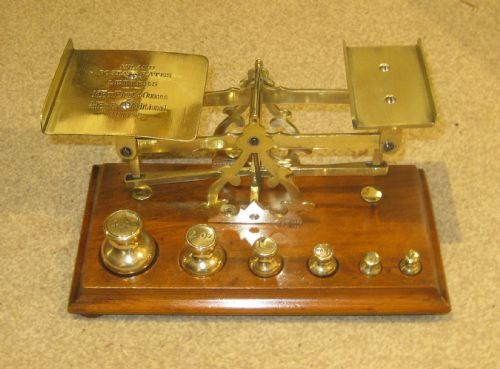
These Victorian postal balance pieces are classic desk accessories that combine brass mechanisms with timber bases, offering both period charm and reliable letter-weighing function.
Victorian Postal Balance
A Victorian postal balance sits on a desk to weigh letters and small packages before dispatch, serving as a functional office tool of the period. These desk objects consist of a brass lever mechanism mounted on a wooden or stone base.
The most common versions on this page are mounted on mahogany or walnut bases, often retaining their original matching brass weights. Examples span from the mid-nineteenth century through the Edwardian era.
Makers such as S. Mordan and Ratcliff of Birmingham produced distinctive designs, ranging from standard rectangular timber boards to unusual candlestick forms. Some pieces incorporate decorative materials like malachite alongside the standard brass and hardwood.
How They Were Made
These items were constructed by joining polished brass moving parts to solid hardwood platforms such as mahogany and walnut. Cabinet makers shaped the timber bases while metalworkers cast and engraved the brass scales and balancing arms.
Heavier luxury versions incorporated decorative mineral panels like green malachite set into the wooden base. Matching brass weights were cast to sit snugly in tailored recesses built directly into the timber platforms.
Some Victorian postal scales doubled as candlesticks, letting letter-writers check postage by the flickering glow of evening tallow.
What Varies in Quality
Quality rests upon the crispness of the brass casting and the depth of the timber grain used for the base. Maker signatures from firms like S. Mordan London elevate a piece above unmarked workshop output.
The presence of a full, matching set of original brass weights distinguishes a complete instrument from one assembled later. Finer examples display precise maker engravings and integrated weight boxes rather than simple flat boards.
S. Mordan London·S Mordan & Co London·Ratcliff Birmingham
The Victorian Postal Balance Glossary
- Postal balance
- A scale specifically calibrated for weighing letters and parcels to determine postage rates. These devices use a lever arm where the letter sits on one side and weights on the other.
- Brass weights
- The small, calibrated metal pieces used to measure the mass of a letter. They are often stored in fitted slots on the wooden base.
- Mahogany
- A durable tropical hardwood favoured for Victorian desk furniture due to its rich reddish-brown tone and stable grain. It forms the primary base material for many larger postal scales.
- Malachite
- A green copper carbonate mineral used as a decorative veneer or inset panel. It appears on select Victorian desk accessories to add colour and status.
Victorian Postal Balance: Frequently Asked Questions
How do you use a postal balance?
Place a letter on the brass pan and add corresponding brass weights to the opposite side until the indicator needle rests at zero. The total weight reveals the required postage rate for the post.
Most antique examples operate on a simple lever principle where the balance tips when the correct mass is achieved. Ensure the scale sits on a flat, level desk surface for an accurate reading.
How do I date these scales?
Examine the style of the wooden base, the typography of any maker inscriptions, and the overall design proportions. Pieces marked with dates around 1850 or 1880 reflect distinct Victorian manufacturing periods.
Edwardian examples from 1900 often feature slightly different geometric treatments on the timber bases compared to mid-Victorian variants. Maker stamps provide the most reliable temporal anchor.
Are original weights important?
Original matched brass weights complete the historical integrity of the scale and fit precisely into the designated wooden recesses. Finding a set with its original weights is a distinct advantage for collectors.
Scales missing their weights still function as decorative desk objects, but complete sets represent the maker's original output. The weights themselves often bear verification stamps from the period.