


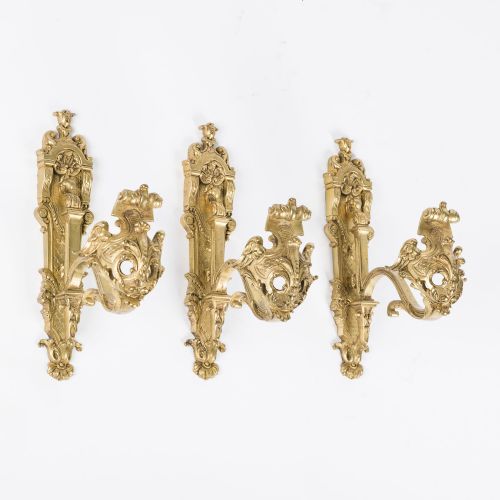


Brass Curtain Tiebacks
Brass curtain tiebacks secure drapery with sculptural weight, bringing period detail to a room.
Brass Curtain Tiebacks
Brass curtain tiebacks anchor heavy fabrics beside a window, combining practical support with ornamental design. When searching for brass curtain tiebacks, a buyer encounters hardware that ranges from utilitarian hooks to elaborate sculptural mounts.
The selections available here lean heavily toward nineteenth-century French production, particularly pairs executed in ormolu and gilt brass. Alongside these French examples appear Georgian brass lion designs and eighteenth-century pieces incorporating enamel.
How they were made
The makers of these objects utilised cast brass, ormolu, and gilt bronze, applying fire gilding or surface ormolu to achieve a rich metallic lustre. Enamel accents appear on eighteenth-century examples, adding contrasting colour to the metalwork.
Many items take the form of wall hooks or detailed figural mounts, reflecting French Rococo Revival, Gothic Revival, and Baroque styles. The heavy metal casting ensures sufficient structural strength to hold substantial drapery folds.
Gothic dragons peer out from the wall to hold your curtains in place.
What varies in quality
Quality rests in the crispness of the cast ornament and the preservation of the original ormolu or gilt surface. Finer examples display sharp definition in motifs such as French Rococo scrolls or Gothic dragons.
Plain gilt brass hooks occupy the simpler end of the spectrum, whereas matched pairs with figural elements or enamel work represent higher levels of period craftsmanship.
The Brass Curtain Tiebacks Glossary
- Ormolu
- Finely ground high-carat gold applied to a bronze base using a mercury amalgamation process. This technique creates a durable, warm metallic finish seen on French luxury goods.
- Gilt Bronze
- Bronze metal that has received a thin layer of gold or gold-coloured wash. It provides the visual richness of solid gold without the equivalent weight and expense.
- French Rococo Revival
- A nineteenth-century decorative style reviving the asymmetrical scrolls, shell motifs, and curving lines of the eighteenth-century French Rococo movement. It dominates many of the ormolu tiebacks here.
- Wall Hook
- A structural fixture anchored into the wall to hold drapery ties. In this collection, these hooks double as decorative hardware.
- Gothic Revival
- An architectural and decorative style drawing inspiration from medieval forms. Pieces in this style utilise motifs like dragons and pointed arches.
Brass Curtain Tiebacks: Frequently Asked Questions
How do I mount brass curtain tiebacks?
These pieces generally secure directly into the wall beside a window frame using appropriate screws through their backplates or mounting holes. Because they carry the weight of heavy drapery, solid wall anchors ensure a secure hold.
Position the tiebacks at a comfortable height, usually around one-third to halfway down the window drop, depending on the volume of the fabric.
Are these tiebacks sold as pairs?
Many listings offer matched pairs designed for the left and right sides of a window. Sets of four also appear, which suit larger windows or multiple openings in the same room.
Individual hooks can occasionally be found listed separately, so checking the specific description clarifies whether the hardware comprises a pair or a larger set.
How do I clean antique ormolu?
Dusting gently with a soft, dry cloth preserves the fragile gilt surface on ormolu and gilt brass. Avoid abrasive cleaners, chemical polishes, or excessive water, which can strip away the historical gilding.
For stubborn grime, a light brush with a soft-bristled artist's paintbrush helps clear dust from recessed carved details without harming the metal.
What periods do these pieces span?
The selection covers items from the mid-eighteenth century through the nineteenth century, including Georgian and Victorian examples. French nineteenth-century ormolu pieces from the eighteen-eighties feature prominently among the listings.
Earlier eighteenth-century pieces often incorporate enamel work alongside gilt brass, reflecting changing interior tastes across decades.