

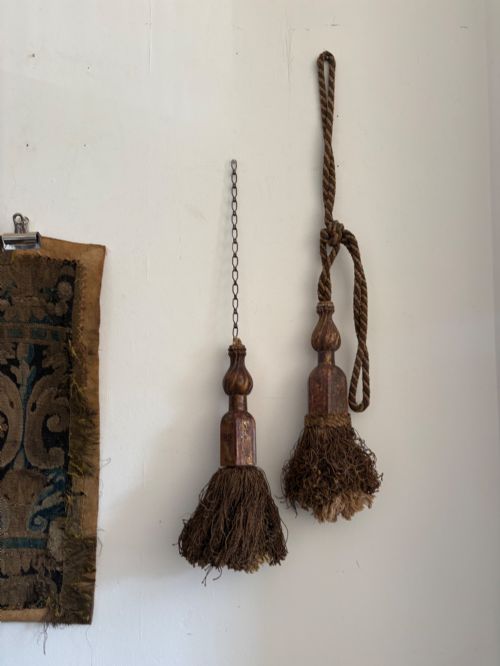


Antique Curtain Holdbacks
Antique curtain holdbacks are functional wall fixtures securing drapery, sought after for their capacity to add period metalwork and carved detail to a room.
Antique Curtain Holdbacks
When you search for antique curtain holdbacks, you encounter hardware designed to hold heavy window drapes back from the glass. The selection here predominantly comprises pairs and sets originating from French and English workshops during the eighteenth and nineteenth centuries.
The forms vary from simple cast brass lions to elaborate sculptural designs in ormolu and carved giltwood. Venetian wood pulls sit alongside French Rococo revival ormolu mounts and Georgian brass castings, reflecting diverse interior tastes from 1750 to 1880.
Materials and Construction
Gothic dragons carved by master founders hold your curtains securely against invading drafts.
Assessing Quality
The quality of the surface finish also dictates value, particularly the depth and retention of the original ormolu gilding or enamelwork. Heavier gauge metals and robust mounting stems indicate commercial longevity and superior workshop execution.
Henri Picard
The Antique Curtain Holdbacks Glossary
- Ormolu
- Gilded bronze produced by applying a mercury and gold amalgam to a bronze object before heating to drive off the mercury. This technique creates a rich, matte gold surface characteristic of fine French decorative metalwork.
- Giltwood
- Timber, usually lime or pine, that has been carved and coated with gold leaf or metal powder. It provides a lightweight yet opulent medium for large Venetian curtain pulls.
- Rococo Revival
- A nineteenth-century design movement resurrecting the asymmetric scrolls, C-curves, and naturalistic shell motifs of the eighteenth-century French court style. It dominates many of the ormolu curtain tie backs from the eighteen-eighties.
- Tie Back
- The functional arm or hook mounted to the window frame to loop the curtain around. This term is frequently used interchangeably with holdback in historical listings.
Antique Curtain Holdbacks: Frequently Asked Questions
How do I mount antique curtain holdbacks?
These pieces generally feature integrated rear screw stems or mounting plates designed to secure directly into window architraves or masonry walls. Pilot holes matching the gauge of the original threaded rods prevent splitting the surrounding timber.
Position them at roughly two-thirds the height of the window to achieve a balanced drape when the fabric is pulled back. Ensure the wall anchors can support the combined leverage of the metal arm and heavy drapery fabrics.
Can these hold heavy drapes?
Cast bronze, brass, and giltwood holdbacks possess the structural strength required to support substantial velvet, damask, or silk window treatments. The physical security depends entirely on the stability of the wall fixing rather than the metal arm itself.
Solid brass and ormolu variants handle heavy everyday use without flexing, while carved wooden pulls require careful alignment to avoid placing undue strain on the mounting joint.
How do I clean ormolu holdbacks?
Dust accumulated in the recessed chased details is best removed using a soft, dry artist paintbrush. Avoid abrasive metal polishes, chemical dips, or excessive moisture, which strip the delicate historical gilding from the bronze surface.
Gentle dusting preserves the microscopic layer of gold and the natural patination built up over centuries of interior use. Enamel sections benefit simply from wiping with a lint-free cloth.
How do I date a pair?
Dating relies on stylistic indicators, such as the exuberant asymmetry of Rococo revival ormolu versus the strict symmetry of Georgian brasswork. Examining the casting method and screw thread type on the rear stem provides further clues to the manufacturing decade.
Eighteenth-century examples often feature hand-cut threads and enamel inserts, whereas late nineteenth-century pieces show machine-standardised fixings and crisper, heavily chased ormolu surfaces.