
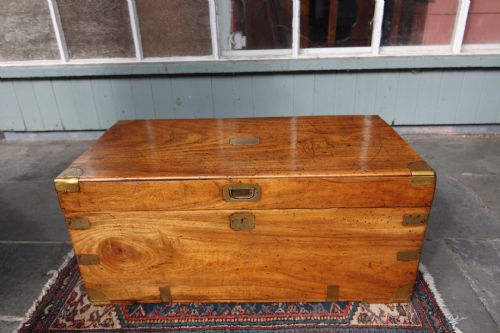
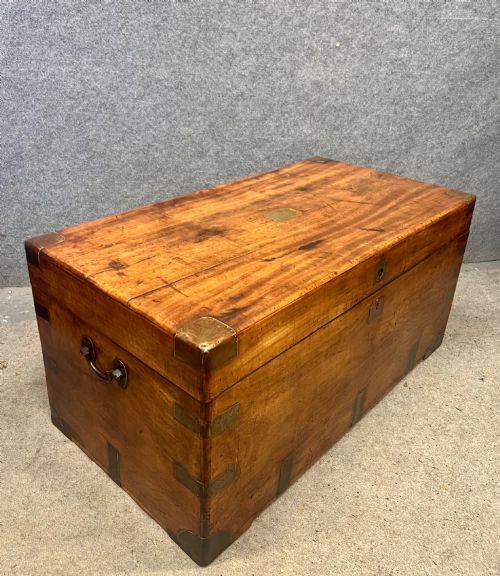
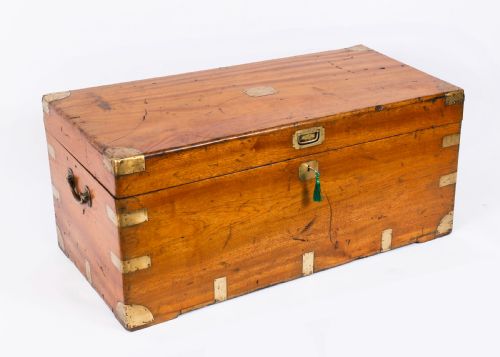


Brass Bound Camphorwood Chest
A brass bound camphorwood chest is a robust travel trunk designed for officers on the move, prized for its fragrant wood and protective metalwork.
Brass Bound Camphorwood Chest
A brass bound camphorwood chest serves as a durable container built for military campaigns, long sea voyages, and colonial life. These pieces emerge chiefly from the nineteenth century, spanning Georgian, Victorian, and Chinese export origins.
Buyers encounter simple trunks, lift-lid coffers, and sophisticated campaign chests featuring internal drawers or secretaire writing sections. The timber repels insects naturally, making these sturdy boxes practical for storing garments and household goods today.
Most examples found on this page display the characteristic metal corners and strapwork designed to reinforce the structure against the rigours of transit. They range from compact peti trunks to large storage chests with recessed carrying handles.
How they were made
Cabinetmakers constructed these pieces primarily from solid camphorwood, selecting the timber for its aromatic qualities and stability in humid climates. Some variants incorporate teak or ebonised wood for specific structural elements.
Brass sheet and strapwork were cut, folded, and fastened with flush screws to protect the vulnerable edges and corners of the chest. Iron and leather components occasionally appear on hinges, locks, and side carrying handles.
Joints were cut tightly to withstand shifting cargo holds and rough handling on overland journeys. Flush-fitting hardware ensured the chests packed neatly inside transport wagons and ship cabins.
What varies in quality
The density and grain pattern of the camphorwood timber set finer pieces apart from plain utility boxes. Well-figured wood displays rich depth and natural movement across the lid and sides.
The weight, gauge, and precision of the brass binding dictate the standard of craftsmanship. Thick brass work neatly mitred at the corners indicates a superior commission.
Internal configuration also separates basic trunks from elaborate campaign chests containing fitted secretaire drawers and clever compartments. Original brass carrying handles and working locks add integrity to the piece.
The Brass Bound Camphorwood Chest Glossary
- Campaign chest
- A modular chest of drawers or trunk made in two or more stacking sections for easy transport on military expeditions. These pieces feature recessed brass handles and corner brackets to prevent damage.
- Secretaire chest
- A chest containing a fitted writing drawer with a drop-front mechanism, pigeonholes, and small compartments. This dual-purpose form allowed officers to maintain correspondence in the field.
- Chinese export
- Goods manufactured in China during the nineteenth century specifically for Western markets, often through ports such as Canton. These items frequently combined traditional British campaign forms with local craftsmanship.
- Coffer
- A heavy storage box with a hinged lid, usually deeper than a standard trunk. They were utilised for heavy woollens and valuable possessions during sea voyages.
- Ebonised wood
- Timber treated with a dark stain or finish to imitate ebony. Cabinetmakers applied this technique to mouldings and trim to create contrast against the warm tone of the camphorwood.
Brass Bound Camphorwood Chest: Frequently Asked Questions
What is a camphorwood chest?
A camphorwood chest is a sturdy storage box constructed from aromatic timber, designed to protect contents from moths and dampness. They were widely used by travellers and military officers during the nineteenth century.
These trunks often feature metal reinforcements and carrying handles for transit. Today, they serve as functional furniture pieces at the foot of a bed or inside a living room.
How do I date a campaign chest?
Dating relies on construction methods, timber choice, and the style of the brass hardware. Pieces from the Georgian period often display simpler joinery and hand-beaten brass elements.
Victorian and later nineteenth-century examples tend to utilise machine-rolled brass strapwork and more complex internal configurations. Maker marks or stamps inside the drawers can occasionally narrow down the decade.
Are these chests waterproof?
While the dense wood and tight joinery offer good resistance to moisture, these chests are not hermetically sealed. They were built to withstand sea air and tropical humidity rather than direct immersion.
The natural oils in the timber help protect the contents from damp conditions over long periods of indoor storage.
How do I care for camphorwood?
Camphorwood requires minimal maintenance beyond regular dusting with a dry, soft cloth. Avoid placing the chest in direct sunlight or near heat sources, which can dry out the natural oils and warp the timber.
Applying furniture wax is rarely necessary because the wood retains its own aromatic resins for decades.