
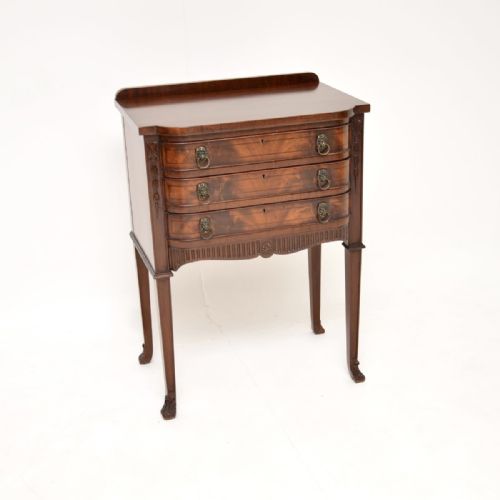
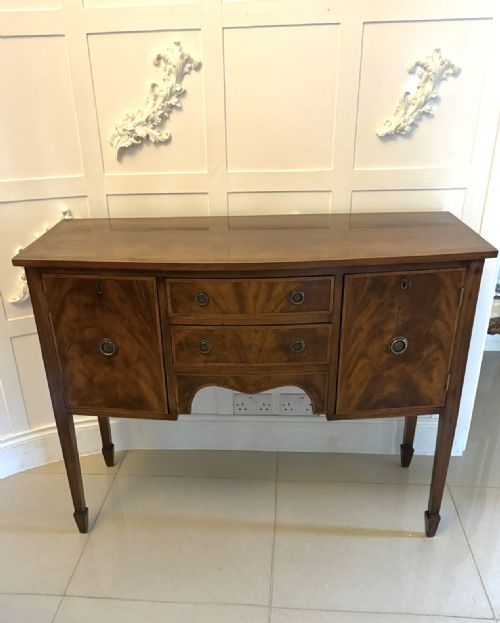

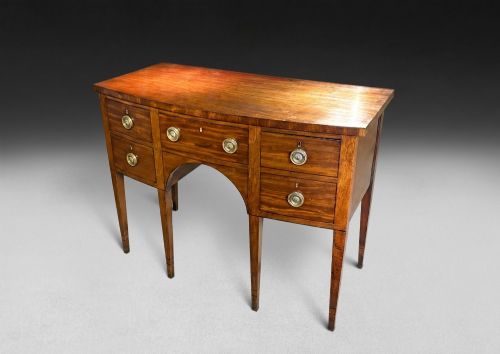
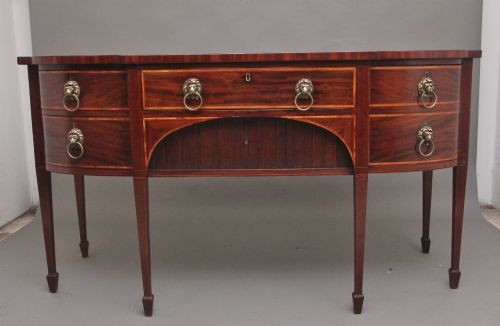


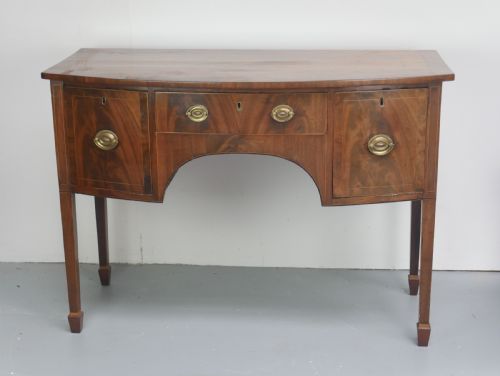
Bowfronted Server Table
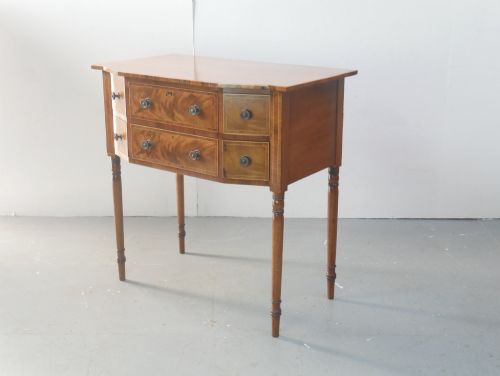
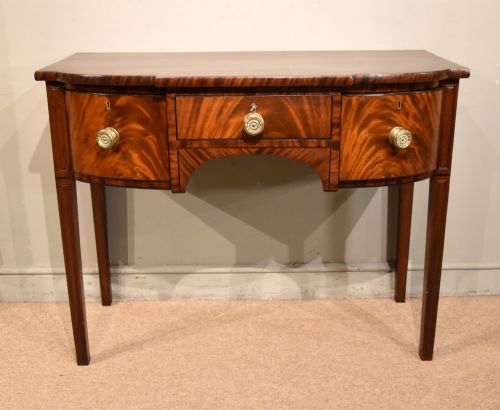
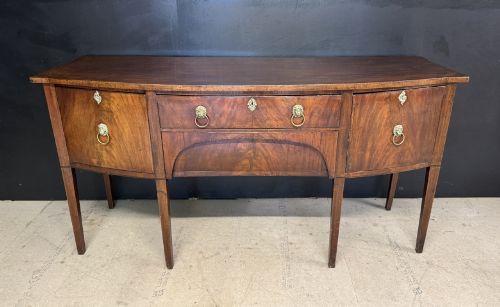
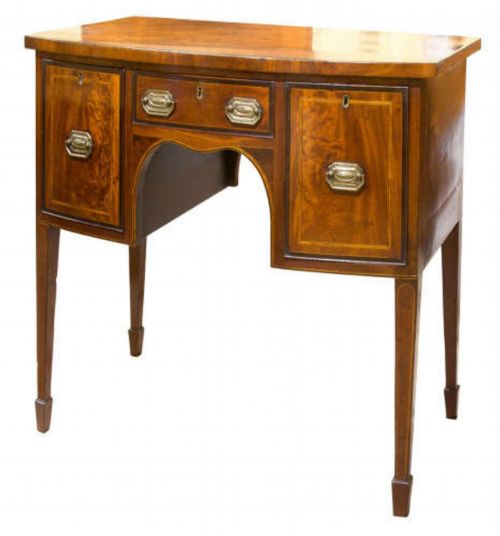
A bowfronted server table brings curving Georgian and Regency lines to dining spaces, offering generous surface storage with a graceful, convex silhouette.
Bowfronted Server Table
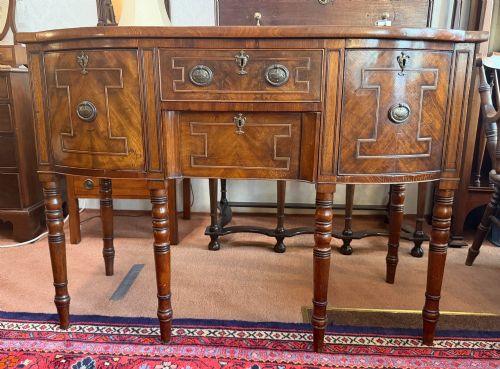
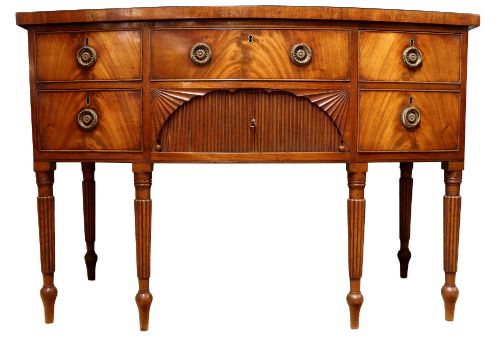
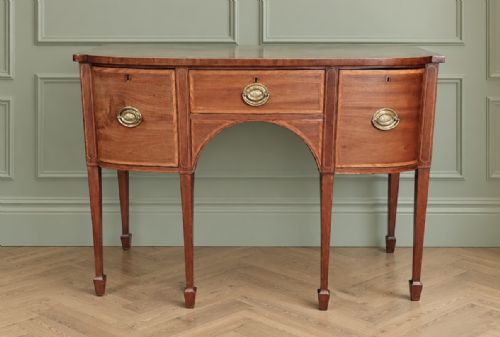
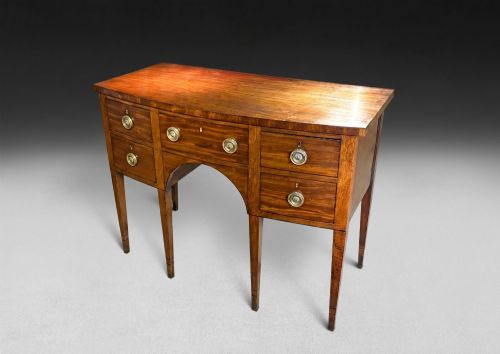
A bowfronted server table combines the practical storage of a sideboard with a sweeping, curved front facade that projects forward in the centre. When exploring these pieces, buyers encounter forms spanning the eighteenth and nineteenth centuries, alongside later Edwardian and revival interpretations.
The selection here draws primarily from Georgian and Regency periods, featuring solid timbers and veneered surfaces shaped to a gentle curve. Makers constructed these items primarily as dining room servers, sideboards, and console tables to display silver and serve food.
The inventory leans heavily towards mahogany structures, often finished with delicate inlay work or crossbanding in contrasting woods. These foundational designs establish the classic proportions expected in a traditional dining interior.
Materials and Construction Techniques
Craftsmen built these pieces using solid mahogany and flame mahogany veneers applied to secondary woods such as oak and pine. The curved front required specialist timber bending or careful sawing of solid stock to achieve the characteristic convex sweep without compromising structural integrity.
Surface decoration frequently relied on boxwood inlay, satinwood crossbanding, and purpleheart banding to frame drawer fronts and tabletops. Brass hardware, including original ring pulls and backplates, completed the construction and added functional contrast to the dark timber.
Some nineteenth-century tables feature six legs instead of four, giving the furniture an unexpectedly sturdy stance that surprises modern guests.
Distinctions in Quality
Quality rests heavily on the selection of timber figures, particularly the grain matching across flame mahogany drawer fronts and the precision of the boxwood or satinwood inlay. Superior examples display seamless curves and tight joints that withstand centuries of environmental shifts.
Proportion and scale separate ordinary workshop pieces from finer cabinet work, with smaller proportions and six-legged configurations often indicating higher craftsmanship. Original brass handles and undisturbed secondary woods further elevate a piece above standard utility items.
The Bowfronted Server Table Glossary
- Bowfront
- A curved front facade that swells outwards in the centre, designed to soften room angles and maximise internal depth. This silhouette defines the classic proportion of the pieces listed here.
- Crossbanding
- A narrow strip of veneer applied perpendicularly to the surrounding grain along the border of a tabletop or drawer. This technique frames the primary timber and adds visual contrast.
- Flame mahogany
- A highly figured cut of mahogany grain resembling flickering flames, prized for its dramatic pattern. Cabinet makers reserved this veneer for primary focal points like drawer fronts.
- Inlay
- The technique of inserting contrasting pieces of wood or metal into recessed portions of a base material to form decorative patterns. Boxwood and satinwood commonly serve this purpose on Georgian pieces.
- Sideboard
- A dining room furniture form developed to hold serving dishes, cutlery, and glassware. These items often feature cupboards and drawers flanking a central storage space.
Bowfronted Server Table: Frequently Asked Questions
Where should I place a bowfronted server table?
These pieces suit dining rooms, hallways, and living spaces where a shallow yet wide surface is required. The curved front projects slightly further in the middle, so allow adequate clearance in narrow walkways.
Position the piece against a flat wall to let the sweeping wooden silhouette stand out as a focal point within the room.
How do I date an antique sideboard?
Dating relies on examining construction methods, timber choices, and hardware styles. Eighteenth-century pieces typically show hand-cut dovetails and native secondary woods, whereas later revival items from the twentieth century utilise different internal assembly.
Comparing the primary mahogany grain and any inlay patterns against established period designs helps narrow down the decade of manufacture.
Are these tables suitable for modern dining rooms?
The balanced proportions and classic timber tones allow these servers to blend effortlessly with contemporary interior schemes. They provide functional surface space for serving meals or displaying decorative objects.
Storage drawers also offer practical organisation for table linen and cutlery while maintaining a tidy aesthetic in open-plan living areas.
What is the difference between a server and a sideboard?
Servers generally offer a lighter, more streamlined profile with fewer heavy cupboards, intended primarily for holding food and dishes during meals. Sideboards frequently incorporate deeper cabinets and more complex internal compartmentalisation.
Both forms utilise the same bowfront geometry found across the Georgian and Regency periods represented here.